





 Sign in with Google
Does your CFO talk about “discounted cash flow” and “hurdle rates”, leaving you unsure how to relate those concepts to your demand generation strategy and budget asks?
As marketers we often speak in tactical metrics, such as likes, impressions, or return-on-ad-spend (ROAS). But to our finance team, ROAS is backward-looking; it doesn’t account for the time value of money or future growth.
To shift the perception of marketing from a line-item expense to a strategic capital investment, marketers need to speak the CFO’s language; from pitching the smartest investment in the room to forecasting the future.
Here’s how marketers can successfully do that — and the terminology to use along the way.
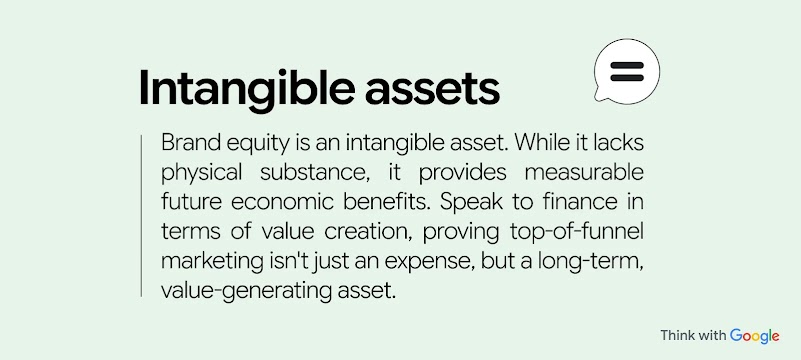
Speak finance by repositioning ‘brand’ as a strategic investment
The world’s biggest companies are worth billions thanks to their reputation. Yet, strict accounting rules treat internally built brand equity as an “intangible asset” that’s inseparable from general running costs. Because of this, its actual value is marked as zero on the balance sheet. To your finance team, brand building has to be logged as a day-to-day operating expense — a sunk cost, rather than a capital investment.
But here’s the catch: when a company gets acquired, that exact same brand equity is suddenly recognised as a highly valuable asset. Finance does value brand; their hands are simply tied by strict reporting rules that favour concrete historical data over unpredictable future projections.
To bridge this gap, ditch soft marketing terms like “awareness” or “favourability”. Instead, reframe your brand campaigns as long-term value creation. Show your CFO how brand building directly drives future baseline sales and gives the business real pricing power.
Speak finance by forecasting the future
Most marketing metrics, like return on ad spend (ROAS), are backward-looking. They only tell your finance team what happened yesterday. But when signing off on budgets, your CFO focuses on tomorrow, evaluating projects based on the future cash flows they will actually generate.
To secure demand-led budgeting, it’s key to shift from retrospective reporting to forecasting. In other words, combine Marketing Mix Modelling (MMM) tools like Meridian with external benchmarks and forward-looking tools to paint a complete picture of future value.
Vadim Histsev is the VP of digital marketing and customer management at Autodoc, a European online retailer for automotive spare parts and accessories. He says: “To build our annual marketing plan, we combined MMM results with external data, such as Google Trends, macroeconomic indicators, market forecasts, and competitive activity. And instead of presenting one revenue forecast, we built three scenarios; conservative, expected, and optimistic — with clear assumptions behind each.
“That was the real turning point. Rather than debating attribution models or historical ROAS, finance focused on understanding the risks and opportunities behind each scenario. It became a much more productive conversation, and it helped us align on investment decisions with far greater confidence.”
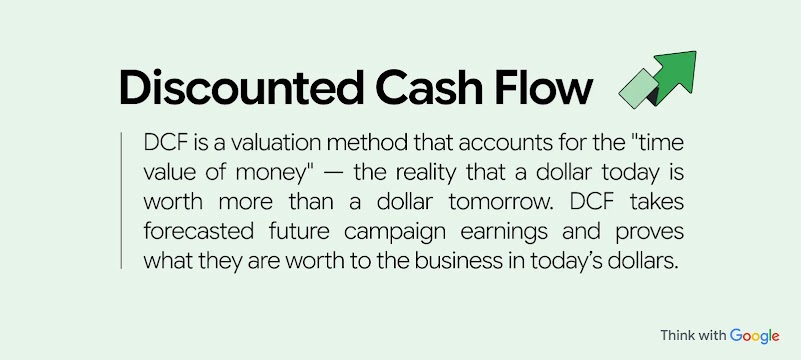
Additionally, look at the financial concept of “Discounted Cash Flow” (DCF). This accounts for the time value of money — the reality that a dollar today is worth more than a dollar tomorrow. This holistic approach helps you project the future returns of your campaigns and present them in the forward-looking terms your CFO understands.
Speak finance by proving bottom-line impact
Marketers usually measure success with revenue, but to your CFO, revenue without profit is just a vanity metric. When you’re asking for a massive initial investment — like a major product launch or an unproven media channel — you must prove the eventual payoff exceeds the upfront costs.
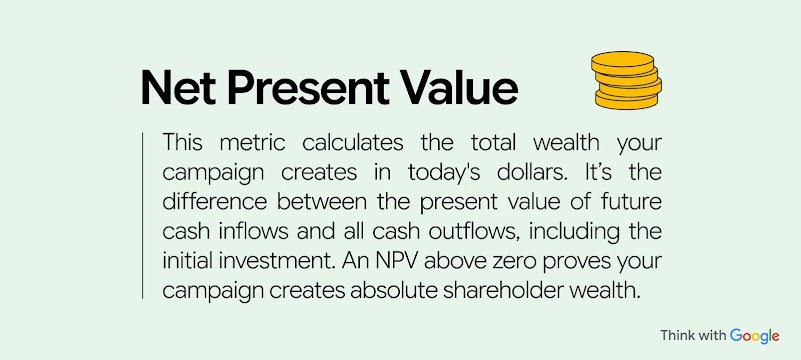
To win over finance, translate your revenue projections into a profit curve and use “Net Present Value” (NPV). This is the total financial value your project adds to the company after subtracting the initial investment.
By factoring in gross margins and operational costs to demonstrate an NPV greater than zero, you give your CFO a shared view of the bottom line. It proves your campaign isn’t just driving top-line sales; it’s creating absolute shareholder wealth.
Speak finance by pitching the smartest investment in the room
Your marketing campaign isn’t just fighting rival brands for market share. Internally, you are competing against every other department asking finance for capital.
Madhavan Sriram is the head of applied science for marketing at global online retailer Zalando. He explains how his team pitches new ideas to finance: “We invest in performance marketing based on proven incrementality. Annually, we run 100+ large-scale experiments — such as geo-experimentation and partner conversion lift studies — across 25+ countries to establish precise causal returns.
“By carefully prioritising our quarterly testing slots across major digital channels and campaigns, we establish a data-driven ‘ground truth’. This allows us to clearly showcase to finance the net-new returns generated through these channels that would not have happened organically, confidently backing our investment decisions.”
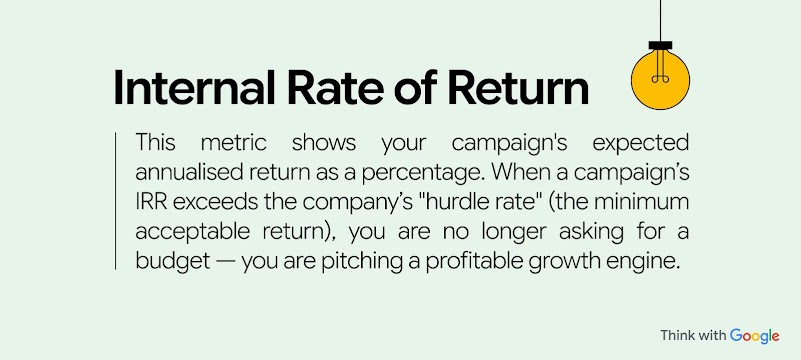
Ultimately, finance’s goal is to maximise return on capital across the business. Internal Rate of Return (IRR) expresses the expected annualised return of your campaign as a percentage. When you can demonstrate that your campaign’s IRR exceeds the company’s hurdle rate — the minimum return required to justify an investment — the conversation fundamentally shifts. Your proposal transforms from being a budget request into an undeniable investment opportunity.
Secure your demand-led budget
Elevating marketing from a line-item expense to a strategic capital investment demands a completely new playbook:
- Stop looking backward: Move away from relying solely on past efficiency metrics like ROAS, which only tell finance what happened yesterday.
- Start projecting future wealth: Speak your CFO’s language by forecasting long-term value and bottom-line impact using financial concepts like Discounted Cash Flow (DCF) and Net Present Value (NPV).
- Leveraging the right tools: Build credible, forward-looking forecasts by combining advanced Marketing Mix Modelling, such as Meridian, with external industry benchmarks.
Embracing these principles is the key to unlocking demand-led budgeting. When you prove your campaigns drive absolute shareholder wealth, you aren’t just defending an expense — you are handing your CFO a predictable blueprint for profitable growth.



Social Module
Share