





 Sign in with Google
This week at Rethink Retail, our annual holiday-readiness showcase for marketers, Google’s VP of retail, Courtney Rose, shared crucial strategies for brands heading into the busiest season of the year. Here is a look at her top advice.

Retail has always moved fast, but this year marks a distinct turning point. It is the first truly AI-powered holiday shopping season. Shoppers are no longer merely experimenting with generative AI. They are relying on it to discover, explore, and verify their decisions.
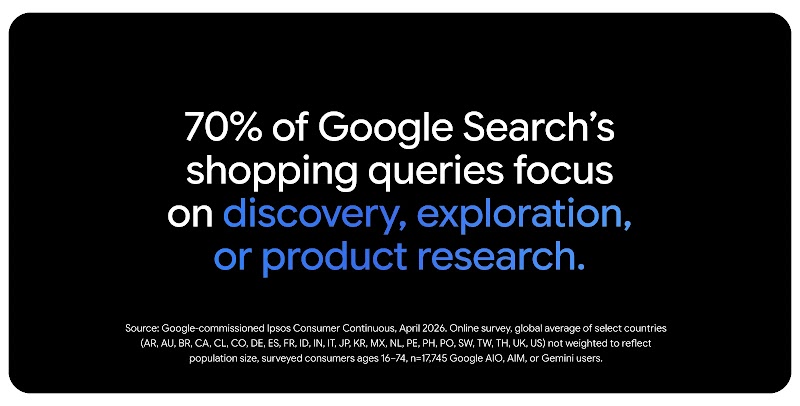
In fact, research from BCG found that shopping is now the third-most popular reason people use AI. Rather than looking for shortcuts, today’s super-empowered consumers interact with nearly 3X as many touchpoints as nonusers,1 using conversational Search to brainstorm and explore. So much so that now, 70% of Google Search’s shopping queries focus on discovery, exploration, or product research.2 And with 3 in 4 users saying AI Mode and/or AI Overviews help them make faster and more confident decisions,3 it’s clear that the old trade-off between purchase speed and buying confidence has disappeared.
For retailers just weeks away from Cyber Week and the critical fourth quarter, winning discovery requires meeting these shoppers where their decisions are formed. Here are three high-impact priorities to put into practice now.
1. Make sure your product listings speak shoppers’ language
To connect with consumers evaluating options in conversational interfaces, product feeds must move beyond basic inventory data to convey contextual relevance.
Shoppers aren’t just searching for specific item names. They are exploring nuanced scenarios and having conversations with Search, such as asking for travel-friendly winter layers or office-party inspiration. By enriching your Merchant Center feeds with Conversational Attributes and detailed product descriptors (such as fit, materials, and specific use cases), you give AI models the details needed to recommend your products during open-ended research.
Shoppers aren’t just searching for specific item names. They are exploring nuanced scenarios and having conversations with Search.
On average, merchants that adopt product-feed best practices see a 5% lift in conversions the following month.4 Pair this with Merchant Center’s AI performance insights to identify attributes your target audience actively searches for, ensuring your catalog is primed for conversational discovery.
2. Find your next, best customer with AI-powered campaigns
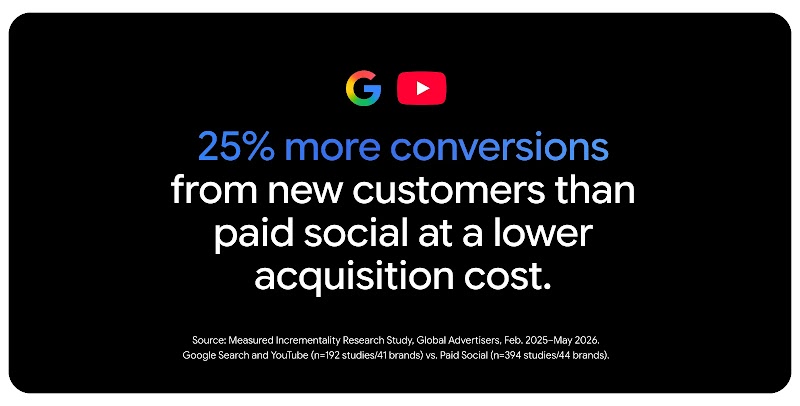
In conversational search, the best ads are just answers. Activating AI-powered campaign formats provides a direct bridge between initial inspiration and checkout across both Search and YouTube. In fact, Google and YouTube drive 25% more conversions from new customers than paid social at a lower acquisition cost.5 And, in MMMs run by TransUnion in the U.S., running Google Search and YouTube campaigns together drove 37% higher ROAS versus all other media.6
To capture this demand:
- Start with Performance Max, your go-to for reach and performance across Google. And for your Search campaigns, turn on AI Max. On average, these solutions drive a 15% lift in conversion value.7
- If you’re running Shopping campaigns, implement AI Max for Shopping. This turns your Merchant Center feed into dynamic ads, written in clear, human language — that can drive 5% more conversion value.8
- Finally, layer on Demand Gen to drive performance across YouTube and beyond. With hundreds of recent AI enhancements, it’s driving 30% more conversions on average.9
Remember: Scaling with AI doesn’t mean giving up control. Tools like AI Brief allow marketers to define strict brand parameters, while Product Value Optimization automatically steers traffic toward high-margin inventory and seasonal bestsellers.
3. Practice demand-led growth to outpace the competition
The fastest way to lose market share during peak shopping moments is capping your budget while high-intent shoppers are still actively converting.
Leading retail brands focus on demand-led growth, setting budgets based on profitability and margin targets rather than arbitrary daily spending caps. If a campaign automatically shuts off in the early evening because it hit a fixed ceiling, late-night shoppers buying at your desired return threshold are pushed directly to competing brands.
Work with finance to establish fixed margin thresholds, rather than static daily limits. As long as incoming traffic meets your target margin, keeping campaigns active ensures your brand captures every profitable conversion available this season.
Shopping behavior is transforming in real time, but the good news is, you don’t need to start from scratch. The groundwork you’ve laid throughout the year is set. By meeting this new wave of shoppers with relevance, speed, and confidence, you can turn the first AI-powered holiday shopping season into your most successful quarter yet.
To learn more, download our holiday playbook.

Social Module
Share