





 Sign in with Google
AI has given Search superpowers, and, as a result, people are searching on Google more than ever before. Last quarter, we saw an all-time high in Search queries.1
Features like AI Mode and AI Overviews have made it fast and simple for users to discover new ideas, stay informed, shop, and get things done right from the search box. In turn, this has created a massive opportunity, but also prompted questions from brands about how to best reach customers with the new AI Search.
The best formula for success remains foundational SEO.
Brands that routinely perform best in Search understand one simple truth: You win by being relentlessly helpful. This has been, and will likely always be, the best way to get seen on Google Search. Our new generative AI features are rooted in the same core ranking and quality systems as traditional Search. And, because these AI experiences retrieve up-to-date content from the existing search index, the best formula for success remains foundational SEO.
Given recent conversations I’ve had with clients, and some of the myths floating around in the market today, we are providing CMOs with the clarity they need to lead in the new era of Search.
Here is what you need to know and things you “don’t” need to do:
1. Don’t worry about all the new names. Good GEO, AEO, LLM SEO is good SEO
Right now you may be thinking, “If AI has changed Search so much, why isn’t your SEO guidance changing, too?”
You’re right that AI has transformed what Google Search is capable of. But one constant is our commitment to matching people with what they’re looking for. The foundations we built are still intact and built to last. Generative AI features like AI Mode are built directly on top of our core ranking systems, while AI techniques, like fan-out, allow for Google Search to highlight a wider and more diverse set of helpful links.
Your existing investment in solid, foundational SEO is your launchpad for AI success. That’s why good SEO is good GEO (or AEO, or AI SEO, or whatever). The great thing about focusing on a solid foundation is that it gives you permission to stop wasting time on misleading tactics.
2. Don’t optimize for bots. Optimize for people
Let’s be clear about what you can officially take off your team’s plate. First, you don’t need to waste time attempting to optimize your content for bots. Search is smarter than that. Instead focus on people. There’s no need to write awkward, keyword-stuffed copy or chunk your content into tiny, artificial snippets. Our systems understand language just like a human.
When you clear the noise, you open the airwaves for work that actually performs.
Also, chasing inauthentic mentions is not helpful as it might seem. Just like the rest of Google Search, our generative AI features can show what’s being said about products and services across the web, including in blogs, videos, and forum discussions. If you participate in content efforts on such platforms, continue to create fresh and helpful content that only your brand can speak to, with your unique voice and authority.
Lastly, you can also stop worrying about new technical formats or special AI text files like LLMs.txt. At least for Google Search, they’re not needed. When you clear the noise on actions like these, you open the airwaves for work that actually performs.
3. Don’t focus on generic content. Prioritize your unique perspective
When you stop wasting time attempting to influence bots, you get to reinvest it in your single greatest marketing asset: your unique perspective. In a world of infinite content, your true competitive advantage is authenticity and expertise. This means sharing unique points of view, creating content from first-hand experiences, and showcasing your internal experts.
Create unique content that stands out and provides real, tangible value.
Consider this example: A local running store could create a deep-dive video analyzing why a customer’s shoe collapsed instead of a generic “Top 10 Things to Consider …” article. This specific, unique content stands out and provides real, tangible value. It addresses a highly specific situation with advice that isn’t a generic review anyone could have written. Think about the real-world stories and unique expertise your business offers. That’s noncommodity content. And that’s a competitive advantage.
Generative AI responses can also include product information, and information about local businesses. Using products like Merchant Center (such as Merchant Center feeds) and Google Business Profile can help your products and services to be visible in both AI responses and other Google Search results.
4. Don’t forget your website. Build a great web experience
Beyond great content, your site should continue to meet people’s expectations for user experience. All of the fundamentals still matter. Things like ensuring it displays well across all devices, reducing latency, and making it easy for people to identify the main content.
Continue to meet people’s expectations for user experience.
Where appropriate, your website could also benefit from relevant, high-quality videos and images. Google Search may opt to highlight rich elements like these in search results, which could expand your visibility.
People coming from AI surfaces may be more informed, looking to engage, or ready to convert. Don’t risk losing that opportunity by delivering a subpar experience when they arrive. Most importantly, remember that everything we suggest to optimize your website for generative AI features on Google Search also makes it better for humans.
5. Don’t get distracted by noisy metrics. Focus on your business goals
With so much change, it is easy to get distracted by metrics that might solve an immediate need for data. It’s important for us to be crystal clear when it comes to measurement; Google does not evaluate third-party SEO tools or vendors directly, and they have no access to our internal metrics.
The most durable measurement strategy for moments like these is to focus on what actually matters to your bottom line: your concrete business goals, including leads, sales, or sign ups. At the end of the day, generative AI features are designed to help users take the next step with confidence, which is what Search has always been great at.
To support your measurement strategy, Search Console has begun rolling out new performance reports that show the number of impressions you’re receiving from AI features on Google Search. And if you are a retailer, Merchant Center has made available reporting that shows how your product listings are showing up across our generative AI features on Search.
These reports function as a solid baseline to verify gains from effective content and technical SEO strategies. We’re continuing to work with website owners to understand what insights and data would be most helpful to inform their strategies, such as adding additional metrics over time.
A closing thought
Optimizing for this new world is really about getting back to the fundamentals of great marketing and being completely obsessed with your audience.
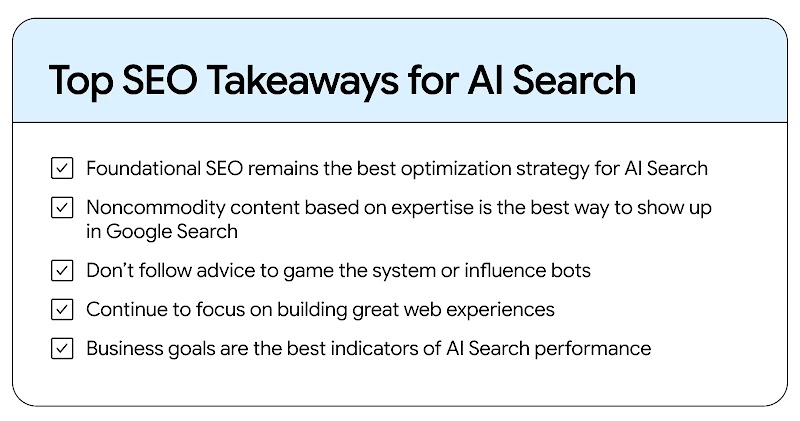
Here are the key takeaways to orient your teams.
This new era of Search is already delivering incredible value for advertisers. Brands like Lufthansa Group, Etsy, and Royal Canin are reimagining what’s possible to reach new audiences, simplify campaigns, and get better returns from their investments.
Social Module
Share