





 Sign in with Google
Think about how your customers are searching for information and products today. They aren’t just typing a few isolated keywords. They are asking long, complex, highly personal questions. And, since AI understands their intent and delivers instant answers across AI Mode and AI Overviews, they are searching more than ever before.
For your brand, this behavioral shift represents a massive opportunity, but it also creates a critical new challenge: How can you show up with relevant messages and offers if your ads remain prewritten and rigid? To keep pace with consumers’ new expectations for helpfulness, ads can no longer just be static copy. They need to be customized to the moment just as quickly as the search results. In short, your ads need to become answers themselves.
To discuss how marketers can safely scale asset optimization on Google Search, we sat down with Brandon Ervin, director of product management, Google Ads, to explore the launch of Google’s new AI Brief feature.
AI Brief lets you customize how your brand shows up in Search.
Think with Google: Thanks for your time, Brandon. Let’s start by addressing the elephant in the room. Advertisers have been quick to embrace AI for bidding and search term matching, but we still hear a lot of concern when it comes to asset optimization. Why is that? What are you hearing from the industry?
Brandon Ervin: It really comes down to a basic trust gap. The clients I speak with have some level of anxiety about letting go of legacy creative controls when their brand’s hard-earned reputation is on the line.
But we anticipated this. Of course brands want control over their messages. For advertisers who have been skeptical of features like text customization, transitioning away from manual creative production can be difficult without a way to set creative boundaries.
Earlier this year, we had introduced text guidelines. The announcement of AI Brief at Google Marketing Live expands what advertisers can do. AI Brief acts as the ultimate safety guardrail, replacing the rigidity of manual creative management with flexible, intuitive, natural language AI controls so brands can embrace asset optimization with total confidence.
Context over constraints
“Natural language AI controls” sounds like a major shift from traditional campaign setups. How does AI Brief work in practice within AI Max for Search campaigns?
Ervin: AI Brief changes how you guide a campaign from the start. Instead of managing restrictive keyword mechanics, advertisers can describe their business, their audiences, and their brand guidelines in their own words, directly to AI, just like you’d do if you were briefing a partner.
When we turn what used to be rigid settings into richer, more flexible inputs, advertisers end up sharing more information that’s critical to their business, that they previously didn’t have any other way to express. There are three categories that we focus on primarily:
- Messaging guidelines. Tell the system exactly what your ads should and shouldn’t say. For instance: “Never mention prices or discount percentages.”
- Matching guidelines. Set parameters for the search intent you want to reach or avoid. For example: “Match users interested in high-precision engine tuning. Avoid users seeking basic oil changes.”
- Audience guidelines. Direct the AI toward desired audiences with tailored messaging. For example: “For health conscious users, highlight our clean ingredients and healthy pantry staples.”
The mechanics of control
How does AI Brief ensure a team’s brand voice and ad matching intentions aren’t lost in translation?
Ervin: This piece is also brand new. Long gone are the days when AI was a black box. Once your guidelines are submitted, AI Brief plays back its interpretation. A live previewer allows you to audit exactly how your direction translates to proposed ad copy, search queries, and audiences before any ads are shown. This provides a new level of transparency and gives advertisers confidence that the AI can respect their brand preferences.
Let’s talk about brand safety. A common question from marketing leaders is “How can you guarantee our brand guidelines are actually being met once the campaign goes live, even if the preview looks great?”
Ervin: This is the crux of a lot of client’s concerns. We look at this through two distinct lenses: strict adherence for term exclusions versus general steering guidelines.
First, term exclusions. Think of these as negative keywords for creative assets. For brand safety or competitive boundaries, like excluding specific competitor names or off-limits phrases, this mechanism is guaranteed to omit defined terms across every generated asset.
Second, we honor strategic guidance. When you prioritize a core value proposition, like a specific sustainability initiative, the system ensures that the theme is honored in your ads, while leaving the AI enough wiggle room to contextualize the message for users in real time.
From manual settings to a real-time partner
For teams ready to take the plunge and test AI Brief, what should their onboarding and workflow look like?
Ervin: Moving forward doesn’t mean relinquishing control, because your guidelines can be refined and adjusted at any time. The workflow itself is simple.
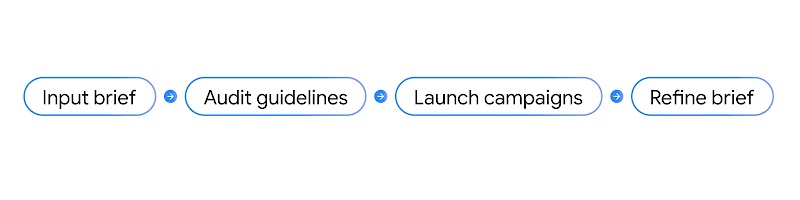
How will this workflow change the way marketers interact with Google Search Ads?
Ervin: We’re really excited about this new interface. First, because it reflects how most users interact with AI. It’s the same mental model that most of us are familiar with: the richer the prompt, instructions, and context, the better the outcome. That’s what you should expect from AI Brief too.
And second, our early testers gave us context and direction that they had never shared before. Long-form inputs help create a richer understanding for the AI. And things are just starting to get really interesting in terms of agents across the platform. So we’ll likely continue to evolve how you share your guidelines with us, and how we can also help you craft even better ones.
Thriving in AI Search
By holding back and sticking with traditional campaign planning methods just because they’re comfortable, what are marketers actually missing out on right now?
Ervin: There’s no mandate to shift to AI Brief today. But, marketers are severely limiting the effectiveness and potential of their campaigns in the AI Search era by not adopting this approach. Manual creative and matching controls worked beautifully when users searched using predictable phrases, but today’s searches are longer, highly complex, and packed with subtext. Traditional methods simply can’t keep pace as Google Search evolves beyond the classic results page into conversational surfaces like AI Mode and AI Overviews.
Think about it this way: the longer the search, the more hidden commercial opportunities there are for brands to help customers. AI can interpret these complex needs, connect advertisers to them, and tailor a perfect, on-brand message in real time. Marketers don’t have to sacrifice brand safety to do this. All AI needs is a framework to operate within to unlock that scale.
What’s the one takeaway you want advertisers to fully understand about AI Brief and asset optimization?
Ervin: To deliver an ad experience that feels as useful and natural as the AI-generated answer it sits next to, the system requires a much higher standard of contextual relevance.
This shift is the fundamental “why” behind AI Brief. By pairing your deep business context with Google’s live signals, the AI can artfully create and match ads to complex queries without sacrificing your brand control.
This is just the beginning of how we are reimagining brand controls for the AI era. Keep testing, keep refining your guidelines, and continue sharing your feedback with us.
Social Module
Share