





 Sign in with Google
Forget the frantic race of crowded stores, endless open tabs, and mounting decision fatigue. Holiday shopping has shifted.
Shoppers are exploring more options and buying with absolute confidence thanks to AI-powered help at their fingertips. They no longer choose between a smart decision and a fast one. They are taking their time and exploring more options.
Understanding the four key consumer behaviours that define this new landscape can help you craft a winning holiday marketing strategy.
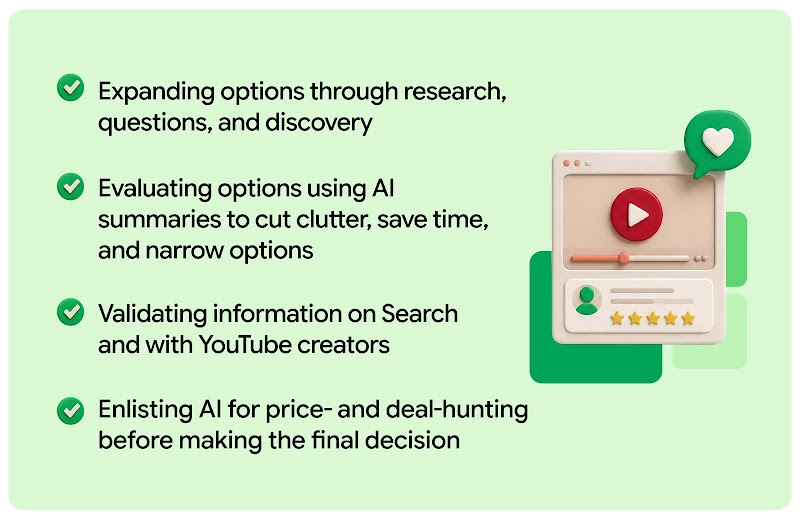
1. Expanding options through research, questions, and discovery
The path to purchase is a continuous, open-ended cycle of discovery. AI tools are transforming that journey, helping consumers explore more deeply. Online shoppers who use AI platforms or features in their purchase journey interact with or notice 12.1 touchpoints, on average, compared to only 4.2 for shoppers who did not use AI.1
Consumers now search naturally with photos and specific questions: 75% of those who use AI on Google agree AI allows them to search more naturally, like asking highly specific questions or searching with a photo.2
This discovery also extends to video: 87% of surveyed viewers in the U.K. say that YouTube introduces them to new things they wouldn’t have discovered on their own, outperforming other online platforms (67%), including Facebook, Instagram, TikTok, and Snapchat.3
Your move: Prepare for conversational and visual searches. Enrich your product data for the Shopping Graph with detailed descriptions and high-resolution images, so shoppers can easily discover your brand through camera searches, AI summaries, and real holiday questions.
2. Evaluating options using AI summaries to cut clutter, save time, and narrow options
Consumers love to explore, but they also get overwhelmed by the sheer mental weight of managing open tabs, conflicting reviews, and fragmented information. Google’s AI-powered Search features bring clear summaries and answers directly into search results.
This efficiency builds buying confidence: 3 in 4 users say Google AI Mode and/or AI Overviews help them make faster and more confident decisions.4
- Seventy-six percent of those who use AI on Google agree AI saves them time by quickly summarizing product details and reviews for them.5
- Sixty-nine percent of those who use AI on Google agree AI helps them cut through the clutter and avoid feeling overwhelmed by too many options.6
Build a great experience for humans, and the AI will naturally recommend it.
Your move: Optimize for humans, not bots. Google’s systems understand language just like humans do. Focus instead on a stellar web experience — fast speeds, mobile optimization, and clean pages. Build a great experience for humans, and the AI will naturally recommend it.
3. Validating information on Search and with YouTube creators
Even in an AI-powered world, trust must be earned. Shoppers consistently return to a trusted environment to verify facts before buying.
With consumers spreading their shopping across many different platforms, Google and YouTube serve as daily trusted bases. In fact, 86% of surveyed consumers use Google and/or YouTube daily, which is significantly higher than other online platforms.7
Even when consumers use other generative AI tools to research products, they rarely skip this step: 99% of those who go to ChatGPT to look into products or services consult with Google Search to help with purchase decisions.8
To lock in choices, consumers turn to creators they trust, making YouTube an indispensable bridge: 80% of surveyed viewers in the U.K. say that YouTube is the video platform that they trust the most.9
According to a survey conducted by Kantar, surveyed viewers in the U.K. rank YouTube as the #1 video platform when they want to research, vet, or make a decision about a brand, product, or service that they want to buy, outperforming other online platforms including Facebook, Instagram, TikTok, and Snapchat.10 Brands can capitalize on this attention: 69% of surveyed viewers in the U.K. say that they pay a lot of attention when watching videos on YouTube.11
Your move: Create a verification loop. Partner with YouTube creators so that when shoppers search your brand on Google to validate their choices, they find authentic reviews that prove your product’s value.
4. Enlisting AI for price- and deal-hunting before making the final decision
For the final click, shoppers want a fast, smooth finish. Shoppers use AI as a personal assistant to find coupons, check inventory, and use virtual try-on features to visualize fit. Sixty percent of those who use AI on Google agree AI helps them make the final decision, find the best deal, and check out faster.12
Showing up at this exact moment protects your entire marketing budget. During the Q4 holiday shopping period, brands that allocate more investment to Google Search typically see a 74% higher return on their total media budget, compared to brands that allocate more investment to paid social.13
Sixty percent of those who use AI on Google agree AI helps them make the final decision, find the best deal, and check out faster.
Your move: Keep inventory updated and checkout fast. Ensure your prices and stock levels are updated in real time so AI assistants don’t bypass you. And offer easy payment options like Google Pay to prevent last-second cart drops.
Connect the dots for your holiday marketing strategy
Consumers don’t use AI to bypass shopping. They use it to master it.
By showing up at their trusted daily bases with clear, verified answers, you make your entire holiday media spend work significantly harder, ensuring every dollar invested drives real, confident decisions.

Social Module
Share