


 Sign in with Google
Thoughtful shopping at speed: Navigating the AI-powered Dutch holiday season

The Dutch holiday retail landscape is defined by efficiency, deliberate decision-making, and high consumer expectations. While peak season across Europe often conjures images of rushed flash sales and impulse buying, consumers in the Netherlands approach year-end shopping with a pragmatic mindset.
Dutch consumers enter the season with calculated intent: exploring multiple categories, vetting product claims, and using AI tools like Gemini as a co-pilot to ensure purchase confidence.
Rather than settling for surface-level promotions, they weigh quality, availability, and value before committing their budgets.
To help marketers navigate this competitive environment, we analysed Dutch holiday consumer behaviour during peak season. Here are the defining shifts in how they discover, evaluate, and purchase — along with actionable strategies to stand out:
1. The intentional holiday journey: Research is the non-negotiable baseline
In the Netherlands, a purchase rarely starts at the checkout counter or even on a single landing page. Dutch holiday shoppers are deliberate. They shop across multiple categories and invest considerable effort into understanding what they are buying.
For these consumers, researching is not an occasional step reserved only for high-ticket electronics or luxury items; it is a habit embedded across everyday baskets. In fact, 71% of reported Dutch holiday purchases were researched.1
This measured approach is compounded by the breadth of modern gift-giving. Shoppers are rarely managing a single checklist.
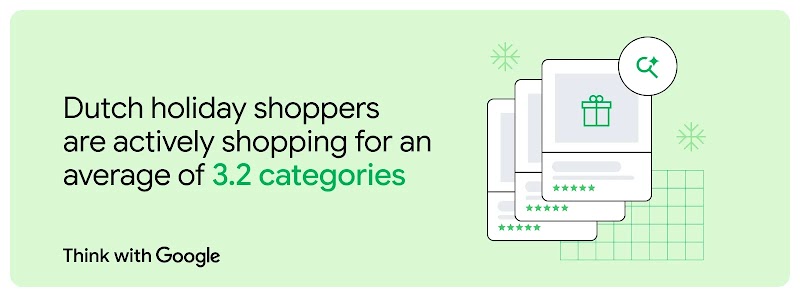
During peak months, Dutch holiday shoppers are actively shopping for an average of 3.2 categories,2 and managing that across multiple gift lists adds complexity to the shopping journey. They are not just casually browsing; they are toggling between gathering fresh ideas and assessing specifications.
Marketing takeaway: Brands that provide clear, detailed product information upfront help simplify decision-making and eliminate friction in the evaluation phase. High-quality structured data is key here to ensure product feeds are optimised with transparent product specifications, upfront delivery timelines, and real-time stock status, to satisfy Dutch shoppers’ research needs.
2. The tech-savvy shopper: AI expands the purchase journey and builds decision confidence
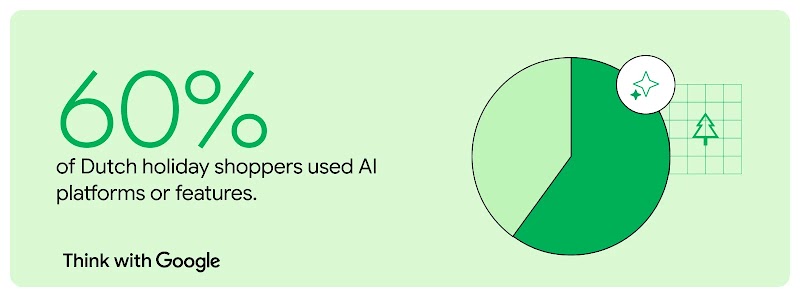
As digital retail environments become more sophisticated, Dutch shoppers are actively embracing smart tools to streamline their decision-making. Artificial intelligence has crossed into the mainstream of shopping routines, in the three months around peak season 60% of Dutch holiday shoppers used AI platforms or features.3
It is easy to assume that assistive technology simply compresses the customer journey into a quick, automated transaction. Instead, AI handles the heavy lifting of comparing options and narrowing down choices, giving shoppers the confidence to explore wider possibilities while moving toward a purchase.
This can be seen in the fact that Dutch online shoppers who use AI platforms or features in their purchase journey interact with or notice 10.7 touchpoints, on average, compared to only 2.9 for shoppers who did not use AI.4
Rather than shrinking the journey, these additional touchpoints reflect supercharged confidence from shoppers who are validating their choices.
A majority of 83% of Dutch holiday shoppers using Google’s AI features say Google Search helps them learn more about an item, find the best deals, see what a product is really like, and/or look things up even while in store.5
Marketing takeaway: Optimise your structured product data and creative assets for AI-driven discovery. When an AI feature analyses and suggests options for a shopper, information such as comprehensive product details, high-resolution imagery, and verified reviews ensure your products surface as the most credible recommendation. You can do this via tools like Conversational Attributes and AI Performance Insights.
3. The essential ecosystem: Video and Search as commercial accelerators
When Dutch shoppers seek out platforms they rely on most, Google and YouTube emerge as the core discovery engine. Two thirds or 66% of Dutch holiday shoppers say Google and/or YouTube are in their top 3 most essential online platforms.6
This reliance isn’t passive entertainment; it directly influences conversion velocity. Consumers who lean on these platforms are actively validating high-intent decisions, and that engagement results in measurable retail volume.
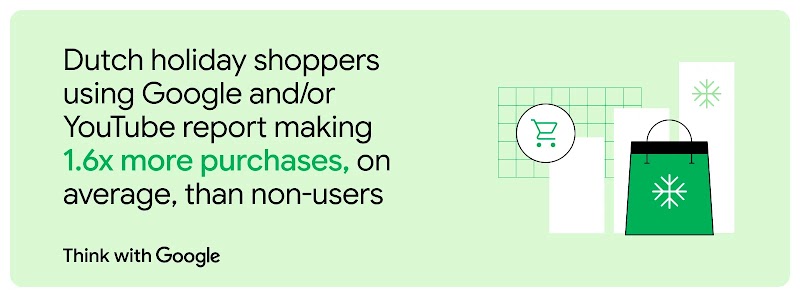
Surveyed Dutch holiday shoppers using Google and/or YouTube report making 1.6x more purchases, on average, than non-users.7
Within this dual ecosystem, visual demonstration bridges the gap between inspiration and commercial action. YouTube functions as an interactive digital showroom: whether viewing unboxings, curated gift guides, or comparative side-by-side tests. Seeing an item handled in real-world settings by trusted creator voices delivers the tangible reassurance buyers need before clicking “buy”.
Marketing takeaway: Deploy a unified AI campaign strategy using AI Max and Demand Gen to turn visual YouTube inspiration (Shorts, creator reviews) into immediate, frictionless actions. Ensure every video creative has clear calls-to-action, product feeds, and direct pathways to checkout.
4. The omnichannel reality: Turn foot traffic into your AI advantage
While e-commerce is well established across the Netherlands, the high street and local shopping centres remain central to peak holiday culture. But that doesn’t mean physical shopping happens in isolation from the digital world.
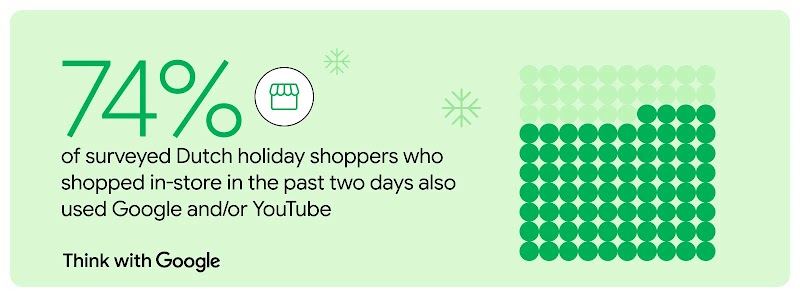
For Dutch consumers, online search and offline retail are deeply interconnected. During October 2025 and January 2026, 74% of surveyed Dutch holiday shoppers who shopped in-store in the past two days also used Google and/or YouTube, which is significantly higher than any other online platform.8
Smartphones have effectively become in-aisle shopping assistants. A consumer standing in front of a shelf in Amsterdam or Utrecht is often simultaneously checking online user ratings, confirming if a competitor two streets away has a better colour variant, or validating that they are securing the best available festive promotion.
Marketing takeaway: Connect digital internet to physical action. Implement Universal Commerce Protocol — an open standard that allows AI agents, apps, businesses, and payment networks to communicate and complete transactions seamlessly.
It’s clear that this holiday-season belongs to the AI-empowered consumer.
Social Module
Share