


 Sign in with Google
Industry perspective: 3 ways to bridge the marketing-finance gap

Ian Whittaker is a leading U.K. financial, media and technology expert with 20 years of experience in financial markets. A two-time City AM Analyst of the Year, he now advises CEOs, CFOs, CMOs and investors on the economics and capital allocation shaping media, marketing and technology.
As a marketer, could you stand up tomorrow, take your CFO’s investor deck, and confidently present the company’s strategy, cash flow, and priorities for the year ahead?
If the answer is yes, you’re already a step ahead.
If the answer is no, there could be a valuable opportunity to strengthen one of the most important relationships in your business.
That’s the test I often give CMOs. You don’t need to know every detail in the finance books. But if you understand the company’s financial priorities well enough to explain them, it’s a good indication that marketing and finance aren’t simply operating alongside one another — they’re planning together.
And that matters. New research from Bain & Company and Google found that businesses with strong CMO-CFO relationships are 1.5X more likely to be growth leaders.
So what separates those relationships from the rest? In my experience, it comes down to three things: collaboration, communication, and clarity.
The CMO-CFO relationship in 2026: Better, but still disconnected
The relationship between marketing and finance is better than it was five years ago. But the disconnect that remains isn’t necessarily personal. It’s structural.
CMOs and CFOs ultimately want the same thing: profitable growth. And what I hear from CFOs isn’t scepticism about marketing itself. It’s scepticism about the evidence used to demonstrate its impact.
That difference matters because both functions operate within very different parameters. Marketing expenditure is accounted for as an operating expense, which creates a powerful incentive to cut it when a business needs to hit short-term profit targets. The financial benefit of that decision is immediate; any damage caused by reducing investment may only become visible further down the line.
At the same time, marketing and finance can apply short-term expectations to investments designed to create long-term value. We may acknowledge that brand building takes time, for example, while still putting it “on the stopwatch of performance”.
Closing that gap requires a bridge between the two functions — and both sides need to be willing to cross it.
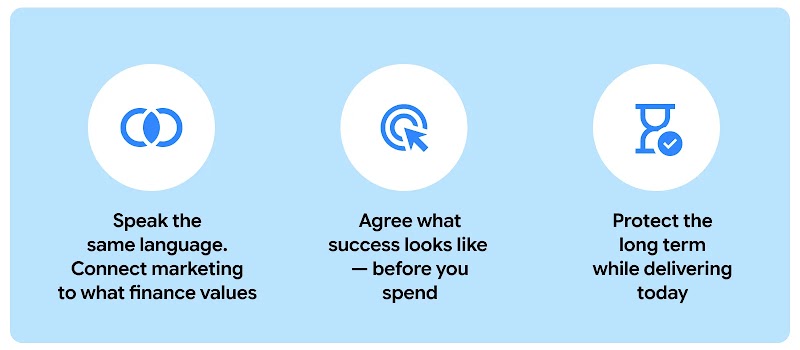
Here are three places to start:
1. Speak the same language: Connect marketing to what finance values
For CMOs, one of the most powerful shifts is to make the case for marketing in terms the CFO already understands.
That means moving beyond marketing metrics as endpoints. Reach and other campaign measures have an important role, but they need to connect to the business outcome they ultimately influence. Otherwise, finance is left asking: What does this mean for the business?
One area I believe marketers underuse is pricing power.
Marketing’s contribution isn’t only about increasing the volume of products a company sells. Strong brands can also affect the price customers are willing to pay. And from a financial perspective, the ability to increase pricing with minimal impact on volume can be an extremely powerful margin driver.
So start with the outcome the business needs to achieve and work backwards. If volume growth is slowing, for example, where will future revenue growth come from? If pricing needs to play a bigger role, what contribution can brand make? Connect marketing investment directly to the priorities the CFO, CEO, and — ultimately — investors care about.
But common language works both ways. CFOs need to give marketers greater visibility into what finance is trying to achieve and why. Open the finance books. Help marketing understand the pressures, priorities and outcomes the business needs to deliver.
The goal isn’t for marketers to become financiers, or financiers to become marketers. It’s for both to understand enough of the other’s world to make better decisions together.
2. Agree what success looks like — before you spend
One of the simplest ways to improve the CMO-CFO relationship is also one of the most important: have the difficult conversations at the beginning.
Before investment is committed, marketing and finance should agree what the spend is designed to achieve, how success will be measured, and — crucially — when they expect to see a return.
The challenge is having the right foundations in place. Among marketers surveyed by Bain and Google, only 41% feel well equipped with the right tools, data, and measurement capabilities to tie their performance to business outcomes.1
And success won’t look the same for every type of marketing investment.
Performance media is vital for delivering financial outcomes and driving sales. Brand investment plays a different role and requires a different time horizon. Rather than defaulting to a universal split between the two, businesses should start with their end goal, work backwards, and determine the balance that makes sense for their particular circumstances.
Measurement itself also needs to be approached differently. Businesses make decisions under uncertainty every day. Finance teams understand risk; they don’t expect every factory, acquisition, or R&D investment to come with a 100% guaranteed outcome.
Marketing shouldn’t need to pretend it can offer one either.
Instead, build confidence in the evidence. Use robust inputs, triangulate methodologies, and show why the available evidence makes an investment worth taking. The aim isn’t to eliminate uncertainty; it’s to reduce it enough to make a well-informed business decision.
When marketing and finance agree those expectations upfront, measurement becomes something they own together — rather than something marketing has to defend afterwards.
3. Protect the long term while delivering today
Finally, CMOs and CFOs need to recognise that profitable growth requires balancing what the business needs now with what it will need next.
Performance investment can help generate the sales a business needs today. But continuously sacrificing brand investment to meet a quarterly number risks weakening the engine that creates demand, pricing power and growth over the longer term.
The Bain and Google research shows that marketing and finance respondents are aligned on how they evaluate performance and brand investments, with performance marketing largely measured in months or quarters (69% of overall marketers, 70% of overall finance). Around four in ten expect brand marketing to need a year or more to pay back (41% of overall marketers, 38% of overall finance).2
Because brand pays back over a longer period, I believe finance teams should consider ring-fencing elements of brand investment, just as they would other long-term investments.
Marketing’s effects, particularly on brand, are cumulative. Cutting investment shouldn’t be thought of as simply removing one isolated block of spend. A decision today can create a much larger drag on marketing’s long-term effect.
For CMOs, that means demonstrating why the investment deserves protection. While performance media that drives incremental sales should be treated as a variable cost of sale that directly fuels today’s revenue, brand should be viewed more like intangible CapEx. I’m not arguing for a change to the accounting rules. This is about how the spend is governed and judged inside the business.
Just as investors and boards moved from treating R&D as a pure cost to recognising it as an engine of future value, we now need to apply that same lens to brand: acknowledge the short-term cost, but show the expected longer-term return and the evidence behind it. For CFOs, it means resisting the temptation to treat marketing as the easiest lever to pull whenever short-term pressure arrives.
Neither side can do that effectively in isolation.
The strongest CMO-CFO partnerships plan together, understand what they are trying to achieve, and agree the timeframe in which they expect to achieve it.
Or, to put it more simply: collaboration, communication, and clarity.
And perhaps the best place to start is with that investor deck. If your CMO can explain the CFO’s priorities — and your CFO understands how marketing will help deliver them — you’re no longer trying to bridge two sides of the business.
You’re working from the same plan.
Social Module
Share