





 Sign in with Google
Brand equity is where untapped growth sits, but according to BCG, just one in 10 CMOs can put a long-term financial value on it.
Modern marketing has a short attention span. Under constant pressure to prove returns quickly, brands often default to lower-funnel channels with shorter tracking windows, while pulling back on brand building. Though this feels disciplined and measurable, it creates a long-term problem.
Speaking to an audience of CMOs at a Google event, Leonardo Fascione, managing director and partner at Boston Consulting Group (BCG), put it plainly: “Our research shows that 100% of CMOs and CFOs agree brands require ongoing nurturing to maintain strength. Yet, when it comes to measuring the financial impact of branding efforts, only one in 10 CMOs can put a long-term value on brand equity.”
The separation between brand and performance is artificial.
Fascione emphasized that, “The separation between brand and performance is artificial. Leaders must dismantle that divide by building a single measurement approach that can evaluate both what marketing drives today and what it creates for tomorrow.”
When leadership cannot quantify the return on brand preference, organizations default to what they can track: the final click or form fill. Falling into this trap risks a shift from building new pipeline demand to merely competing for existing in-market buyers. To build durable value, organizations require an operating framework designed to secure today’s conversions while systematically seeding tomorrow’s demand.
The compounding cost of a short-term mindset
Pulling back on brand investment to protect immediate margins can look like sound financial stewardship when a business is under pressure to deliver in the short term. But in reality, it acts like an expensive loan against future pipeline velocity.
“Across hundreds of public companies, our research shows that for every near-term brand dollar cut, companies will need to reinvest $1.92 just to win back the lost market share,” Fascione noted. “The apparent savings realized by cutting upstream brand building simply defers the expense, requiring brands to buy back market relevance later at nearly twice the cost.”
At the same time, turning away from brand building weakens the efficiency of performance marketing itself. Research from Analytic Partners indicates that brands that moved to a performance-only model saw a 40% decline in median ROI.1
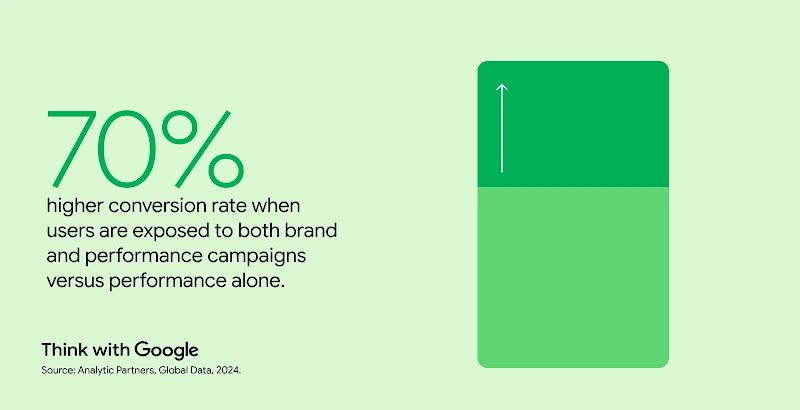
Whether closing a sale today or guiding buyers through months of decision cycles, direct-response formats capture demand rather than create it. But when you consistently nourish the brand, every downstream touchpoint works harder. In controlled experiments, people exposed to both brand and performance campaigns had a 70% higher conversion rate than those exposed to performance campaigns alone,2 proving that brand equity is not an alternative to performance marketing. It’s a catalyst for it.
Closing the C-suite trust gap
If brand building is universally important across leadership, why does it remain so vulnerable during budgeting cycles?
According to Fascione, “The friction stems from an alignment gap between the CMO and the CFO. While both leaders value strong brands, they often interpret marketing data through different lenses.” BCG’s research highlighted this divide by showing that 67% of CMOs are highly confident that their marketing mix model (MMM) reliably predicts future sales, versus just 40% of CFOs.3 To build confidence among finance leads, partner closely with your MMM provider. Together, assess how to capture both short- and long-term outcomes, incorporate the right KPIs, and rigorously calibrate models using incrementality tests.
When finance and marketing align, brand building stops feeling like a loss leader and becomes a predictable indicator of future cash flow.
Fascione also stressed the importance of aligning on “one fast-moving, predictive KPI for brand equity. For BCG, that’s First-Fast Response, rooted in mindshare not awareness, and 4X more predictive of future sales.” Similarly, attributed branded searches from Google are another reliable way to monitor how brand spend impacts high-intent search activity. When finance and marketing align on shared leading metrics that connect awareness and consideration to sales, brand building stops feeling like a loss leader and becomes a predictable indicator of future cash flow.
The long-term value of active attention
Not all impressions carry equal commercial weight. To move beyond broad awareness and influence future demand, brand investment must focus on environments where active audiences are already in an evaluation mindset. Video is uniquely positioned to capture this focus, and on YouTube specifically, viewers lean in with deliberate commercial intent — researching topics, evaluating options, and informing purchase decisions rather than passively scrolling past content.
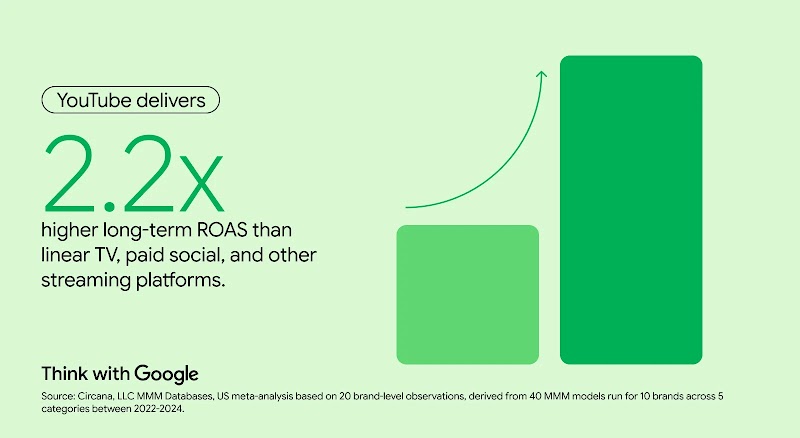
This active attention helps explain the platform’s outsized downstream impact. Rather than logging a transient impression, audiences lean into the content they love, rely on trusted voices, and engage with deep-dive product videos during critical moments of deliberation. Marketing mix modeling from Circana reflects this dynamic, showing that YouTube delivers 2.2X the long-term ROAS of linear TV, paid social, and competing streaming platforms.4
By seeding brand preference within high-intent environments, marketers lower the cost of future acquisition, ensuring that when demand is ready to be captured downstream, conversions are substantially more efficient to win.
The new growth mandate
The strategic takeaway for decision-makers is straightforward. As Fascione summarized, “Unless leadership measures both brand and performance outcomes within a unified framework, organizations will miss the true, total ROI of their marketing across the business.”
Ultimately, brand equity is not a luxury reserved only for household names during stable market conditions. It is the structural backbone of pricing power, conversion velocity, and sustainable market share across every vertical.
By uniting brand building and performance marketing on YouTube — and anchoring that strategy in measurement standards that both CMOs and CFOs can stand behind — decision-makers can move past the trade-off between today and tomorrow. In doing so, they elevate marketing into its highest commercial purpose: a reliable, compounding engine of growth.

Social Module
Share