





 Sign in with Google
Over the past couple of years, marketing departments have been scrambling to test every generative AI tool, plug-in, and extension in what feels like an era of “random acts of AI.” But spinning up AI pilots is not the same as engineering agentic workflows. It’s why that, according to McKinsey’s research, while 90% of CMOs are experimenting with gen AI, less than 10% are realizing real value with AI.
To drive value, marketers must shift from tool accumulation to system design. It’s time to account for AI in your workstreams and put building, directing, and managing AI agents in marketers’ job descriptions. That’s the approach we’ve been taking on my team in Google Cloud Marketing. Let me share how we are doing it.
Shift from ‘random acts of AI’ to collective workforce capability
Like many marketing teams, when we started experimenting with generative AI, we focused on personal productivity. It was something we used to draft a quick email, brainstorm a headline, or summarize a report. Our approach was fragmented and bottom up.
If agents reliably automate 80% of routine tasks, team roles must be redesigned, elevating strategic judgment, context, and empathy.
Moving from that individual activation phase to a systemic rewiring of our work required connecting stand-alone capabilities into a cohesive, ecosystem where partners and human talent utilize AI systems directly. We challenged ourselves to redefine our roles. If we automate tasks with AI agents, team roles would need to be redesigned, elevating strategic judgment, context, and empathy.
We created “AI pods,” teams of three to five people from across marketing, agencies, and sales, paired with a “workflow architect.” These pods are tactical and temporary. They are established with a clear goal and dissolve after that objective is achieved. The people building the agents were the front-line marketers who knew the work best and could best build and direct AI agents.
Map taxonomies and agent archetypes
You can’t reengineer a workflow if you don’t actually know what it’s made of. To move from pilots to production, we ran an audit of our team’s process dependencies — a foundational step documenting marketing activity, taxonomy, and architecture.
We established a granular understanding of marketing microtasks and mapped them directly to agent archetypes to assist with things like research, analysis, and content operations. The goal is to optimize and then reimagine legacy workflows and ultimately create entirely new ways of working. By breaking down complex workflows into structured microtasks, we could build specialized agent combinations that integrate seamlessly into our work.
For example, we agentified our integrated marketing campaign workflow. The process begins when a marketing owner defines objectives and uploads key information into a central intelligence layer. Grounded in this data, the AI agent scans calendars and budgets to flag redundancies and find opportunities. The agent then notifies relevant stakeholders and generates three distinct brief options for a human marketer to review, consolidate, and approve.
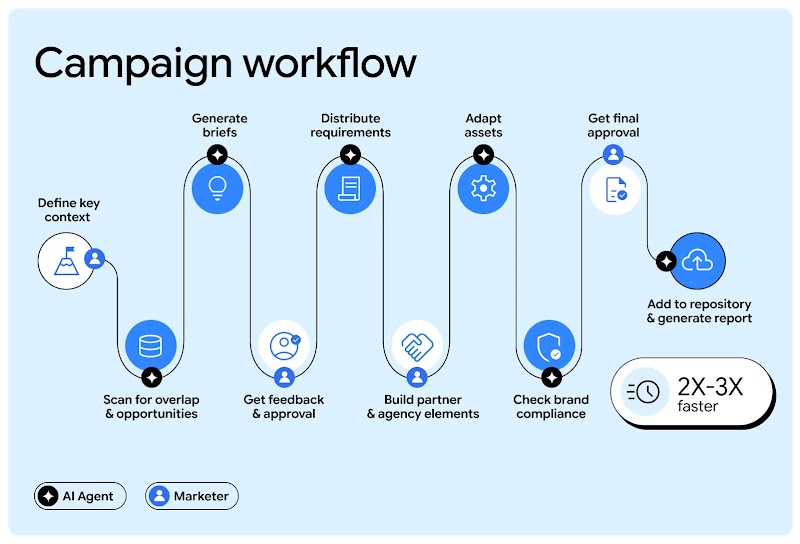
Once the brief is approved, the agent outlines digital and event requirements, and distributes the approved strategy to our agency and internal partners. As these partners build campaign elements, the agent localizes, translates, and resizes creative assets under close human supervision. Finally, the AI agent performs brand compliance checks before marketing leadership gives the ultimate sign off. Approved assets are added to a central folder where performance is tracked, resources are shared, and impact reports are automatically generated. With AI agents, we’ve accelerated this process 2X to 3X, compressing a weeklong cycle into just two days.
Set clear criteria and reviews for AI agents
AI initiatives often fizzle because they lack formal governance, explicit ownership, and clear goals. Lasting AI impact requires human marketers to manage and review AI agents and their work. For example, a content marketer managing a copywriting agent would bring their personal experiences, product knowledge, and audience context to review AI drafts. The manager is responsible for auditing outputs and fine-tuning prompt instructions.
We developed an AI agent review rubric for managers focused on key criteria.
- Accuracy: Is the agent output correct and pulling from grounded, verified facts?
- Speed: Is execution running smoothly and efficiently without lagging, and keeping up with the pace of the market?
- Brand compliance: Is the output on brand, and within style and specifications guidelines?
- Value: Is the customer benefiting from our improved workflows?
How to lead in the agentic era
As AI reliably automates more and more operational execution, marketing leaders and their teams must pivot to focus on strategic steering, context-setting, and high-empathy leadership. These deeply human capabilities are more valuable than ever in the era of AI agents.
Ultimately, we aren’t building agents; we are building human capabilities. By taking the administrative weight off our marketers’ shoulders, we empower them to do what they do best: steer the system, grow as leaders, and drive high-impact creative ideas forward.

Social Module
Share