





 Sign in with Google
Jacek Major manages e-commerce growth and digital transformation for insurer Uniqa’s customer platforms in Poland. He bridges the gap between marketing strategy and technical IT execution while consulting on broader European digital initiatives.
In a hyper-competitive market, there’s a point where pushing harder on the gas pedal stops giving you more speed. We found ourselves there. Following the merger of Axa and Uniqa, we faced the complex task of introducing a new brand name to the Polish audience. In a mature market where almost everyone is already insured, this transition meant our standard optimisation hit a ceiling where the marginal cost of growth began to outpace our budget.
For our team at Uniqa, this challenge sparked a fundamental shift in strategy. We realised that sustainable growth would no longer come from simply finding new customers, but from reaching the right ones more efficiently. This meant moving beyond the final click and teaching our systems to value the entire customer journey.
Scaling reach with value-based bidding
To redefine our approach to customer acquisition, while improving cost efficiency, we partnered with Salestube and Value Media agencies.
“Because of this merger, we faced a challenge in the extremely difficult and commoditised Polish insurance market,” Wojciech Franaszek, Business Manager at Value Media explains.
“In the face of low recognition of the Uniqa brand in the field of motor insurance, we set an exceptionally ambitious goal: to bring Uniqa into the top three strongest and most frequently considered insurance brands in Poland in just three years.”
The first and most fundamental shift was moving to value-based bidding via Maximize conversion value — a strategy that uses AI to prioritise leads based on their predicted business worth rather than treating every conversion as equal.
Because we assigned distinct values to specific consumer actions, the algorithm could finally differentiate between a user just starting the process and one on the verge of purchasing a policy.
To do this, we assigned strategic values, such as 100 points for the first step and 1,000 points for the final step, to each of the four steps in our online car insurance calculator.
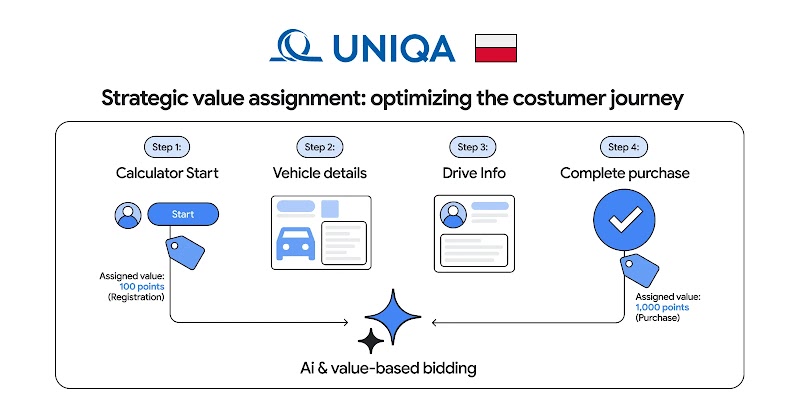
These weren’t actual revenue figures, but indicators of priority. We analysed historical data to understand the volume and frequency of each step, assigning higher values to actions that occurred closer to the final purchase.
This change had a profound effect. By weighting each stage of the journey, we were feeding the AI-powered bidding tool a much richer dataset. Because we assigned distinct values to specific consumer actions, the algorithm could finally differentiate between a user just starting the process and one on the verge of purchasing a policy. This enabled the system to bid more intelligently for higher-intent shoppers.
“Flexibility is at the core of this strategy,” Depending on the objectives, we shift our focus between different stages of the customer journey.” says Jan Daszkiewicz, search engine marketing expert at Salestube.
“For instance, we may prioritise the quotation stage, allowing Uniqa’s contact centre to follow up with users who haven’t yet finalised their purchase. In other periods, we invest more heavily in the final purchase stage to maximise online transactions.”
Driving cross-channel growth with agile campaigns
Building a smarter Search strategy was only half the battle. To truly scale, we needed to increase our visibility across more channels.
This led us to invest in AI-powered Performance Max (PMax). PMax acted as a multiplier for our value-based bidding strategy. By feeding our weighted conversion data into a single, consolidated campaign, the AI could seek out high-value users across YouTube, Display, and the full range of Google’s channels.
We never adopted a set-and-forget mentality. We monitor performance in real-time.
We guided the AI toward the shoppers most likely to buy by feeding it a rich set of data signals within our Performance Max campaigns. We focused on in-market audiences, such as “autos and vehicles” and “auto insurance”, to capture active insurance shoppers and remarketing lists and reconnect with past website visitors. By adding search themes, such as “tanie oc” (“cheap oc”) and “ubezpieczenie samochodu online” (“car insurance online”), we gave the system a clearer understanding of the topics and categories most relevant to our business.
What’s crucial, however, is that we never adopted a set-and-forget mentality. We monitor performance in real-time. At its peak, our PMax spending was nearly double that of our generic Search campaigns because it was driving superior efficiency. But as market trends evolved, we shifted focus back to standalone Search campaigns.
“This agility is essential; you have to be willing to adjust your strategy based on what the data is telling you at the moment,” Daszkiewicz says.
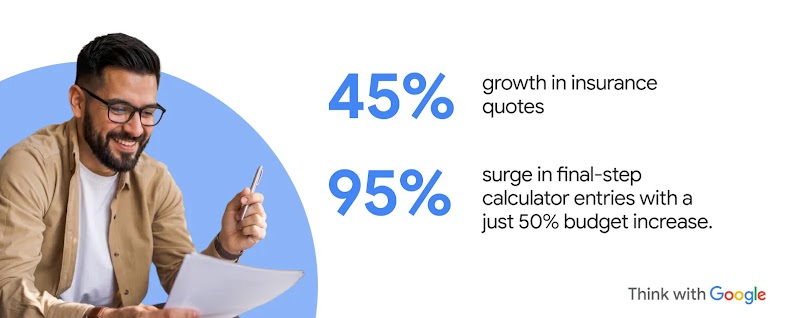
The synergy between our supercharged Search strategy and the broad reach of PMax was powerful. We have seen a steady 80% increase in leads since the strategy’s inception and 2025 marked a major breakthrough. The new approach delivered a 45% growth in insurance quotes and a 95% surge in final-step calculator entries with a just 50% budget increase. We were finally breaking through our performance ceiling.
Navigating change through experimentation
As a next step, we are piloting AI Max, which allows the algorithm to find new, relevant search queries by matching them to the high-value intent we’ve already identified. We initially launched a test on a low-spend campaign in December to see if we could drive higher conversion volumes. During the first two months of the pilot, AI Max expanded our reach, delivering a 13% increase in conversions with a marginal 3% increase in cost per acquisition (CPA).
You have to be willing to adjust your strategy based on what the data is telling you at the moment.
Following these positive results, we have now activated AI Max on our primary generic search campaigns to drive cost-efficient growth in line with our goals.
Our journey highlights a fundamental shift in how we think about growth. The market is dynamic, and so are the tools we use. Clinging to old patterns is the biggest risk. You don’t even have to increase your budget like we’ve done to maximise our success. In our tests where spend stayed the same, we still found that our growth rate improved while acquisition costs decreased.
Ultimately, success was not just about the technology, but about a mindset of humility and flexibility. It requires humility to acknowledge the limits of our intuition and the flexibility to adapt as the market evolves.
Social Module
Share