





 Sign in with Google
Marta Piotrowska is the director of integrated marketing at Allegro, Poland’s leading e-commerce platform. She has 15 years of experience across marketing, digital, e-commerce, and IT.
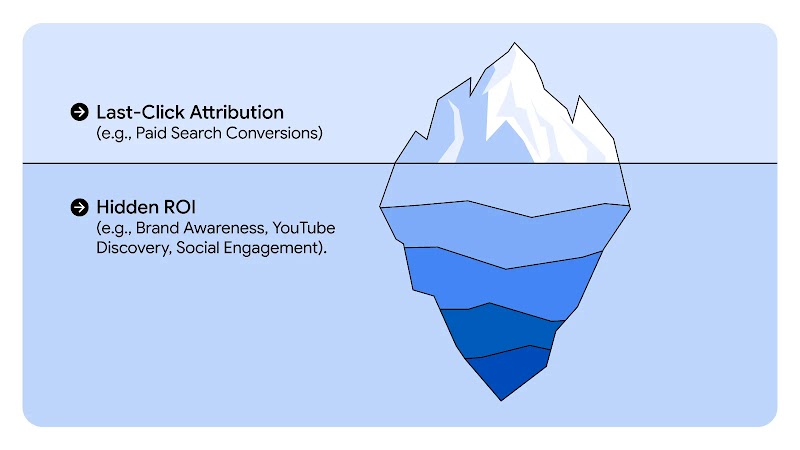
For many e-commerce companies, marketing measurement is like an iceberg. The small peak of last-click conversions is visible, but the massive, powerful base that truly drives business remains hidden beneath the surface. For years, the industry was guided by that peak, attributing a sale to the final click.
But the rise of video and social media has created an entirely different customer journey. People don’t watch short videos to immediately click and buy; they’re in a discovery process. This shift left us, and many others, in a difficult position.
We were systematically underinvesting in the very channels that build future demand because we couldn’t prove their direct impact on sales. We needed a way to see the whole picture, both in our domestic market of Poland and internationally.
Taking marketing mix modelling in-house in 3 steps
To get a holistic view, we turned to marketing mix modelling (MMM). While powerful, many existing MMM solutions felt like a black box, often requiring specialised statisticians to operate. We wanted something we could control and scale in-house.
That’s when we began collaborating with Google on Meridian, its open-source MMM framework. Because Meridian is built on Python, it eliminates the technical friction common with other frameworks. Our team didn’t have to learn a new ‘language’ to understand the math; they could simply plug the model into our current workflow and start optimising.
The process of building our own MMM model started with the fundamentals:
- Define the goal. We first decided which key business metric we wanted to explain. We chose to model our Gross Merchandise Value (GMV), as it represents the total transaction volume and reflects the overall consumer demand on our platform.
- Map the inputs. Next, we collected all our media spending data, from traditional channels like TV and radio, down to granular digital touchpoints on YouTube.
- Account for the baseline. Finally, we identified the external and internal factors that influence sales outside of marketing, like competitor promotions, pricing, and the number of active buyers on our platform.
From benchmarks to reality: Customising the mix for growth
The results were illuminating. We suspected that we were underinvesting in our upper-funnel marketing, but we didn’t realise the extent of the gap.
Based on industry benchmarks, one might assume an ideal mix for an e-commerce company would be 80% performance-focused media and 20% brand-building. However, the data revealed a different reality: our optimal balance was actually closer to 60/40.
The insights also revealed that a one-size-fits-all strategy doesn’t work. We deployed separate models for each country we operate in and discovered major differences.
To draw our conclusions, we first established hypotheses and introduced variables into the model to segment the data; our analysts then validated various scenarios against these findings. Additionally, we used Meridian’s budget optimiser feature, which recommends optimal cross-channel media allocations to maximise our return on investment.
For example, in our home market of Poland, the data showed that short-form video is a powerhouse. In that market, YouTube and other social video platforms are incredibly effective at driving business results. However, when we looked at the model for Czechia, the performance of short-form-specific channels was significantly lower.
This discovery was a crucial turning point. It prevented us from blindly replicating our Polish strategy and forced us to ask deeper questions: Is short-form social video less popular in Czechia, or is our creative approach failing to resonate with the local audience?
These insights also shaped our strategy in Hungary, providing the data-driven confidence to use a digital-only marketing mix.
Driving ROI across brands and categories
We discovered that this need for a custom approach doesn’t just apply across borders; it applies across our own portfolio of brands too.
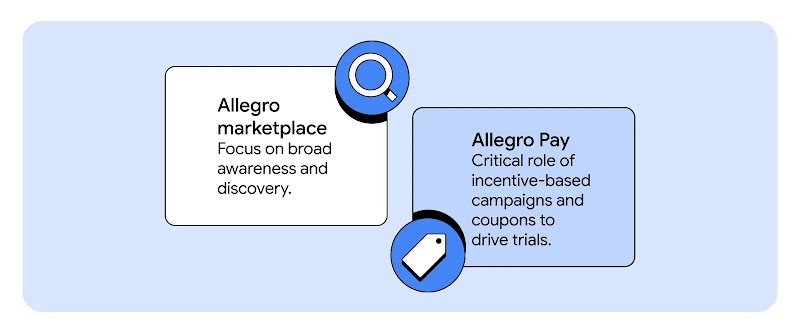
In addition to our core marketplace, we operate a fintech service called Allegro Pay, a “buy now, pay later” solution. Our initial instinct might have been to promote it with the same media mix we use for the main Allegro brand.
The data told a different story. For our established marketplace, coupon campaigns are not a primary driver of growth. But for Allegro Pay, a newer product still building trust with shoppers, the model revealed that incentive-based campaigns are the most effective tactic to encourage trial.
By understanding the whole “iceberg” of our marketing funnel, we could reallocate our budget with precision and confidence.
The results speak for themselves. While keeping our overall media budgets flat year-on-year, we’ve achieved double-digit growth in both revenue and our key business metric of Gross Merchandise Value. A significant part of that growth comes directly from the media mix efficiencies uncovered by our model.
The journey has transformed how we operate, allowing us to be more agile and pivot our media mix based on monthly data refreshes.
We’re now taking it a step further, building category-specific models for fashion, automotive, and electronics. After all, we now know that in a local and product-first marketing mix, the strategy for selling a car tire is and should be different from the strategy for selling a dress.
Social Module
Share