





 Sign in with Google
Jarosław Bednarczyk brings more than a decade of expertise at Google to his role, where he partners with marketers across Central and Eastern Europe. He focuses on helping brands optimise their marketing strategies through data-driven solutions.
For businesses across Central and Eastern Europe (CEE), the global market is a fertile ground for growth. But competing internationally often means challenging established players with deeper pockets.
Today, the key to growth isn’t always outspending the competition; it’s about outsmarting them. An advanced tool like marketing mix modeling (MMM) that was once the exclusive domain of large corporations is now more accessible than ever, allowing CEE brands to punch well above their weight.
This shift is particularly timely because MMM relies on aggregated data, such as weekly sales and media spend, rather than individual user tracking. This makes it a privacy-safe solution in an increasingly regulated landscape.
Despite these benefits, traditional MMMs were long perceived as slow, cost-prohibitive, and something of a “black box”. Because these models were often managed exclusively by third-party providers, even the largest advertisers lacked direct control over their own data inputs and strategic outputs.
Fortunately, the industry is moving past these limitations. Modern, open-source MMMs are finally putting control back into the hands of brands.
From black box to open source: Democratising measurement
That’s why our teams at Google have developed Meridian, an open-source MMM framework. It’s designed to be faster, more transparent, and more actionable. With an automated workflow, Meridian drastically reduces the time it takes to go from data to insight. Instead of waiting six months for a report based on old data, you can refresh the model on a quarterly or even monthly basis.
Meridian uses control variables to isolate the true, underlying drivers of your business outcomes.
Crucially, Meridian doesn’t just work faster; it works smarter. While traditional models often mistake things that happen at the same time for things that actually drive results, Meridian uses a ‘cause-and-effect’ framework. It doesn’t just note that two trends move together; it uses control variables — like regional economic shifts, seasonality or weather patterns — to isolate the true, underlying drivers of your business outcomes.
For CEE brands eyeing international expansion, this level of clarity is vital. Without it, a brand risks misidentifying a mere correlation as a true cause, leading them to invest heavily in vanity metrics.
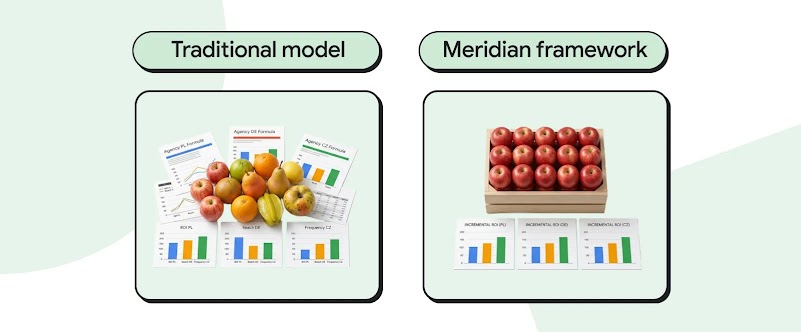
This challenge is amplified when operating across multiple borders. When managing different agencies and conflicting campaign goals, comparing performance can feel nearly impossible. To solve this, Meridian introduces a standardised framework that applies consistently across every market.
It moves brands from ‘comparing apples to oranges’ to a true ‘apples-to-apples’ view of the region. For example, if Poland shows a higher ROI for YouTube than Germany, you’ll know it’s a reflection of the market — not a discrepancy in how two different agencies calculated their formulas. It establishes a common language for success, enabling true apples-to-apples comparisons across the region.
Best practice in action: Autodoc’s ‘triangle of evidence’
International online automotive parts retailer Autodoc serves as a prime example of a company embracing this innovative approach to measurement. Operating across 27 countries, Autodoc needed a standardised way to compare performance. Moreover, they wanted to move from simply seeing what happened to proving why it happened.
“We don’t rely on a single source of truth because every model has its own bias,” says Alex Aychew, head of paid marketing at Autodoc. “Instead, we use a ‘triangulation’ approach.” This method balances three distinct measurement lenses:
- Attribution models: To understand customer journeys and make agile, day-to-day decisions about campaign performance.
- Marketing mix models: To get a high-level, strategic view of its marketing mix and how to allocate budgets for maximum impact.
- Incrementality experiments: To test hypotheses and validate the findings from both attribution and MMM, grounding its strategy in real-world results.
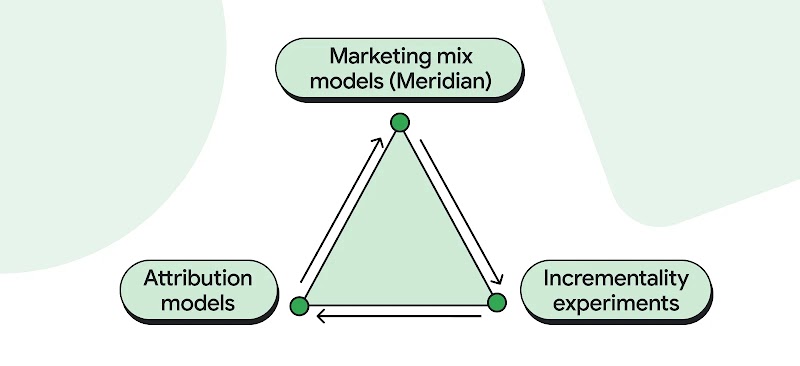
For instance, while attribution might show an ad campaign driving high sales for winter tires in Norway, an MMM analysis might reveal that a regional cold snap was actually the primary driver. To find the “ground truth,” Autodoc uses incrementality experiments to measure exactly how many sales the ads generated beyond the weather’s influence.
To power the MMM leg of this triangle, Autodoc turned to Meridian. For their technical team, the shift was as much about human efficiency as it was about data.
“Meridian gave us a solid foundation for the MMM — automating data preparation, visualisations, and diagnostics,” explains Anna Zubareva, data scientist at Autodoc. “This automation freed our team to focus on improving model logic and aligning it with real business objectives.”
By combining this automated efficiency with their “triangle” framework, Autodoc gained the confidence to make bold, data-driven decisions, which has delivered a sales revenue increase of 17%.
Building a future-proof measurement strategy on a budget
To be successful with an MMM like Autodoc, you don’t need a multi-billion-euro budget. The democratisation of measurement means any business can adopt a more sophisticated approach. Here’s how to get started:
- Embrace a holistic view: Don’t rely on a single source of truth. Combine the tactical speed of attribution with the strategic depth of MMM.
- Think privacy-first: Build your measurement foundation on methodologies that respect user privacy by design. Aggregated approaches like MMM are resilient to industry and regulatory privacy changes.
- Stop guessing, start testing: Use incrementality experiments to ground your statistical models in real-world results. This builds confidence and validates your strategy.
- Move beyond observation to calibration: Use Meridian not just to see what happened, but to run optimisation scenarios that guide future budget allocation.
Ultimately, while sophisticated measurement models are powerful tools, they still rely on human judgment to frame the right questions and provide critical business context.
The future of marketing measurement isn’t about finding a single perfect tool, but about building a flexible, multi-faceted framework that allows us to make smarter decisions with confidence, no matter what changes come next.
Social Module
Share