





 Sign in with Google
Aleksandra Coombes is a senior analytics leader with deep expertise in marketing measurement, incrementality science, and advanced data strategy. Over a 15‑year career at Expedia Group, she has built and scaled global data science organizations spanning the U.K., U.S., Hong Kong, Brazil, and India.
We’ve all been there. You know your brand marketing is working. You can feel the momentum. You can see the cultural resonance. But “feeling it” doesn’t unlock more budget.
This is the challenge with media that creates demand. These channels typically lack direct attribution, which makes measuring the direct impact on sales difficult. And it makes securing additional investment from finance an uphill battle.
At Expedia Group, we needed a better way to measure brand impact, something credible enough to support investment decisions without asking leaders to take a leap of faith. Our solution was to build a measurement engine that bridged the gap between our brand marketing and hard business outcomes.
Triangulating brand truth with Search data and Meridian
The traditional approach to brand measurement — large, high-frequency brand surveys — wasn’t the right fit for us. These surveys can be time-intensive and resource-heavy, often taking many months or more to deliver actionable insights. In a market that moves daily, that kind of timeline makes it difficult to respond quickly.
The unlock for us came when we realized that branded Google Search data is a strong indicator of brand health. These are typically queries that signal clear awareness or intent — whether someone is looking for your brand, exploring what you offer, or trying to take the next step. Instead of waiting months for survey results, branded Search data is available daily. This data acts as a proxy for consideration, and you can see near-immediate shifts following a campaign launch. It gives you a real-time snapshot of intent.
If branded Search data from Google served as a high-frequency proxy for consideration that we fed into our MMM, we used Brand Lift studies to validate the trends we saw.
Building an in-house marketing mix model (MMM) wasn’t a practical option, so instead we fed this data into Meridian, Google’s open-source MMM. This enabled our teams to move faster and with greater agility.
There was one critical, technical detail we needed to account for. We couldn’t just use generic “travel” search volume in our model. To make branded Search data a reliable signal, we pinpointed the queries specific to each of our brands, not broad categories. We performed this exercise across all of our brands including Expedia, which is our one-stop travel shop; Vrbo, which connects hosts with families and friends looking for places to stay; and Hotels.com, which is the hotels expert.
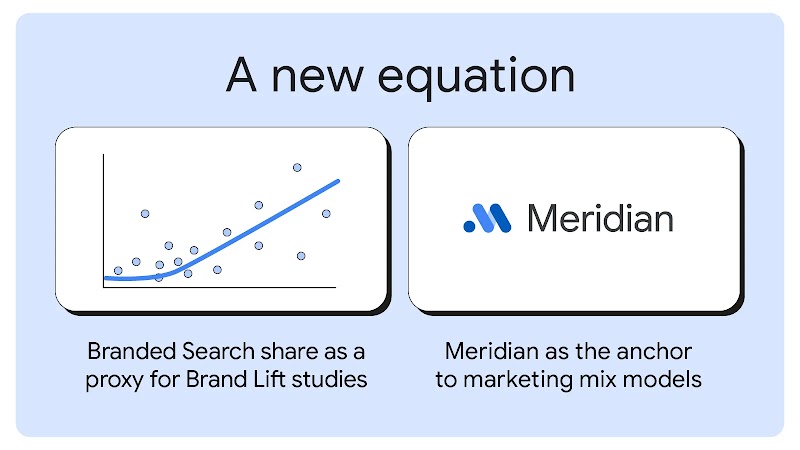
From here, we calibrated our data. If branded Search data from Google served as a high-frequency proxy for consideration that we fed into our MMM, we used Brand Lift studies to validate the trends we saw. Then we could distinguish between channels that drove short-term brand performance from those that grow long-term consideration.
From guessing to growing
As a deeply focused brand performance advertiser, all of our conversations focus on driving business outcomes. Branded Search share in the Meridian MMM helped us understand the performance of demand-generating dollars at the speed of performance campaigns. This is our “CFO-speak.”
The framework validated a long-standing hypothesis: Marketing efforts that drive awareness and consideration are top drivers for long-term brand health. Instead of vague promises that brand marketing was driving business outcomes, we can now quantify the impact. This has empowered our teams to confidently understand the contribution from each of our channels and increase our budget for brand marketing.
Instead of vague promises that brand marketing was driving business outcomes, we can now quantify the impact.
Today, our reconciled and unified brand measurement framework gives our teams permission to make big bets, and try out new tactics and investment levels that previously would have been impossible to justify up front, while also validating the impact of these bets across different regions or countries to see if it drives the impact that we are looking for.
The bottom line
The journey I’ve shared proves that you don’t just get better data when you bridge the gap between brand marketing and financial outcomes. You can drive more confident budgeting decisions.
To move from defending your budget to driving the business strategy, we recommend making three fundamental shifts.
- Speak the language of your CFO. Anchor the marketing science to financial outcomes to truly understand the impact brand marketing has on your business.
- Prioritize experimentation. Test, validate, and continuously evolve your brand measurement approach, so you have the best data needed to build trust within the business.
- Consider pragmatic approaches to MMMs. If building an in-house MMM isn’t the most practical option, explore existing open-source or external solutions to help you move faster and make more informed decisions.
The greatest gift you can give your organization is the clarity to stop guessing and start engineering growth.
Social Module
Share