





 Sign in with Google
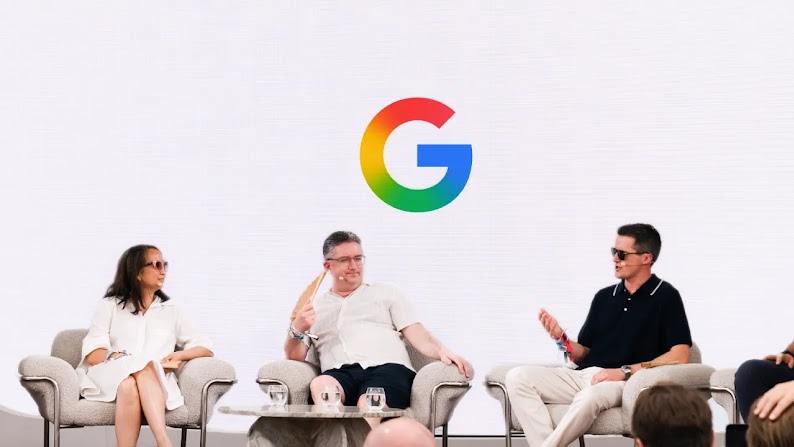
Google Search is undergoing its most profound expansion, becoming more intelligent, conversational, and agentic. AI Search moves curious consumers from discovery to decision and helps marketers connect across the entire purchase journey. To understand how marketing organizations can navigate this transition, we invited three global business leaders to the Google Beach at Cannes to share how they are steering into the new era of AI Search.
The conversation featured Linda Ha, deputy CMO of Ikea; Dan Finley, group CEO of Debenhams Group; and Andy Wells, VP of growth marketing at DoorDash. Their marketing thought leadership offers practical lessons on shifting behaviors, Search visibility, AI-powered advertising, and modern measurement frameworks. The discussion has been edited for length and clarity.
Decoding the conversational consumer
Google: We’re seeing growth in both short and long queries in AI Mode, and the average AI Mode search is triple the length of a traditional Search query.1 As queries get longer and Search becomes more conversational, how are you meeting this moment?
Dan Finley, Debenhams: At 248 years old, Debenhams is one of the oldest retailers in the world. But our ambition is for Debenhams to be to retail what Spotify is to music. We want to offer the ultimate destination of choice across fashion, home, and beauty, delivered in a curated and personalized way. We’re increasingly seeing customers discover us through extended search terms, so we’re focused on making sure we show up at our best, with richer, deeper content, and more relevant and personalized imagery. We’re seeing a greater demand for information through these emerging discovery channels than we typically see through our direct channels.
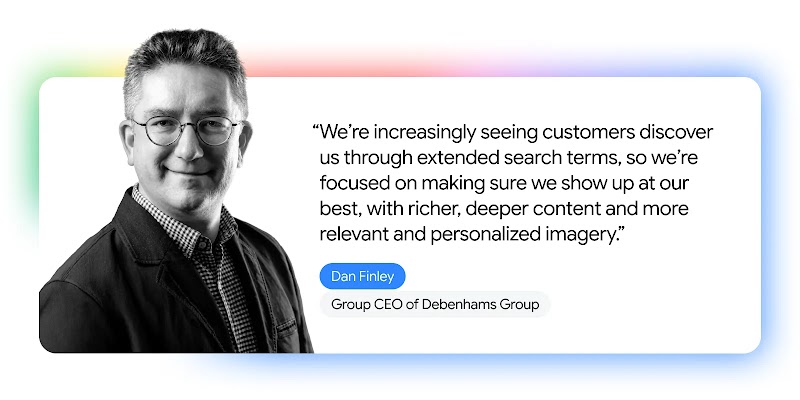
Andy Wells, DoorDash: We’ve definitely seen a shift in terms of how folks are discovering our brand. Just from a conversational perspective, we’ve seen 27% longer search queries year over year. And that’s within the traditional Search engine, not just AI Mode. Our potential gig workers aren’t just searching to “find a job,” they’re looking for “best gig delivery jobs in San Jose.” We’re leveraging products like AI Max to make sure we’re showing up for those more situational and specific queries.
We’re also assuming that shift will happen, not just on search platforms but within our product itself, within any app where you’re searching or asking questions. We just released a feature called Ask DoorDash, which is a conversational shopping assistant. So now you can add a recipe link, you can snap a photo from a cookbook, and our assistant will actually build a full shopping cart for you.
Linda Ha, Ikea: We start with rich data that we get from our loyalty program, Ikea Family. We have over 200 million members, so we know what they do within Ikea. But now Search helps us understand what they do outside Ikea. Having a conversation in their exploration, that helps us bring our expertise to them. For example, planning a kitchen is such a complex journey, but now it’s so easy with the new era of Search. We can show our experiences by telling them what complements their complete kitchen. It’s really brought us so many more opportunities. We’re showing up in a much more relevant and personalized way.
Good SEO is good GEO
Google: As AI makes Search more helpful, we get lots of questions about what it means for organic traffic and discoverability. The best formula for success remains foundational search engine optimization (SEO). How are you seeing this play out for your websites, content, and business?
Wells: I do think that there is a misconception that technical answer engine optimization (AEO) needs to be this entirely new practice that’s separate from SEO. That’s just not what we have seen. We’ve continued to focus on site architecture, structured data, and ensuring that best practices are in place so that crawlers can read our site and will serve up the right content. We have over 500,000 product SKUs across the platform today, which are available at certain local merchants and not at others. So, being able to integrate directly with products like Google to ensure that Gemini and Google AI Overviews can read that and understand when to recommend DoorDash, or a specific product based on what it knows we have, is super critical.
For organic traffic and discoverability, the best formula for success remains foundational SEO.
Ha: We’ve really prioritized Search as a growth topic. And we need to be on top of what others are saying about us. We’re working closely across paid, owned, and earned to ensure that we show up in the way that we want to, and that way we can really double down on our home-furnishing expertise. We’re making sure that we have an integrated search foundation, and we know there are different local nuances, but to establish those best practices is so important. Then you can build on that foundation.
AI-powered ads are delivering measurable, incremental growth
Google: Just as AI is expanding what’s possible on Search, AI is supercharging ads. How are you using AI-driven ads to automate and personalize at scale?
Finley: We might be one of the oldest retailers in the world, but we’re positioning ourselves at the frontier of this new AI age. We have over 25,000 brand partners, tens of millions of products, and tens of billions of pounds of inventory. Google’s full suite of AI technology, whether it’s AI Max or Performance Max, through to measurement and attribution, is enabling us to operate at a scale far beyond what we could ever have done.
It’s also allowing us to show up in a more personalized way to customers, with automated creative technology that’s relevant to each customer, wherever they are in their shopping journey.
It’s about making sure we capture all of the demand that is economically viable for us. We are really focused on driving profitable demand. We don’t want to leave any money on the table. We’re using a demand-led AI strategy, to make sure we consistently show up at our best. We’re focused on using ROAS targets, making sure that our budgets are never depleted and measuring that in real time.
Wells: We’re focused on capturing as much growth as possible, looking at incremental gross order value (GOV) as well as ROAS and a payback from an efficiency standpoint. Incrementality is super important to us. Especially as the behavior shifts, we have to make sure that we’re running experiments and not just relying on click-based attribution.
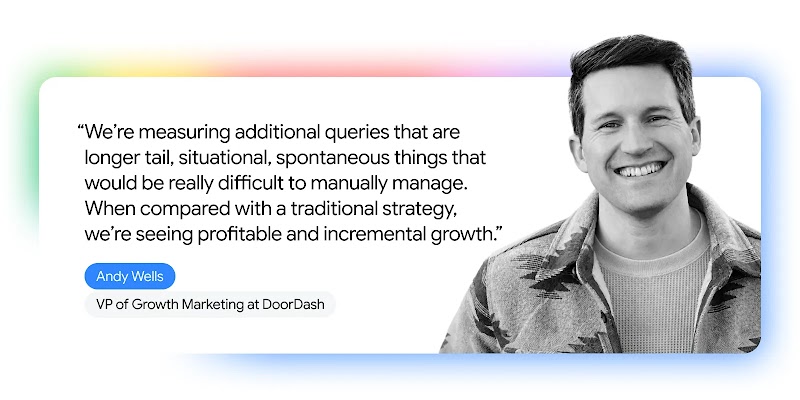
We’ve shifted about 30% of our budget to AI Max for Search and Performance Max, and we’re trying to get to a much higher percentage. What we’re measuring is additional queries that are longer tail, situational, spontaneous things that would be really difficult to manually manage. And then, when compared with a traditional strategy, we’re seeing profitable and incremental growth. That type of approach can complement our upper-funnel work.
DoorDash’s Andy Wells talks with Google EMEA President Debbie Weinstein at Cannes about the app’s search strategy.
We sponsored the World Cup for the first time this year, and we saw a stat that 79% of sports fans are on their phones while they’re watching the matches. They may be hungry, but they may also be searching for a specific product to enhance their experience. And if they don’t know it’s on DoorDash, they’re going to turn to Google. And we better show up there.
My favorite example: There was a guy who was at a watch party that was way too crowded. He was in the back of the audience. He couldn’t see the match on the big screen they had there. So, he DoorDashed a TV to the event. This was not a paid sponsorship. This was organic behavior. We need to ensure that we’re showing up, because most people wouldn’t necessarily think of DoorDash as the solution to that problem. And if we’re not showing up where they’re searching, we’re not going to be able to solve that problem for them.
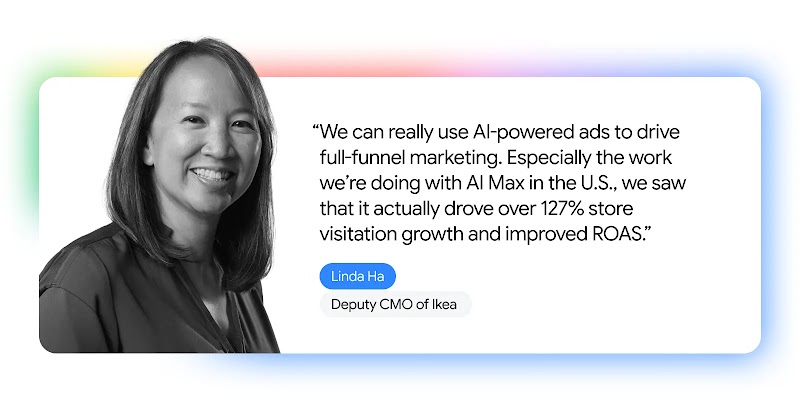
Ha: We are doing a lot of experiments to see what works. And one thing that we’re seeing is that we can really use AI-powered ads to drive full-funnel marketing. Especially the work we’re doing with AI Max in the U.S., we saw that it actually drove over 127% store visitation growth and improved ROAS. So now we’re scaling this to all of our top markets.
The AI Search era: From adaptation to action
The transition to agentic, conversational Search isn’t a future milestone. It is happening now. As leaders from Ikea, Debenhams, and DoorDash demonstrate, winning in this new era requires a dual commitment, maintaining a structured organic search foundation to strengthen Search visibility while deploying AI-powered ad campaigns to capture spontaneous, long-tail consumer intent. Ultimately, the marketers who thrive on this frontier will be those who embrace constant experimentation and shift toward real-time, incremental measurement. The next step is clear: Audit your search architecture for AI-readiness today, and lean into AI-powered campaigns to capture demand you might otherwise be leaving on the table.
Social Module
Share