





 Sign in with Google
Manna Faldo runs digital performance strategies within Trustpilot’s internal paid media team. The team are cross-platform specialists responsible for Google Search, LinkedIn, and Display ads.
As one of the largest open platforms for customer feedback, Trustpilot is a household name for many consumers. But that widespread recognition creates a unique challenge for our growth with business customers.
When people search for “Trustpilot”, the vast majority are consumers looking to read or write reviews. They often search for us in connection with another brand, like a car insurance provider or a brand of jeans.
To drive business growth, we needed to reach C-suite and marketing leaders looking for our services.
Moving beyond a traditional keyword strategy
Historically, we managed this through a very targeted search approach. We relied on high-volume keyword lists and exact and phrase match targeting to try and isolate business intent.
One of the biggest hurdles was managing the sheer volume of noise from consumer searches. And that’s not because we don’t want consumers to find us. We want them to find the right page; the page they are looking for.
It’s the difference between a consumer searching for “Trustpilot reviews for X brand” and a marketing manager asking “how can I build trust for X brand via Trustpilot reviews”.
We were constantly trying to map out every iteration of how a business user might find us, translating that intent into thousands of specific keyword strings.
This was a massive undertaking. All of these keywords had to be localised into every language we appear in globally. We have great collaboration with our regional marketers, but when you look at all those keywords and then scale that by nine different regions, the complexity is immense. In foreign language markets, we would also run the English versions alongside the native language — essentially doubling the workload for every single region.
Despite this effort, capturing generic business intent remained difficult. A business owner might search for “how do I get more reviews for my business?” or “how do I improve my sales conversions?”
These searches often don’t include the Trustpilot name at all.
Because we span such a broad category of business solutions, it was incredibly hard to capture that generic demand through traditional manual targeting.
Embracing trust in the age of AI
At Trustpilot, our leadership and teams are aligned on being AI-first and we have a strong test-and-learn culture.
We recognise that modern AI systems evaluate brand credibility through the lens of the 3Rs, favouring Recency of data, Relevance of content, and the Ranking of trusted sources. And when we heard about AI Max for Search it sounded like a great fit for us. We were eager to see if it could provide the precision we couldn’t achieve manually. Rather than being fearful of losing control, we saw it as the natural next step in our evolution.
That’s why at the start of this year we launched a pilot in the U.S., our market with the largest volume and budget, to achieve statistical significance rapidly.
Fuelling AI with high-quality data
But AI is only as smart as the data you feed it. We knew that simply turning on a keywordless campaign — that’s one that uses signals other than keywords to understand intent — could not achieve what we wanted, if the tool didn’t understand what a successful outcome looked like for us.
To guide AI Max, our team collaborated closely with Google to align our conversion metrics. We implemented Enhanced Conversions for leads — an ads feature designed to improve the accuracy of conversion measurement. We then set our “true north” to track Marketing Qualified Leads, for us these are a stage deeper than basic demo requests.
In just six weeks, the data confirmed that our trust in the technology was well-placed.
Powerful results and a new AI-powered reality
The AI Max for Search pilot transformed our B2B lead generation efficiency in the U.S.. By allowing it to discover relevant search queries we hadn’t previously considered — including capturing those broad, generic business questions — we achieved:
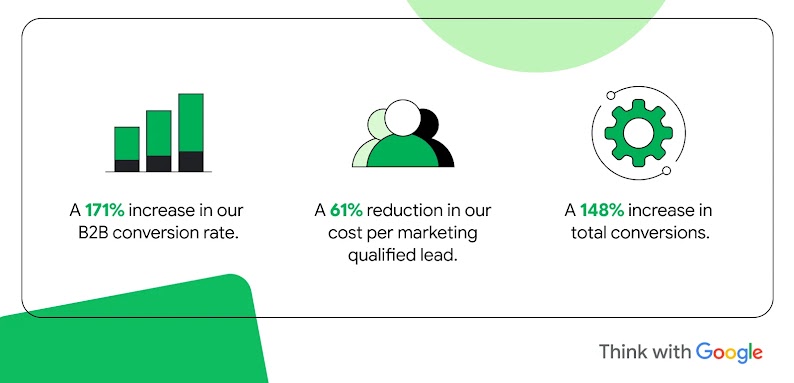
The results were so strong it actually created a funny kind of “visibility” challenge for us. I remember being on a call with Google and saying, “These results are amazing — but can we get even more information?”
When you hit those numbers, your instinct as a marketer is to immediately pull the engine apart to see which specific cog is doing the heavy lifting.We had to lean into a new reality: the AI was processing multi-layered signals — everything from the time of day to cross-platform patterns like a YouTube view or a specific search intent — at a scale our team simply couldn’t replicate manually.
We had to accept that the day-to-day data streams might be less visible because the AI is operating on signals that are largely invisible to us. It’s a shift in mindset, but the trade-off is undeniable. The tool was mapping out high-value customer paths that weren’t even on our radar.
Expanding our AI-powered B2B strategy across Europe
We don’t view this as a one-off project, but as a continuous journey. Based on the success in the U.S., we are now scaling this approach across the U.K. and the rest of Europe.
For other B2B marketers, our experience shows that when you have a culture that embraces AI, you can move past the limitations of manual targeting and localisation. If you provide the system with high-quality signals and trust the technology, it can identify growth opportunities with a level of speed and precision that traditional methods simply cannot match.