





 Sign in with Google
Brian Thornton is the digital and performance marketing manager at Swedish home improvement retailer Clas Ohlson. He specialises in scaling high-growth strategies in marketing, using a data-first approach to drive omnichannel success and innovation.
Clas Ohlson is more than just a retailer in the Nordics; it’s a 108-year-old institution. Starting as a mail-order business in rural Sweden, today we have almost 250 stores and online sales across Sweden, Norway, and Finland.
But heritage doesn’t guarantee future growth. And in today’s retail environment, search is the doorway to meeting customers as they discover and decide what to buy.
To maintain our position in search, we needed to improve our “hygiene metrics” — the quality scores that algorithms use to rank ads. If your ad copy isn’t perfectly relevant to the user’s search, you pay more to be seen.
With a massive product catalogue of around 17,000 items, optimising search ads across three languages normally takes weeks of manual work.
A solution was needed that offered scale and efficiency, without sacrificing the helpful tone our brand is famous for.
The use case: Scaling without losing our voice
Partnering with Google and Dentsu, our team explored whether the “RSA AI Generator” could be the answer. Developed by Google gTech, this uses large language models (LLMs), specifically Google’s Gemini, to generate headlines and descriptions for responsive search ads (RSAs) based on existing keywords.
The idea of handing over our distinct brand voice to an LLM raised some eyebrows internally. After all, the copy still needed to sound authentically like Clas Ohlson.
To prove the concept, the AI tool was stress-tested with the most difficult challenge first: the Finnish language. Its complex grammar is notoriously difficult for translation models, so our logic was simple: if it could handle Finnish and retain a consistent brand voice, it could handle anything.
The results were promising. After the internal copy team reviewed the AI-generated Finnish assets, they gave it a 96–98% accuracy rate.
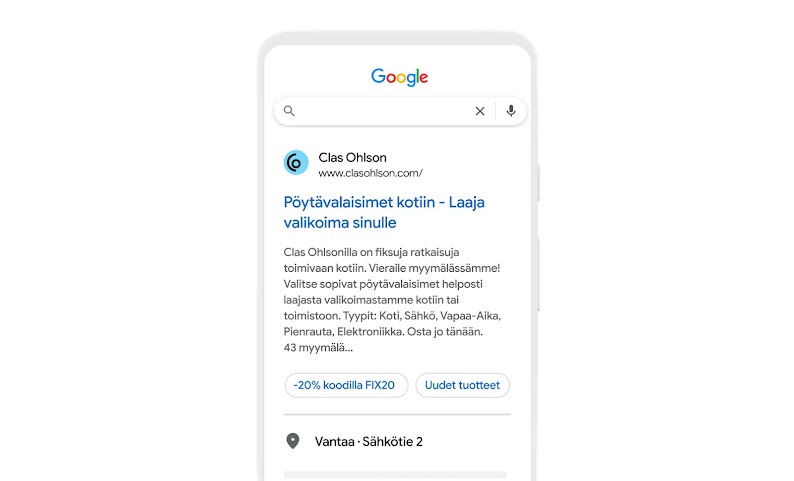
That gave us the confidence to take our next steps.
The solution: Prompt engineering and stress-testing
From that point on, our process ran on two parallel streams: technical implementation and quality control.
We involved our creative directors from the start to define the rules for how our brand should sound. This information was used to build detailed prompts for the AI, asking it to write descriptions, whilst guiding it on tone and messaging.
Iryna Tarasenko, senior paid search specialist at Dentsu, led the technical implementation. She spotted that while the AI was fast, scaling up exposed small inconsistencies that weren’t visible in smaller tests.
“We started with a sample of 10 texts, which looked great. But when we scaled to 100 and then 1,000, we realised that a minor misalignment in a small sample becomes a massive issue at scale,” explains Tarasenko.
She continues: “That is when we understood we had to evolve our prompts, sometimes adding more context, sometimes disabling specific variations. For example, we introduced ‘negative keywords’ into the prompts to prevent the model from using aggressive language like ‘Buy Now’, which simply isn’t the Clas Ohlson way.”

Iterating our prompts was crucial. It ensured the AI-generated copy was not only accurate, but it was also authentically us. It’s sort of like teaching a new team member our brand’s dos and don’ts.
Quality control: Using AI to audit AI for brand safety
Whilst many teams might have stopped their use of AI at this stage, we went one step further.
To give us more assurance that our new copy met our high expectations, we used BrandAlign, an AI-enabled tool developed by Google gTech and enhanced by Dentsu. It uses Gemini to make sure that Search ads and image assets are not violating brand policies and guidelines.
We think of this as “AI auditing AI”.
Alongside the Dentsu team, we agreed on 17 specific rules regarding our brand voice; how Clas Ohlson ads should sound and how they definitely should not sound. BrandAlign reviewed every AI-generated headline and description against these rules.
“We categorised the rules into key areas — like safety, clarity, and tone. Our team at Dentsu then customised BrandAlign to include a scoring system,” Tarasenko says. “This allowed us to calculate a measurable success rate for each category and track quality improvements. For example, we could see if the AI was passing our ‘safety’ checks but failing on ‘tone’, and then adjust our prompts accordingly.”
To put this into context: our generic search campaigns for “Home & Garden” received an overall quality score of 65% (out of 100%) from BrandAlign. While scores for rules like “Clarity & Simplicity” were high, the score for “Persuasive Messaging” was lower.
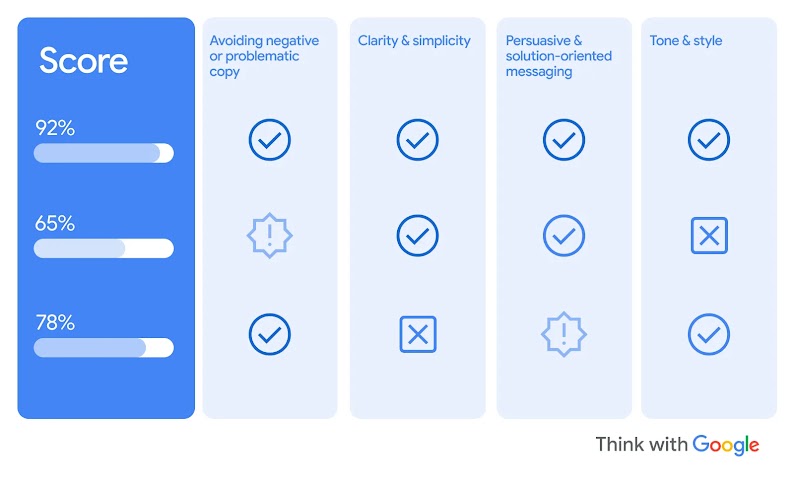
This wasn’t a failure; it was a reflection of a conscious strategic choice to prioritise keyword relevance over hard-sell language in those particular ads.
This meant that by the time human native speakers did their final review, the copy was already polished and compliant. It also freed up our internal copy team to focus on high-value creative work, because the hygiene and volume tasks were competently handled by AI.
The results: 8X faster production for the PPC team and higher engagement
The efficiency gains were immediate. What used to take weeks was compressed into days. We successfully produced localised ad copy for approximately 700 ad groups across Sweden, Norway, and Finland.
- Speed: Production time was reduced by 8X.
- Engagement: 4 percentage point increase in click-through rate (CTR) in our initial test case compared to our old campaigns.
“We also saw that the ads became more engaging,” adds Tarasenko. “When we looked at year-on-year data, the click-through rate had improved significantly, proving that the new copy wasn’t just faster to produce — it was resonating better with customers.”
These results directly addressed our initial challenge: achieving massive scale and efficiency without compromising on performance.
For any marketer hesitant about “handing the keys over” to AI, my advice is to start with a single use case to validate the tool.
Involve the right people from the start — creative directors, copy experts — so everyone is on the journey together. Test, validate, and build a process that combines the scale of AI with the oversight of human experts.
We managed to turn a 100-year-old retailer into an AI-first digital advertiser, not by changing who we are, but by using technology to amplify our helpful, Nordic voice at scale.