





 Sign in with Google
Jim Lecinski is a clinical professor of marketing at Northwestern University’s Kellogg School of Management and author of “The AI Marketing Canvas” (Stanford Press, 2026), in which this concept originally appeared. The opinions expressed are his own and may not reflect those of Google.
One of the questions I get asked most often by CMOs is this: Given how much AI is changing marketing work, how should I redesign the marketing team?
It’s an urgent question. Just months ago, most marketers were using AI mainly as a chat-based assistant. They prompted it, iterated with it, and used it to speed up familiar tasks. Today, AI is moving fast toward agentic execution and “marketing workflow systems.” Marketers define the task, provide the inputs and guardrails, send the AI agent to do the work, and then evaluate the output. This new model calls for a new kind of team and brings new leadership challenges to CMOs.
I recently collaborated on research with McKinsey that looks at how marketers are experiencing this shift.
The marketing organizations that handle this transition well will become more credible as true growth engines inside the enterprise.
The pattern was clear. AI enthusiasm is high. Some 86% of marketers say they’re excited about the possibilities AI creates. And usage is widespread. Nearly 60% use AI multiple times per week. Yet 57% of marketers also report feeling anxious about what AI means for their roles, and only 28% view their companies as pursuing a fundamental rewiring of marketing teams and workflows. Most are still layering AI onto existing processes rather than fundamentally rewiring how marketing teams and workflows operate.
That gap matters because this is no longer just a technology issue. It’s now an operating model issue. It’s a talent issue. It’s an org design issue. And, increasingly, it is a CEO and CFO issue as well. The marketing organizations that handle this transition well will move faster, make better decisions, shorten cycle times, reduce rework, scale best practices more consistently, and become more credible as true growth engines inside the enterprise.
So what should a frontier CMO actually do here? My answer is: Rewire the work. Rewire human-AI collaboration. And rewire the marketing organization. Let’s take each in turn.
Rewire the work
Start with the work itself.
In a recent article, I argued that AI is pushing marketing away from episodic initiatives and toward always-on systems. That point matters here, too. Before a CMO can rethink roles, reporting lines, or team structure, their first job is to understand which marketing workflows matter most and how they actually run today.
Most marketing organizations still know their org chart better than they know their workflows. In the human-AI era, that’s backward.
The first “Monday morning move” is straightforward. Pick a very small number of high-value, high-frequency workflows and map them end to end. Not twenty. Three to five is enough to start. These might include things like: how you segment audiences, plan promotions, test your creatives, optimize campaigns, score leads, or report on performance. The exact list is less important than the act of mapping out the workflow steps in detail.
Most marketing organizations still know their org chart better than they know their workflows. In the human-AI era, that’s backward. The workflow is now the real unit of change. If you can’t see the work clearly, you can’t redesign it clearly. And if you don’t redesign it, AI will simply get tacked onto yesterday’s process.
This first workflow step is vital. But it’s not the entire solution. The next big question to address is: who, or what, should do which parts of each workflow?
Rewire human-AI collaboration
This is where the deeper redesign begins. “Humans and AI will work together” sounds good, but it’s not a management model. A CMO now needs to define the hybrid partnership much more explicitly. What should humans do? Where should AI act? Where should humans review? Where should judgment remain fully human? Where should escalation sit? Those are now core leadership decisions, not just technical tools questions.
Take a familiar marketing task, such as moving from a set of focus group transcripts to an executive recommendation. In the old model, a marketer or researcher manually worked through the material, pulled insights, clustered themes, drafted the story, and packaged the output. In the new model, an AI system can ingest the transcripts, extract the themes, synthesize, and prepare an initial management readout. The human role then shifts upward. Less time goes to the execution layer, assembling the intermediate output. More time goes to the start — framing the initial business question, setting the standards — and to the end — reviewing the synthesis, judging what matters, and deciding what to recommend. This is the strategic vision and decision layer.
Teams are told to “use AI,” but no one has thought about how the work should now flow. The result is anxious marketing teams.
So the next “Monday morning move” for a frontier CMO is to choose one important workflow that you’ve mapped in detail and now define the human-AI handoffs step by step. Don’t settle for broad language about augmentation. Write it down. For each workflow stage, specify who (or what) commissions the work, who performs it, who checks it, and who approves it. What happens if the output is wrong, weak, or incomplete? What happens if goals or inputs or directions are in conflict? Think about the execution layer, the orchestration layer, and the vision-decision layer.
Why does this matter so much? Because one of the most common failure modes right now is not bad technology. It is bad role clarity. Teams are told to “use AI,” but no one has thought hard about how the work should now flow. The result is duplication, rework, fuzzy accountability, superficial adoption, and anxious marketing teams. (Remember that 57% stat I mentioned earlier.)
In the human-AI era, the scarce resource is sound judgment applied at the right points in the workflow.
As execution becomes cheaper and faster, human vision and judgment become more valuable, not less. Someone still has to decide what problem to tackle, define what good output looks like, protect the brand, weigh trade-offs, interpret weak signals, and connect the output back to that business problem. In the human-AI era, the scarce resource is not content generation. It is sound judgment applied at the right points in the workflow.
Get this right, and the payoff is big. Better human-AI collaboration means better decisions and faster learning loops. It won’t take long for the rest of the C-suite to see that marketing is getting it done with AI, not just playing with it.
Once that division of labor is clear, the next question is organizational: Do your roles, skills, reporting lines, and management systems match the way the work now gets done?
Rewire the organization
Many CMOs start by assuming AI will make their teams smaller, and maybe even wondering what roles they might cut. That is understandable, but it’s not the best place to start. The more critical question is what shape and skill mix the organization now needs.
Execution-heavy roles are likely to shrink. Other roles will expand. You’ll need more people who can orchestrate hybrid workflows, supervise agents, define standards, connect functions, and translate strategy into operating rules. You’ll also need more people who can be standard-bearers for vision, judgment, taste, and quality.
That is why your “Monday morning move” here should not be to redraw the full org chart. Instead, pick one team where AI is already changing the work and redesign that team first.
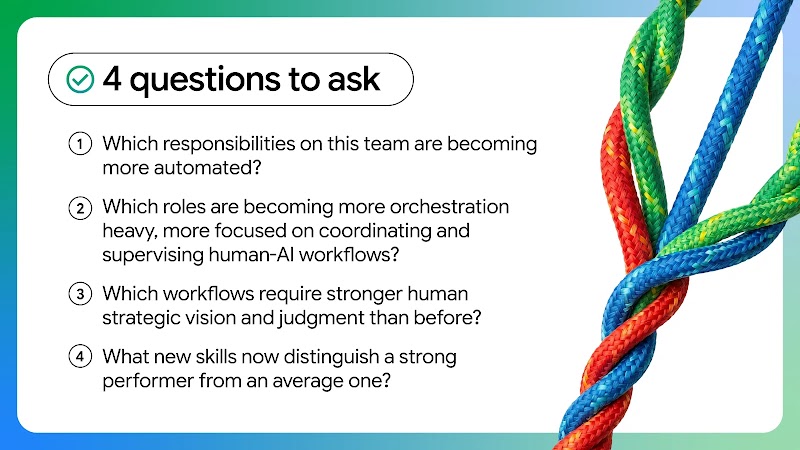
That exercise usually reveals something important very quickly: AI changes the shape and skill mix of the marketing organization, not simply its size.
This change also has direct implications for hiring and training. You can’t hire for yesterday’s roles. Yes, look for classic strategic thinking. But also ask today’s early- and mid-career candidates to show you an end-to-end fully automated AI workflow they have built. Many recent MBA graduates now come with that skill set as more graduate programs integrate AI for marketing into their curricula. For senior-level candidates, ask them to walk you through how they’d redesign and lead a real human-AI marketing workflow. Where would automation sit? Where should human judgment remain? What guardrails would they establish, and how would they manage the team and measure results?
Frontier leaders must shape the human-AI system through which modern marketing increasingly runs.
Today’s teams urgently need managers who can help and coach them as they redesign actual workflows in practice, day by day. Quarterly AI training seminars won’t cut it. Teams need clearer expectations about what good everyday hybrid AI-human performance looks like. And they need career paths and performance evaluations that include and reflect the emerging realities of AI orchestration, supervision, and judgment.
This is where the CMO’s leadership role expands. The job is no longer only to drive demand today and build brand over time. Now frontier leaders must also shape the human-AI system through which modern marketing increasingly runs. Done well, that makes marketing more adaptive, more scalable, and more legible to your CFO, the C-suite, and the board.
The CMO leadership task now
AI’s evolution from chat-based assistants to agentic execution is changing the nature of marketing work in real time. That’s why this question of “what should my org look like” keeps surfacing in my conversations with CMOs, who already sense that the old model will not hold.
The practical answer of what to do is becoming clear. Rewire the work. Rewire human-AI collaboration. Rewire the org.
CMOs who move now on those three fronts will build teams that learn faster, operate with greater clarity, and create more enterprise value. In the human-AI era, that is what real marketing transformation looks like.

Social Module
Share