





 Sign in with Google
Attention, trust, and action: 3 shifts defining YouTube in Poland

Polish consumers now spend roughly an hour each day on YouTube, and more than 5 million hours of content went live over the past year.1 But the critical takeaway isn’t simply the volume of time spent — it is how that time is being used.
Historically, video platforms were treated primarily as upper-funnel branding channels, separate from direct commerce and performance media. Today, that boundary is quickly disappearing. This is also the case in Poland where viewing habits have evolved from passive streaming into active discovery.
Here are three behavioural shifts on YouTube shaping the Polish market — and what they mean for marketing strategies.
The blurring of formats: Navigating multi-screen habits
Traditional media plans love neat borders: television belongs to the living room, podcasts to the commute, and short-form video to quick mobile breaks. In Poland, these borders have largely vanished.
Two key figures illustrate this shift:
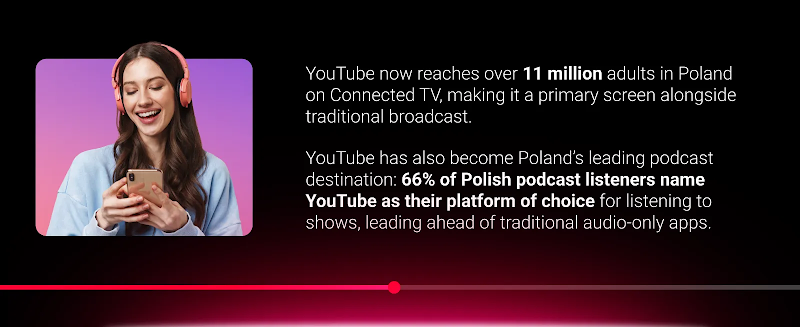
Viewers frequently switch context within the same day: listening to a long-form interview or video podcast (vodcast) during a commute, then continuing the same programme on TV at home, punctuated by quick vertical Shorts throughout the day.
The takeaway for marketers:
Plan for mindsets rather than ad placements. When screens and formats are fluid, creative assets must be built for dual consumption: compelling audio and explicit verbal cues ensure the message lands when a viewer is merely listening, while clear visual hooks and subtitles capture sound-off scrollers on mobile.
Redefining commercial trust: The Gen Z reality
Reaching an audience is no longer the same as winning their trust. According to a survey conducted by Kantar, 77% of surveyed GenZ (18-28) viewers in Poland say that YouTube is the video platform that they trust the most.2
That trust is the platform’s greatest asset, giving brands a credible environment in which to engage. However, commercial success depends on how brands show up within it: viewers expect partnerships that feel as natural and grounded as the content they come to watch.
When that authenticity is missing, younger demographics are the first to tune out. Gen Z has the lowest receptivity to online video ads of any generation, fueling the assumption that younger audiences reject advertising altogether. Creators challenged that view: audiences do not object to sponsored content; they object to forced alignment.
As content creator Dusia notes, digital natives see right through manufactured spectacles. Breakthrough impact only occurs when a product feels organically anchored in a creator’s everyday reality.
“By capturing attention, I don’t mean a hook or controversy — I mean a creator who inspires trust, where the audience knows and feels this is a product they genuinely use.”
When brands move past scripted ad reads and allow creators to integrate products into their real routines, skepticism turns into consideration.
Yet for advertisers, the goal is not to abandon conventional formats entirely. Polish e-commerce platform Allegro captured the day-to-day dynamic: “Sometimes it’s the creator who leads to purchase, sometimes it’s the regular ad.”
The takeaway for marketers:
Treat creator collaborations and conventional ads as complementary levers, not competing priorities. Giving creators the freedom to speak in their genuine voice earns the initial trust, while traditional ad formats provide additional clarity and control to guide consumers toward action.
From product research to purchase: Closing the consideration loop
Polish consumers are deliberate, thorough, and value-conscious. They rarely buy on impulse directly from social feeds; instead, they seek validation before making a purchase. According to a survey conducted by Kantar, surveyed viewers in Poland rank YouTube as the #1 video platform when they want to research, vet, or make a decision about a brand, product, or service that they want to buy.3
Video helps shoppers remove doubt by showing how a product actually looks, fits, and performs in real life. But, historically, this value often leaked off-platform: a consumer watched an in-depth review, closed the app, and manually searched for an e-commerce platform to buy the product, resulting in drop-offs.
To close this gap, we recently launched the YouTube Shopping affiliate programme in Poland in partnership with Allegro. This allows creators to pin clickable product tags directly inside their videos, Shorts, and livestreams. When a creator features an item, viewers see an on-screen prompt with the live Allegro listing, allowing them to browse and head straight to checkout while the video keeps playing. By removing the need to pause and search manually on a separate app, product validation connects directly to purchase with zero friction.
Connecting product research directly to sales requires a presence across every screen and format. Yet keeping up with that volume can quickly stretch team resources.This is where automation and AI step in to support media teams:
- Creating formats at scale: Instead of filming separate videos for widescreen TV, square feeds, and vertical Shorts, tools like Multimodal asset generation in Google Ads use AI to automatically reshape and adapt your existing footage to fit every screen.
- Smarter ad delivery: Rather than guessing where an audience will be, campaigns like Demand Gen automatically match your mix of video and image ads to where each viewer is most engaged, driving 22% higher return on ad spend than traditional paid social.4
The path forward for brands in Poland is clear: stop treating YouTube as a pure awareness channel. By pairing creator credibility with direct paths to purchase and letting AI handle the friction of cross-format production, marketers can turn high-intent viewer attention on YouTube into measurable business growth.
Social Module
Share