




 Sign in with Google
 Sofia Tavares and Miranda Tomasik lead the global expansion of the language-learning platform Preply. Together, they combine Tavares’s two decades of international leadership with Tomasik’s data-driven brand planning to elevate Preply’s market presence.
For a language learning platform like Preply, the primary challenge is not a scarcity of audience. There are about 2 billion language learners globally. The challenge is that people don’t simply wake up one day and decide to learn a language. Usually, there’s a specific trigger, whether it’s career growth, relocation, or family ties. Building awareness, therefore, isn’t just about telling people we exist. It’s about being present when language learning becomes relevant in their lives.
Spain was a great example of that challenge. Unlike more mature, online-native markets such as Germany or the United States, people in Spain either used simple, game-like apps or went to offline language academies. That meant our job wasn’t just to introduce our brand. It was to educate the market. We had to show people why learning online with a real tutor who adapts to their needs and goals helps them progress faster.
In just 1.5 years, we tripled brand awareness while sustaining a positive ROI. But to build on that success, we knew we had to go beyond demographics and understand who our audience really was. What did they care about? What did a Sunday morning look like for them?
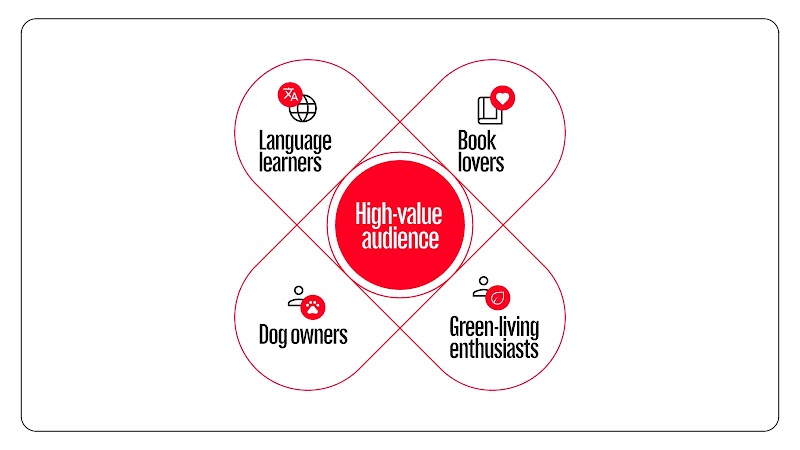
People interested in language learning are often green-living enthusiasts, book lovers, and dog owners
How overlapping interests revealed our true audience
To uncover our audience’s lifestyle and hobbies, our team turned to Insights Finder on YouTube. The tool helped us look at the full picture of our prospective users’ digital habits, analysing what else they search for and watch when they aren’t practicing vocabulary. This analysis relied on aggregated, anonymised data to ensure user privacy.
The results gave us a surprising look into their lifestyle. We discovered that in Spain, people interested in language learning are often green-living enthusiasts, book lovers, and dog owners.
We put these insights into action by shifting our focus from demographics to reaching real people. Instead of casting a wide net reaching people with all sorts of interests, we focused on the exact overlap where core language learners and these newly discovered interests meet, allowing us to reach language learners by tapping into their passions, whether they are dog enthusiasts, book lovers, or environment-conscious.
Why a multi-channel format is the most effective solution
Our next step was exploring a variety of YouTube formats to find the most effective combination. As a result, we focused on three mediums to ensure maximum coverage and engagement:
- Connected TV (CTV): To secure living room views and deliver our core brand message effectively, we used non-skippable 15-second ads tailored for the big screen. This format became our top performer for scale, delivering the highest overall reach. It also proved to be exceptionally efficient, driving a 29% higher increase in brand awareness than any other format at our lowest cost per impacted user. Furthermore, bringing our brand to the living room gave us the bonus benefit of reaching entire households without extra ad spend.
- YouTube Shorts: We used quick, vertical videos for people scrolling on their phones. We expected this to mostly reach younger Gen Z viewers, but the data surprised us. It actually brought in a massive number of mid-career professionals, giving us a 10% boost in incremental reach.
- Audio Ads: Tested for the very first time, this was our most surprising success. By shifting the focus from visuals to sound, we integrated ads into our audience’s daily routines, like their commutes, workouts, or podcast breaks. It proved to be our most cost-efficient choice, delivering a 14% incremental reach.
Here is an example:
Our success didn’t stem from a single best format, but rather from the synergy between them. While our broader campaign used Google’s full suite of video solutions, CTV, Shorts, and audio ads drove our most surprising and impactful results. This strategic combination allowed us to connect with high-intent audiences we couldn’t have reached otherwise.
What it takes to nearly double campaign assets
Showing up effectively across CTV, Shorts, and audio meant we needed a massive volume of creative assets. We scaled our production by nearly 70%, deploying a massive volume of unique creatives.
Managing that many ads meant we had to constantly check what was working. Every week, we looked at the data, tested three different versions of our ad hooks, and immediately turned off the ads that weren’t doing well. Through all this testing, we learned an important lesson: keep it simple.
For example, through humorous storytelling, we showed how learning a new language could help people excel at work. We also realised that starting an ad with a statistic from our efficiency study works well to build credibility.
Our main recipe for achieving such scale was structured planning. While we used AI as a supporting production tool, we refrained from using it for our core assets to highlight our human-first approach.
How the brand awareness challenge evolves once a brand is known
The results proved that we are on the right track. We achieved a 3X higher brand awareness lift compared to our previous campaigns and cut the cost per lifted user nearly in half, all while keeping our cost per thousand impressions (CPM) at the same level.
Moving forward, our challenge is evolving. It is much easier to jump from zero awareness to a higher number than it is to keep growing once you’re already well-known. But that hard work is already leaving a lasting footprint.
As we expand, we will continue using tools like Insights Finder to uncover audience passions. By staying closely aligned with our learners’ real-world habits and keeping our messaging clear, we can refine how we connect with them in their daily routines.


Social Module
Share