





 Sign in with Google
“Our philosophy is ‘move at the speed of culture.’”
It’s a bold mandate for any organization, but for a heritage brand like Gap, it’s the strategic North Star that allows them to be everywhere their customers are. As consumer behavior shifts rapidly toward AI-driven discovery and agentic commerce, the paths to purchase are becoming infinitely more complex.
To stay ahead of the curve, Damon Berger, Gap Inc.’s SVP of marketing shared services, is focused on building a customer experience that reduces friction between discovery and purchase decision. From adopting AI-powered campaigns to turning product feeds into growth levers, Berger’s team is redefining how Search creates and captures demand in real time.
In this conversation, Berger shares how.
Think with Google: AI is changing how people discover and evaluate products. How is Gap evolving its Search strategy to stay ahead of this shift and capture demand as behaviors change?
Damon Berger: We look at search from both a brand and performance perspective. Brand Search remains a really good indicator of brand health, while nonbrand is still a competitive channel and a workhorse for driving conversions.
We need to meet consumers where they want to be met, in the ways they want to be met, where they want to buy, how they want to buy, and at the time they want to buy.
For us, it’s about continuing to get value from Search today while staying ahead of where it’s going next. We’ve seen that with products like Performance Max and AI Max, which are helping us reach more consumers and capture demand in new ways. Ultimately, our philosophy is “commerce everywhere.” Increasingly, we need to meet consumers where they want to be met, in the ways they want to be met, where they want to buy, how they want to buy, and at the time they want to buy.
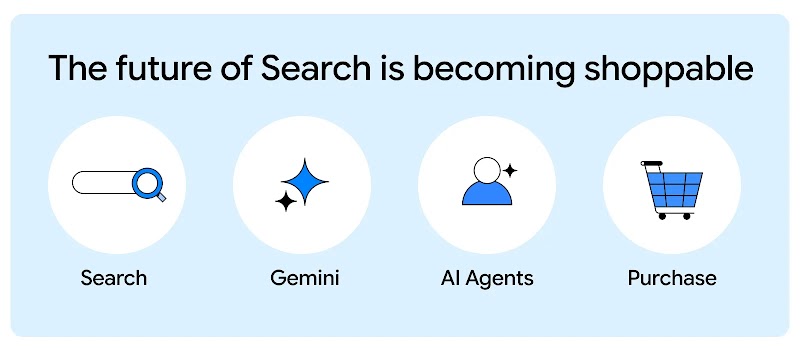
Search has been, and continues to be, a massive lever for us. But the landscape is changing fast. With Gemini, the Universal Commerce Protocol (UCP), and new agentic surfaces that could allow consumers to initiate and complete purchases within AI experiences, we’re thinking ahead to how and where consumers will search and shop as those behaviors scale.
Think with Google: As Search evolves from simple keywords to more complex, conversational queries, how are you rethinking your approach to measuring success and ROI?
Berger: We currently look at return on ad spend (ROAS), incremental ROAS, and new customers. But if the analogy for Google Search is, “Which keywords are we successful with?”, then the analogy on AI Mode is, “Which conversations are we successful with?” That opens up a whole new way of thinking about what success looks like.
Is it the number of times we show up in an organic query or through a paid placement? Is it the number of times certain products surface? If we got exposure but not clicks, how do we account for that? As user behavior changes and technology advances, those traditional metrics may only tell part of the story. The way marketers measure success will need to evolve with them.
Think with Google: Gap has been an early adopter of AI-powered campaigns. What advantages have you seen as a result?
Berger: Performance Max has helped us scale across Google’s inventory. In fact, for some of our brands using Performance Max, we’ve seen great improvements in ROAS. Because of this, we’re continuing to invest there.
We’ve also adopted AI Max across our brands and expanded it across our nonbrand campaigns. That’s helping us reach more customers and get more visibility too. While AI Max is still new, we see a lot more potential ahead. We’re excited to be there early, work with Google, learn together, and understand where we can take it next.
Think with Google: Product feeds have evolved from a back-end IT requirement into a critical growth lever for conversational commerce. How does a high-quality feed drive Gap’s strategy?
Berger: Control over the feed — how we present it and what the product presentation or assortment is by platform — allows us to move at the speed of culture by being able to distribute our products wherever we want them to be. With commerce increasingly happening everywhere, distribution of our feeds is a powerful way for us to grow our brands.
Think with Google: With the rise of agentic commerce, how is Gap adapting to new customer journeys, and what role is UCP playing in capturing intent?
Berger: We’ve already seen technology shorten the distance between discovery and purchase. Take social. As social commerce scaled, you could see a brand you love through an influencer or piece of content, and make a decision right there. The idea of a linear funnel went out the door when you could see something and buy it immediately.
Agentic commerce takes that idea even further. What does a complex query ultimately result in a purchase from? Is it outfitting? Wardrobing? Style guides? Those paths are going to become much less predictable. But the principle stays the same: When that consumer is ready to buy, we need to make that as seamless a proposition as possible.
We’ve built an infrastructure that allows the organization to move quickly and understand which signals to chase.
UCP allows us to do that in a unique way. As more platforms adopt the same standard, we don’t have to build a separate instance for every place we need to show up. We need to be ready wherever intent emerges. That could be someone simply saying, “I’m looking for a new pair of jeans in this style and shape,” and Gap can be right there with the answer: “Hey, here are the Hailey Bieber jeans.”
Think with Google: Navigating this pace of change requires immense organizational agility. How do you do that? What advice do you have for other marketing leaders?
Berger: I don’t think there’s any advice I’d give that makes this sound like some version of an overnight success, because it isn’t. For us, the hard work is focusing on what the consumer is doing, how they’re behaving, and how we lean into that at the speed of culture. We’ve built an infrastructure that allows the organization to move quickly and understand which signals to chase.
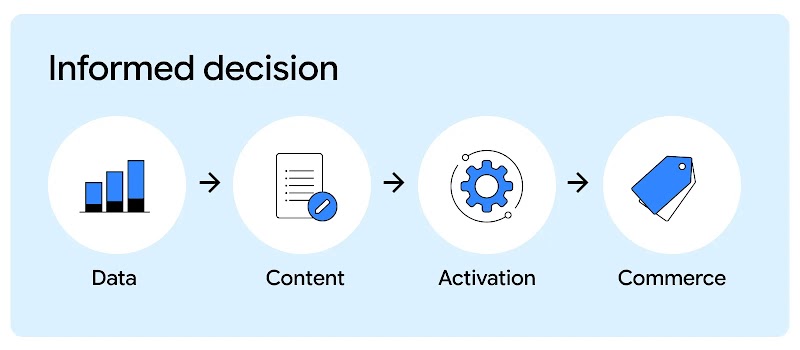
Everything we do comes back to: “What does the data tell us, and what outcome are we trying to drive?” Data leads into content, content leads into activation, and activation leads into commerce. When companies don’t work that way, they’re guessing. We don’t guess. We don’t want to guess. We want to test based on a potential outcome.
The craft is in how quickly you can act on those signals, adapt to trends and technology, and measure whether it’s working. But it all starts and ends with the customer. Moving at this pace and with this amount of change can be uncomfortable. We’ve learned to be comfortable being uncomfortable — and that’s a skill of its own.

Social Module
Share