





 Sign in with Google
Ivan Gubenko leads the charge in high-growth iOS strategies, blending data-driven performance marketing with a deep respect for user data integrity. His expertise lies in transforming privacy constraints into competitive advantages for the modern app business.
As privacy standards evolve and more people choose to stay invisible to tracking systems, I’m seeing a fundamental shift in how brands need to look at their app measurement and performance. At InDrive, a global mobility app with a presence in Egypt, Saudi Arabia, and Morocco, as well as Latin America and Asia, we adapted to this new landscape by redefining how we track our app’s success.
Since the widespread adoption of Apple’s App Tracking Transparency (ATT), a significant portion of our iOS users are now opting out of individual-level tracking. This means we have to move away from analysing granular, step-by-step user journeys in favour of privacy-first, aggregated data models.
This shift has revealed a fascinating data paradox within our growth strategy. Because so many paid conversions are now categorised as organic due to the lack of tracking IDs, our ads are often doing far more heavy-lifting than the surface-level data suggests.
Without visibility into that full-circle impact, we can easily undervalue a paid media campaign that is, in reality, a primary growth driver.
We have to be much more intentional now to ensure we don’t pull back on the very initiatives that are quietly fuelling our expansion. Part of that has been understanding that the key to modern measurement is recognising that a surge in organic growth is often the invisible byproduct of high-performing paid media.
Seeing the true power of paid ads in a privacy-first world
Our mobile app has been downloaded over 400 million times across 48 countries, and iOS is a big part of our business model. As the industry moves toward more secure data frameworks, we want to make sure we’re leaning into that shift, scaling our reach while respecting the high privacy standards our users expect. But this new landscape also means we sometimes have to get a little more creative with how we measure success.
Because so many paid conversions are now categorised as organic due to the lack of tracking IDs, our ads are often doing far more heavy lifting than the surface-level data suggests.
To get a clearer picture of our true impact, we turned to incrementality testing. We chose this path after noticing a trend that didn’t make sense. Whenever we increased ad spend, we saw a massive spike in “organic” traffic that didn’t align with our brand efforts. We suspected this rise was actually an indication of paid-driven growth on iOS.
To prove this, we ran controlled geo-experiments across the Middle East, North Africa, and Latin America. We isolated specific cities as holdout groups, withholding ads there while scaling in others, to measure the total volume of conversions that would not have happened without our media spend.
The results were eye-opening. The correlation between “organic” surges and our active campaigns suggests that privacy-related tracking limitations have been underreporting our true iOS performance.
This was the proof we needed. Our campaigns weren’t just hitting targets, they were the primary engine behind a significant wave of iOS growth that standard attribution tools weren’t capturing.
How probabilistic measurement fuelled 3X growth in attribution
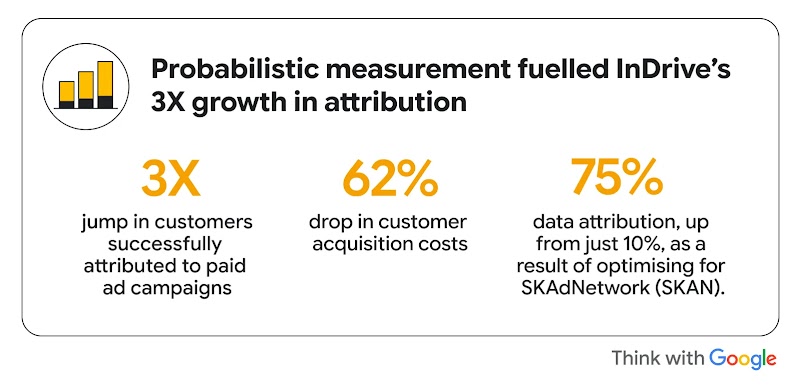
Our app measurement turning point came mid last year, when we partnered with Google to implement Integrated Conversion Measurement (ICM). This solution uses probabilistic modelling — which accounts for uncertainty and randomness to enrich conversion data — to give us a more complete, high-definition view of our campaign performance. The results were immediate. We saw:
- A 3X jump in customers successfully attributed to our paid ad campaigns
- A 62% drop in customer acquisition costs
- 75% data attribution, up from just 10% previously, as a result of optimising for SKAdNetwork (SKAN), Apple’s proprietary, privacy-centric framework for measuring the effectiveness of app install campaigns on iOS.
This deeper insight into our true growth drivers did more than just fix our charts. It delivered a direct, powerful impact on our global ROI.
A clearer North Star: Unlocking true efficiency through sophisticated measurement
Our measurement evolution proves that today’s privacy landscape isn’t a hurdle. It’s a competitive edge for those willing to look deeper. By trading fragmented data for a holistic view, we didn’t just bridge the gap. We uncovered massive efficiencies hiding in plain sight.
The takeaway for modern marketers is simple: stop settling for surface-level metrics. Moving past the data gap does more than just fill in the blanks. It gives you the evidence you need to defend your strategy and prove your true impact.
Guided by these insights, InDrive is doubling down. By moving beyond surface-level metrics, we are more efficient with our ad spend and sharpening our stack to fuel the next phase of our growth. The path forward isn’t just visible. It’s wide open.
Social Module
Share