


 Sign in with Google
How to sustain profitable growth is a multibillion-dollar question for today’s commerce platforms.
As they compete for more of India’s $250 billion market potential, the winners will be those maximising the effectiveness of their huge promotion spend to grow their top and bottom lines.
And the key to achieving that, as BCG’s new research shows, lies in using both promotions and advertising as synergistic profit levers.
BCG’s earlier study had already established that when businesses boost critical promotions with advertising, they can achieve both growth and profitability. Now, it has crystallised the significant impact of doing exactly that for India’s e-commerce and quick commerce platforms in the current business environment.
Here’s how BCG’s latest findings can help businesses unleash a flywheel that sustainably increases ROI, by applying a four-step strategy for measuring and optimising their marketing mix.
The unmissable opportunity for profitable promotions
To evaluate Indian commerce players’ promotion efficiency, BCG first analysed their promotion spend, which it found to be highly disproportionate to their ad spend.
For e-commerce platforms, promotion budgets (including budgets owned by platforms and merchants) compared to ads are 4.2X to 7.2X.1 And for quick commerce, that ratio is 2.8X to 4.9X.2
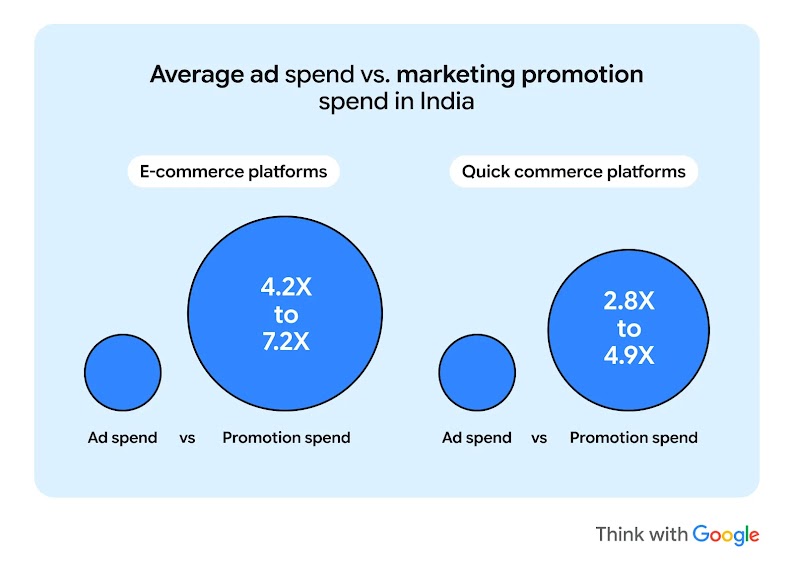
This imbalance reflects Indian platforms’ reliance on promotions to drive growth. That long-standing strategy has indeed helped businesses win over India’s deal-loving consumers.
But aggressive discounting can also cause “promo burn,” by training customers to buy only during sales. The result? Brand dilution and profit margin erosion. In fact, 30% to 40% of retail promotions are either inefficient or unprofitable, a global BCG study found.
Indian platforms like Eternal, the parent company of Zomato and Blinkit, acknowledge the industry’s current discounting levels are not sustainable. During an earnings call for the quarter ended June 2026, Eternal CEO Albinder Singh Dhindsa said there is not a lot of wiggle room for such promotions to deepen, “because that would balloon losses fairly significantly.”
The good news: Indian commerce players can significantly boost incremental EBITDA earned on every promotion dollar, when they apply the right balance of promotion and ad spend in the context of the existing business environment.
For India’s e-commerce platforms, the incremental EBITDA per promotion spend can potentially be improved by 5.7X to 21.1X when compared to benchmarked leaders, according to BCG.3
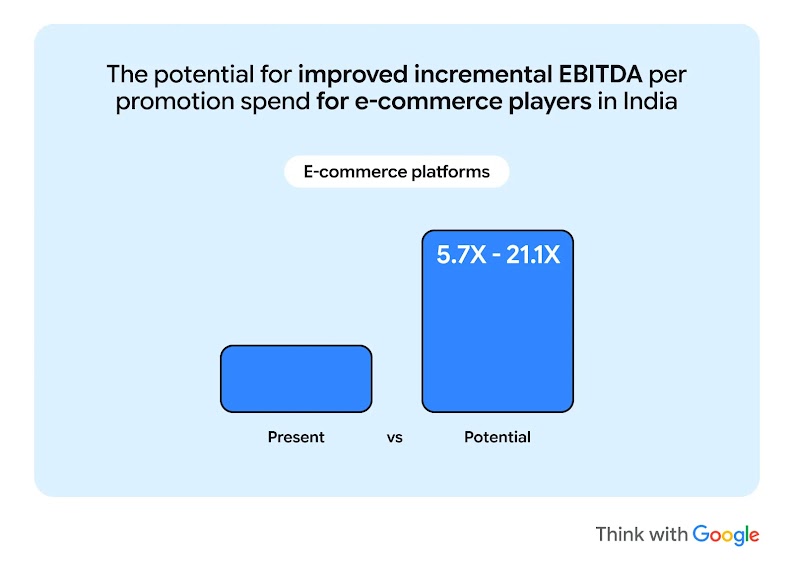
E-commerce players can unlock significant promotion efficiency when they use ads to boost targeted promotions that grow the lifetime value of customers, especially those who would pay full price even without discounts.
Similarly, quick commerce platforms can benefit from rebalancing their promotion and ad budgets:
- For those already realising returns on every promotion dollar, the incremental EBITDA per promotion spend can potentially be as much as 1.2X higher.4
- For those in the process of turning losses on every promotion dollar into profits, the incremental EBITDA per promotion spend can potentially be improved by 6X.5 That can enable a turnaround from loss to profitability — for example, a move from negative EBITDA of $1 to positive EBITDA of $6.
Improving promotion efficiency is a pressing task for quick commerce players. Their high fixed floor for operating costs like urban dark stores and last mile deliveries squeezes margins. That makes pruning inefficient promotions and boosting core discounts with targeted advertising even more critical for driving positive margins.
The flywheel for driving profitable growth with promotions and ads
The quest for greater promotion efficiency is already underway in APAC, as platforms like Lazada shift away from constant discounting. Players in “Asia and Southeast Asia have over-indexed on promotions over the past decade,” Lazada co-founder Magnus Ekbom told The Warc Podcast. “We need to get back to great marketing and great brand building.”
So how can you pivot your marketing strategies to increase ROI for the next decade and beyond? The answer lies in optimising your balance of promotion and ads spend. Here’s a four-step strategy to unleash a flywheel for sustainable, profitable growth.
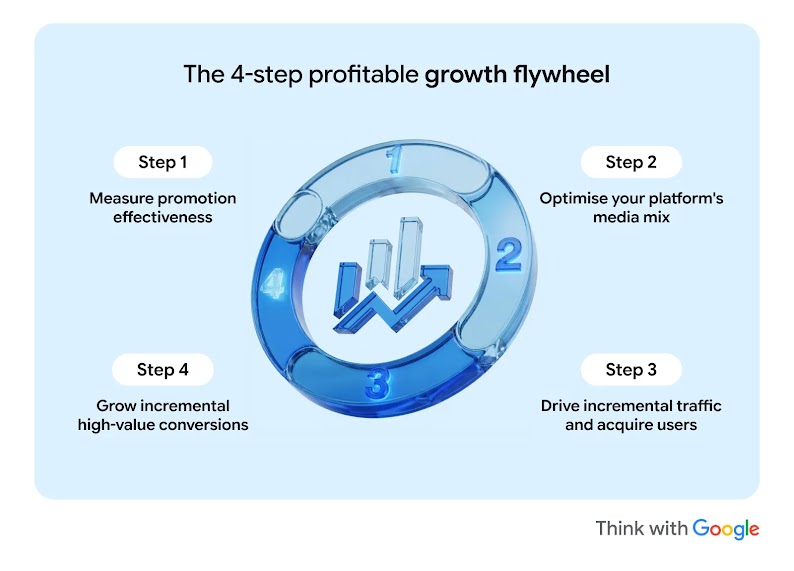
Step 1. Measure promotion effectiveness and marketing mix
Understanding how much incremental revenues and returns your discount pricing strategies generate is key to success. But as BCG’s research found, Indian commerce marketers have varying degrees of clarity in their understanding, ranging from fairly accurate in a few cases to heuristics-driven for many cases.
They’re also unclear how efficiently their promotion budgets drive profits relative to ad spend, because they lack a unified framework to evaluate both.
Leading brands like Muji recognise the importance of having precise insights into promotion budget effectiveness, which vary significantly depending on the context, such as categories, geographies, and large sales. That’s why it’s investing in a Promotions Insights Hub powered by causal machine learning (Causal ML).
Muji discovered that offering a 10% discount was highly effective in driving sales of categories that involve planned and bulk purchases, such as children’s wear, electronics, footwear and bags. The promotion had less impact on essentials like health and beauty.
Another insight: Promotions for furniture, housewares and stationery lifted in-store sales only during peak demand periods; they were negligible or even negative during off-peak seasons.
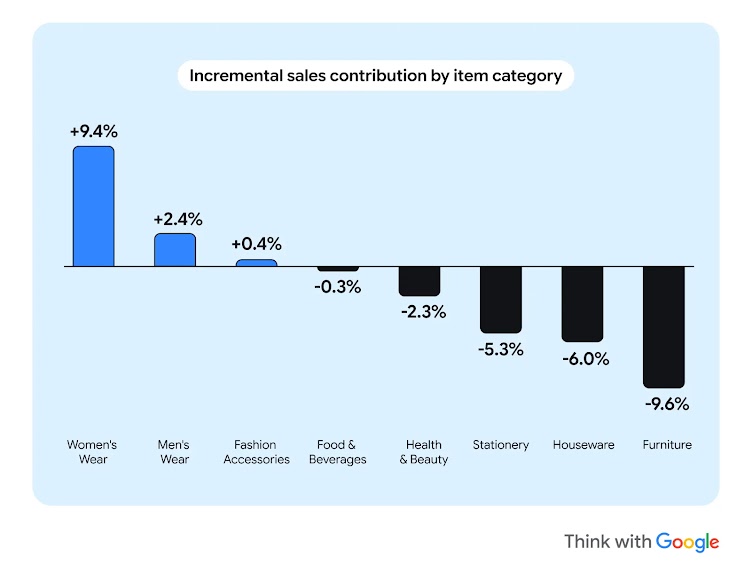
Like Muji, your platform can use causal ML to better understand the effectiveness of your promotions under different conditions, including geographies like Tier 2 and Tier 3 cities. And to validate your results via transparent, cost-effective Geo experiments, tap Meridian GeoX, Google’s open-source incrementality solution.
That robust evaluation will help you find the optimal promotion budget allocation and act confidently on those insights, such as cutting discounts that negatively impact sales and margins. Better yet, share those learnings with merchants, so they, too, can improve promotion efficiency.
Step 2. Optimise the media mix of your platform
Activate your flywheel for profitable growth by using a powerful Marketing Mix Modelling (MMM) like Meridian to understand the optimal budget allocation for your platform’s media mix.
Meridian can help you audit for inefficient platform-funded promotions and free up budget. Reinvest those savings in high–performing media channels that help accelerate growth in merchants’ sales and your own ROI. Here are some ways:
- Optimise platform-funded promotions: Increase Google Ads spend to boost your high-performing offers, say cashbacks and free deliveries, that drive high-intent traffic to merchants.
- Grow merchant sales via onsite retail media ads: Spotlight more merchants via platform-funded ads, and help them boost transaction velocity.
- Build brand trust: Engage and convert more users in fast-growing areas like Tier 2 and 3 cities, by partnering with YouTube’s vast ecosystem of trustworthy creators. They’ll help you build your brand and tap into $1 trillion of influencer-driven consumption.
- Partner with the YouTube Shopping affiliate programme: It lets creators tag your merchants’ products directly in their videos, driving high-intent conversions for sellers.
- Tap offsite media ads: Commerce media through Google Ads can accelerate shoppers’ journeys from discovery to check-out for your merchants’ products. Commerce Media Network campaigns, which are available to merchants on marketplaces like Blinkit, Flipkart, Myntra, Swiggy and Zepto, helped performance wear brand Technosport scale its women’s apparel sales 5X on the Myntra marketplace.
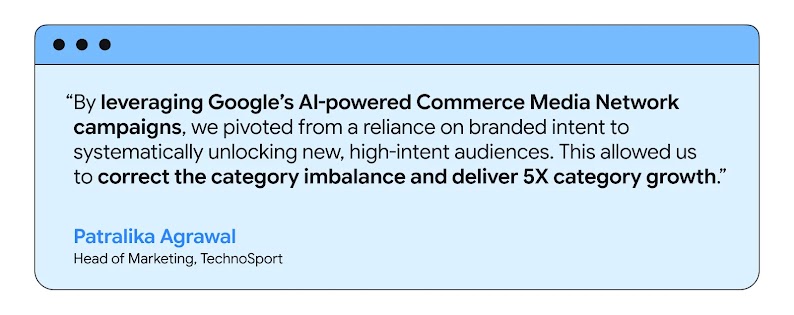
By optimising your platform’s promotion and media budgets, you can help merchants grow sales volumes without impacting their margins. And as merchants buy more of your onsite retail media ads to sustain their higher sales, your growth and ROI will compound together.
Step 3. Drive incremental traffic and acquire users
Having optimised your promotion and ads budgets, accelerate your growth loop by winning new users.
Reach beyond your platform to drive incremental traffic and returns. Blinkit, for example, partnered with Google to bring Performance Max for Marketplaces to its merchants. The solution helped Renée Cosmetics boost incremental sales on Blinkit by 11.5% and lower cost per order by 48%.
Additionally, acquire users for your merchants via retail media ads. That can unlock a lucrative revenue stream for your platform. BCG found in 2025 that media margins can exceed 65% for retailers that scale their offerings.
Step 4. Grow incremental high-value conversions
To truly sustain profitable growth, you’ll need to build your brand and grow incremental conversions with high-quality users. Engage them continuously with tailored ads and discounts that drive brand affinity and repeat orders, so your promotion efficiency stays optimised.
Investing to boost customer retention and net order value is already paying off for Eternal, which reported in July 2026 that one customer cohort is spending nearly 3X compared to three years ago. “If customers are staying and spending more despite aggressive pricing from competitors, the business is working,” Eternal CFO Akshant Goyal said in the latest annual shareholders’ letter.
Looking ahead, India’s commerce marketers will be even more laser-focused on increasing long-term ROI. For the astute ones embracing the four-step flywheel for promotion efficiency and profitable growth, that prize is well within reach.

Explore more in this series on promotion efficiency
Contributors: Divyashree, Industry Head - Platforms & Commerce, Google India; Anuj Gupta, Account Executive, Large Customer Sales, Google India; Ritika Mahajan, Account Executive, Google India; Shipra Mehandru, Research Manager, Google Ads, APAC CMI


Social Module
Share