





 Sign in with Google
 Businesses often face the challenge of balancing profitability with growth. New research findings on marketing promotion strategy, however, flip that balance scale for good.

Profitability has always been important to businesses. In recent times, it has become a top priority because it drives total shareholder return.
The pursuit of profitability, however, is often thought to mean trade-offs in growth. When businesses spend on marketing promotions like discounts and vouchers to drive customer growth, it impacts returns.
But BCG’s research on marketing promotion strategy shows businesses don’t have to trade growth for profitability. They can achieve both by boosting critical promotions with advertising.
The marketing promotion strategy for driving profitable growth
A recent BCG analysis for Google on e-commerce and delivery platforms shows that these businesses can focus on incremental ebitda per promotion spend to help them home in on unlocking profitable growth.
The metric is a marker of promotion efficiency. It measures how much profit one makes for every dollar spent on promotions. The higher the incremental ebitda per promotion spend, the higher the profitability.
BCG’s analysis shows that in Southeast Asia (SEA), the incremental ebitda per promotion spend for platform businesses has the potential to be between 3.2X and 5.5X higher.1
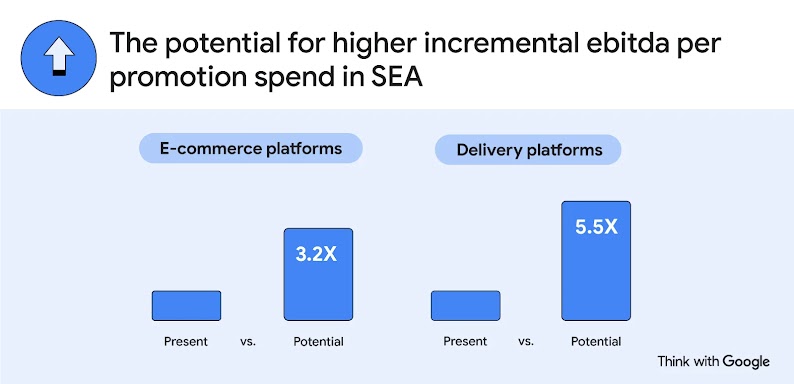
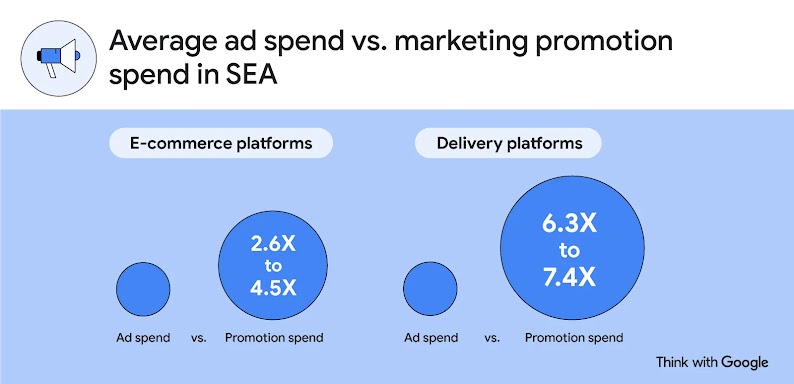
The potential can be readily unlocked because in SEA, marketing promotion spend is disproportionate to ad spend in both e-commerce and delivery platform businesses.
For e–commerce businesses, marketing promotion spend can be up to 4.5X higher than ad spend. As for delivery platform businesses, the difference can be up to 7.4X.2
So, here’s how SEA platform businesses can drive profitable growth by improving their marketing promotion strategy:
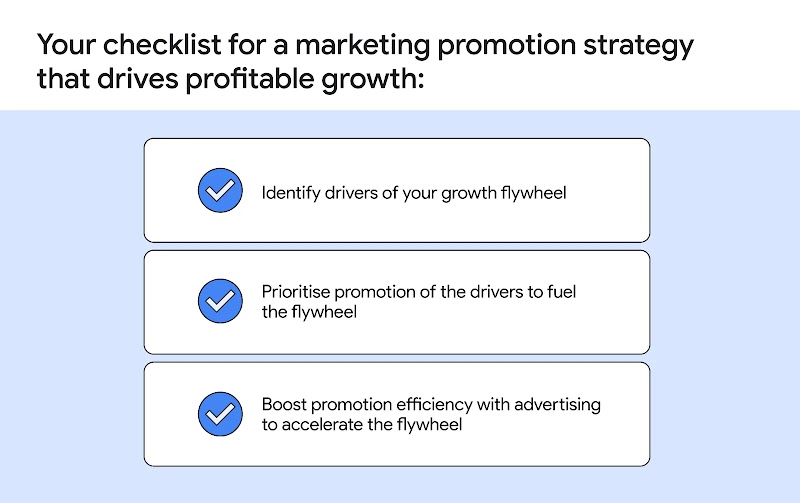
- Consider the balance and marketing budget allocation between promotion and ad spend;
- Focus marketing promotion on parts of the business that have a flywheel effect on driving profitable growth; and
- Boost business-strategic promotions with advertising to accelerate the flywheel.
That approach has helped top platforms improve their promotion efficiency, optimise incremental ebitda per promotion spend, and raise profitable growth.
One such success story is Mercado Libre, the leading e-commerce platform in Latin America.
E-commerce case study: How Mercado Libre drives profitable growth with promotional advertising
In the last four years, Mercado Libre has achieved significant growth and profitability.
Its financial reports show that the company’s gross merchandise value (GMV) grew at a compound annual growth rate (CAGR) of 22% from 2021 to 2024, exceeding the market average of 14%.3
Additionally, its adjusted ebitda grew at a CAGR of 38% during the same period. And its adjusted ebitda margin as a percentage of GMV increased from 2.3% in 2021 to 6.3% in 2024.
A key catalyst of its profitable growth is its marketing promotion strategy.
Mercado Libre knows which components of its business structure have a flywheel effect on profitable growth. One such core component — besides MELI+, its customer loyalty program, and Mercado Pago, its digital payment and financial services platform — is free shipping.
Mercado Libre’s President of Commerce Ariel Szarfsztejn said at its 2025 Q2 earnings conference call: “We have proven over and over since 2017 that offering more free shipping to our buyers has a direct impact in customer satisfaction, in customer retention, in frequency, and that creates long-term value for us.”
A low free shipping threshold strengthens MELI+, which in turn raises traffic and orders. That makes its logistics operation more efficient and lowers its free shipping threshold further.
Given the flywheel effect of free shipping, Mercado Libre runs strategic promotions to lower its free shipping threshold. And with the help of Google, it uses advertising to boost promotion efficiency and accelerate the flywheel.
Watch the video
Mercado Libre uses advertising to boost its promotion of lower free shipping thresholds and accelerate profitable growth.
Google’s measurement capabilities further empower Mercado Libre to optimise its advertising returns for profitability.
Mercado Libre’s success at accelerating its flywheel, by using advertising to boost the promotion efficiency of its core business components, shows that businesses don’t have to trade growth for profitability — they can achieve both.
And in SEA, where platform businesses have a higher promotion spend than ad spend, there’s a significant opportunity to improve promotion efficiency with advertising, and accelerate profitable growth.


Social Module
Share