





 Sign in with Google
 Since 2014, Jarno Duurstra has analysed the development of AI and translated its implications for business, government, and society. Duurstra has given 1,500+ keynotes on the topic and is a LinkedIn AI Top Voice. Most recently, he was keynote speaker at Google’s Onshore VIP Track event, discussing the future of business in the age of AI.
Not so long ago, digital marketing was defined by scarcity.
Launching a campaign required months of brainstorming to come up with that one perfect idea. Focus groups would dissect every word, production budgets were carefully rationed, and execution unfolded across long, rigid timelines. All to land one monolithic campaign on launch day.
Today, generative AI has turned that dynamic on its head, evolving into an infinite idea machine.
To see what this shift looks like in practice, consider a personal example. Every evening, an automated workflow I built scrapes 40 distinct AI research feeds, reads through roughly 400 pages of technical documentation, synthesises the core developments, and delivers a contextualised briefing to my inbox before I wake up. The processing cost is near zero, and the execution is autonomous.
And I am not an outlier.
Across Europe, marketing teams are building similar capabilities into their daily operations. They are using multimodal models like Gemini to draft copy, Gemini Notebook to synthesise market research, and Nano Banana to generate on-brand visuals in minutes.
The new baseline: AI as a basic skill
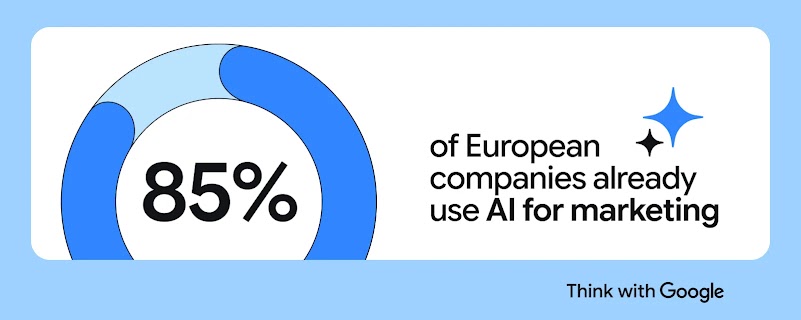
According toIAB Europe’s Impact of AI on Digital Advertising Report, 85% of companies across Europe already use AI tools for marketing, with nearly three-quarters running campaigns actively powered by AI.
This shift marks an unprecedented leap forward in operational efficiency. But it also presents a new skills gap.
As directing a language model becomes a basic marketing skill — on par with using a spreadsheet or an analytics dashboard — the core skillset required to succeed shifts.
It is no longer: “How much content can your team create?”
It is: “Can your team make choices that make your brand genuinely distinctive?”
To answer that question, leaders need to think about their teams in a whole new way.
The framework: 4 essential human marketing skills
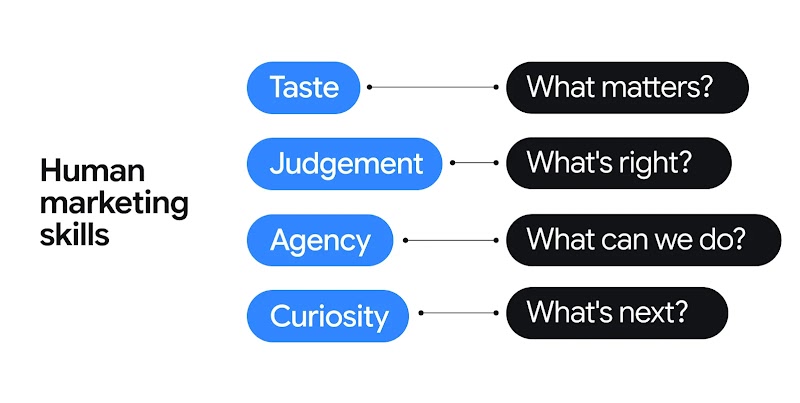
To build a resilient, high-performing organisation in the agentic era, businesses must actively recruit for, train, and reward four non-automatable human capabilities:
1. Taste — the intuitive filter
Taste is the intuitive sense of how a brand should look, feel, and sound. It is the ability to recognise whether an idea will truly resonate with an audience.
A large language model can generate numerous grammatically flawless campaign headlines in seconds. But it cannot feel brand identity. Taste is what allows a creative director to spot the single option that carries authentic character and emotional truth, rejecting the variants that feel synthetic.
Imagine launching an artisanal zero-sugar botanical soft drink in The Netherlands. Generative tools will instantly spit out clichés like “Nature’s Purest Refreshment” or “Guilt-Free Fizz”, but human taste is what says: “Let’s lead with a dry, self-deprecating tagline about how terrible most wellness drinks actually taste.”
AI produces choices; human taste determines which choice matters.
2. Judgement — the critical evaluator
Judgement is the capability to critically audit output, validate facts, verify brand safety, and ensure ethical compliance.
With the rollout of the EU AI Act setting enforceable benchmarks for transparency, copyright, and synthetic content, European marketers face a far stricter regulatory reality than their peers in Silicon Valley. “The AI wrote it” is not a legal defence when an unverified claim blows up on social media.
Let’s go back to our soda example. AI might generate hyper-realistic imagery of your drink next to fresh botanicals along with persuasive claims about “cognitive clarity”, but human judgement is the brake that asks: “Does this breach European food safety health-claim regulations?”
AI generates content; human judgement defines what is true, safe, and right.
3. Agency — the bias for action
Agency is the willingness to take bold initiative, challenge legacy processes, and experiment independently.
With natural language serving as the new interface for software, marketers equipped with high agency don’t have to wait for rigid IT cycles or software updates. They build custom prompt workflows, test agentic pipelines, and prototype new customer experiences in real time.
In our drinks launch a low-agency team waits for a three-month media plan before testing sentiment. Meanwhile, a marketer with high agency builds an autonomous pipeline to scrape reviews across Amsterdam, Belgium, and London, clustering consumer feedback to pitch a reactive ad concept by lunchtime.
Agency is the line that separates a passive tool-operator from a transformational marketer.
4. Curiosity — the exploration engine
Curiosity is the relentless drive to explore emerging tech, evolving media formats, and shifting audience expectations.
Instead of sticking to standard social carousels, a curious team marketing our soft drink asks: “How can we tap into AI-assisted search summaries when people search “low-sugar craft drinks”, and can we use real-time weather agents to adapt our out of home digital screens when temperatures go above 25°C?”
Marketers who stay intensely curious will spot structural market shifts long before they become industry consensus.
The CMO playbook: How to apply this framework
To transition your marketing organisation from content production to meaningful creation, consider this simple leadership audit:
- Audit your talent profile: Shift hiring criteria away from purely mechanical execution skills (e.g. speed of drafting, basic copywriting volume) towards candidates who demonstrate strong domain expertise, editorial taste, and a track record of initiative.
- Re-anchor the creative process: Require teams to present the rationale behind their AI selections. When reviewing campaign concepts, ask: “Why did we choose this specific variant out of the 50 the system generated?”
- Incentivise safe experimentation: Give team members dedicated space to build and test custom agentic workflows for routine tasks, freeing up cognitive budget for high-level strategy and creative direction.
The role of the modern marketing leader is not to flood digital channels with automated output. In an era of infinite ideas, raw volume simply creates noise.
The true mandate of modern leadership is to create meaning.
By delegating routine execution to AI systems, we liberate human minds to draw on intuition, empathy, domain expertise, and cultural awareness. That is how we navigate past algorithmic mediocrity — and build brand experiences that forge genuine, lasting connections with real people.
Social Module
Share