


 Sign in with Google
The ultimate combo: How Domino’s drove 40% more reach with its media consolidation

Domino’s Pizza U.K. & Ireland’s Senior Media Manager Lewis Kimber leads the brand’s media strategy, finding new ways to maximise reach, improve effectiveness, and make its media investment work harder.
My job at Domino’s is forever trying to make more people crave that Pepperoni Passion, which means I spend a lot of time thinking about how we show up, who we reach, and, crucially, whether the money we spend actually works.
And, lately, one challenge has been taking up more of that thinking time: media fragmentation. As audiences spread across more platforms and screens, reaching people at scale is getting harder, and controlling how often we reach them is harder still.
So, together with Havas Media and Google, we set out to gain greater control over reach and efficiency — and make our ad spend go further.
Fragmentation was creating a frequency problem
At Domino’s, we’re always looking for ways to improve performance. But as viewing habits change, doing that effectively is becoming more complex.
Our audiences are increasingly switching between touchpoints, from linear TV and YouTube to streaming services and other digital channels. The challenge isn’t simply how to reach them all. It’s how to do it without repeatedly reaching the same people, and wasting valuable media investment in the process.
So we dug into the data.
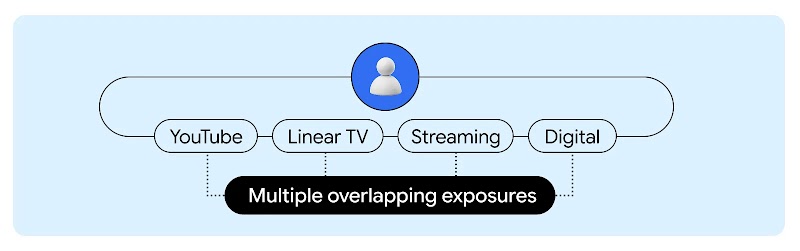
With BeatGrid, we looked at cross-channel exposure and found something that really stuck with us: brand lift plateaued after a campaign frequency of four. Put more simply, once someone had seen a Domino’s ad four times, additional exposures were no longer really moving the needle.
Yet fragmentation meant some audiences were being exposed considerably more often than that, while missing others altogether. And that presented an opportunity.
If further impressions weren’t driving further impact, we needed to stop spending on the people we’d reached enough times — and redirect that investment towards those we hadn’t reached at all yet.
Getting the channels to work stronger together
We were already using Display & Video 360 (DV360) for media buying, so rather than reinventing our strategy, we evolved an ecosystem we already trusted.
We trialled bringing YouTube together with inventory from other big streaming platforms in a unified DV360 buy. This gave us a way to manage frequency at a user level across those channels, rather than treating every platform as a separate media plan.
It also meant working differently behind the scenes.
Our YouTube and subscription video on demand (SVOD) had historically been bought by separate agency teams. For the first time, those teams came together around shared principles for awareness, reach and frequency — all laddering up to the same Domino’s business goals.
As our agency partner Chris Clarke, programmatic business director at Havas Media, put it: “As audiences become increasingly fragmented, the future of media planning won’t be about buying more channels, it will be about connecting them more intelligently. The opportunity comes when we stop thinking in terms of individual platforms and start focusing on the total consumer journey.”
And that’s exactly the shift we made: from thinking about how each channel performed independently to the role each could play in reaching our total audience.
From there, we built a measurement approach that looked at performance through multiple lenses. Alongside DV360’s real-time view of unique reach and frequency, BeatGrid measured cross-channel overlap, and our MMM provider Ebiquity provided independent verification of ROI.
Then, we set a rule: once a user reached our advertising frequency cap of four, DV360 could stop bidding to reach them again and redirect that investment towards new audiences.
The ultimate combo: Same budget, 40% more reach
By controlling frequency across our consolidated buy, 30% of our total investment was diverted away from media wastage and could instead be reinvested into new reach. And, crucially, by shifting to this approach, we delivered 40% additional reach from the same original investment.
Third-party measurement gave us further confidence in the approach. BeatGrid’s results came within 0.01% of DV360’s, while channel overlap was just 2.4% — meaning each channel was largely adding incremental reach rather than duplicating audiences.
Turn fragmentation into opportunity
Fragmentation isn’t going away. If anything, people will have even more choice over where and how they consume content. But for marketers, there’s a real opportunity to address that complexity. By unifying media buying across channels such as YouTube and SVOD, we can build more effective media plans that drive both reach and effectiveness.
And for this campaign, being able to get that Pepperoni Passion (or whatever your topping of choice) to 40% more people, for the same cost? Now that’s an ultimate combo we’re proud to have delivered — and excited to build on.
Social Module
Share