





 Sign in with Google
Virginie Faggin and Flora Buchanan lead Booking.com’s global growth marketing efforts and performance creatives. They help the brand achieve its core mission: to make it easier for everyone to experience the world.
Imagine a global campaign that can speak to every audience, in their language, with pinpoint accuracy. That isn’t easy to achieve, even for a global brand like Booking.com.
A campaign that works in every market comes with a unique set of challenges, especially in marketing. After all, how can we truly personalise experiences at scale, overcoming language barriers and cultural nuances efficiently?
That was the core question that sparked our journey into our first end-to-end AI-enabled marketing campaign.
We wanted to see if we could use the technology to amplify our team’s creativity and achieve a level of personalisation previously unimaginable.
Prompting paradise: What makes travellers click
The first step was to move beyond assumptions and delve into data-driven strategies.
As a team, we hadn’t used Google’s AI, Gemini to gather insights before. That’s why we leaned on our partners at Google, to inspire us with new ways to use prompting in our creative research and development process.
The prompts used were designed to understand the nuanced needs of our core audiences — families, couples, and groups of friends — in four key categories:
- Drivers and motivators: This aimed to understand what truly drives each group’s travel decisions. For example, we explored the idea that groups might be primarily seeking an activity-based escape, a motivation quite distinct from the needs of a family.
- Stereotypes vs. truths: This was to challenge any preconceived notions about each audience. A significant insight here was that while there’s a stereotype of friends travelling with aligned budgets, the reality is often diverse financial situations, leading to potential stress in planning.
- Audience relationships to Booking.com’s benefits: This focused on connecting our unique selling points (USPs) and benefits to the specific needs of each group. Although not a new thing for us to explore as a brand, we always want to show how our offerings could directly address our customers’ pain points and desires.
- Fresh take on characters: Again, something we continually look at, thinking differently about how we portray travellers, and “embracing imperfections”. We recognised that travel isn’t always perfect and that relatable, human moments can create stronger connections. For example, one such prompt could have been:
This AI-enabled approach allowed us to identify key emotional drivers. We could then tailor the campaign’s core concepts to resonate with distinct audience segments quickly and efficiently.
From 1 to 40: Localisation at scale for global adventures
These prompts yielded new insights that formed the foundation of our campaign’s creativity. For instance, the “Stereotypes vs. truths” prompt directly inspired the video of the “group chat hero"; finding a great deal to solve the common problem of budget misalignment among friends:
Watch the video
Similarly, the “Fresh take on characters” prompt led to the creation of videos featuring relatable, imperfect scenarios. For example, momentarily forgetting you have a pet or a kid when booking a trip. This makes the campaign feel more authentic and human:
Watch the video
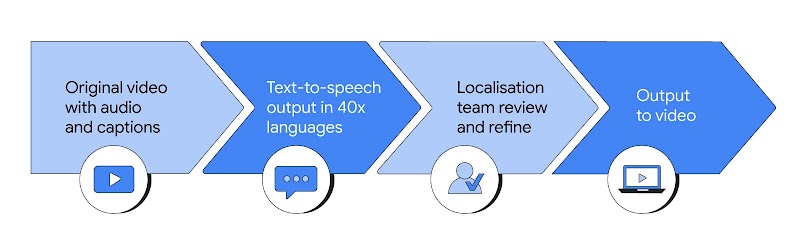
Once we had our core assets, the next challenge was to rapidly localise and scale our output. By integrating Google Cloud’s text-to-speech AI capabilities into our workflow, we were able to revolutionise our voice-over production.
Previously, we were limited to producing voice-overs in only a handful of priority languages due to time and cost constraints. AI shattered these limitations.
The impact on our production speed and costs has been significant. We can now generate high-quality voice-overs across over 40 languages — a 7X increase compared to previous campaigns — all without incurring additional costs.
This freed up time and resources. Our localisation teams simply had to review and refine the voice-overs to ensure linguistic accuracy and cultural appropriateness.
AI as a compass: Delivering the right trip to the right explorer
The sheer volume of assets we could now produce — over 600 different variations, including different dimensions and localisations — presented an exciting opportunity for optimising our ad delivery.
We used Demand Gen and App Campaigns, entrusting their algorithms to serve the right message to the right audience at the right time. By uploading a diverse range of assets, encompassing different concepts, ideas, and unique selling points, we empowered the AI to learn and adapt in real-time.
We consciously allowed the algorithm to decide which ads resonated best with which specific user segments, without imposing strict targeting restrictions. This hands-off approach yielded positive results, driving new app installs and engagement.
An AI adventure: Learnings for fellow marketing explorers
By monitoring the performance data provided by the AI tools, the team were able to refine our ad creatives. Continuously improving the campaign’s performance.
One significant improvement was in our ABCD framework scores. We assessed our videos on how many of the ABCD best practices they met. Looking at our creatives before this project, our average ABCD scores were between 50-70%. This leapt to around 90% after, indicating stronger creatives, with clearer calls to action.
Reflecting on this journey, the most significant outcome has been a fundamental shift towards an even more personalised customer-centric approach. AI has empowered us to speed the scale of our global localised video output.
AI is a powerful tool, but it’s the human understanding of customer needs that truly drives impactful and successful campaigns.
We’ve embraced AI throughout this project, but we recognise that we’re still in the early stages of its potential. The rapid evolution of AI tools, like the advancements in Gemini, suggest that the possibilities for future campaigns are even more exciting.
For instance, instead of focusing on a limited number of core audience segments, we could use AI to identify hundreds — even thousands — of hyper-specific micro-segments.
For other marketers considering integrating AI into their campaigns, our advice is simple: test, learn fast, and be open to failure.
Most importantly, always keep your customers at the heart of your efforts. AI is a powerful tool, but it’s the human understanding of customer needs that truly drives impactful and successful campaigns.


Social Module
Share