





 Sign in with Google
Ashwin Naiksatam is a senior digital marketing manager at Lenovo EMEA, where he leads paid and organic media and online marketing strategy. He focuses on using data-driven insight, creativity, and smart optimisation to drive sustainable growth and acquisition at scale.
In digital marketing, established control — through strong brand guidelines, precise keyword strategies, and manual bidding — is what builds a solid foundation. Marketers stick to these strategies because they’re erring on the side of caution, rather than innovating. But for those chasing the next phase of growth, that foundation isn’t the destination, it’s the launchpad.
Last year it became clear that our performance at Lenovo EMEA was strong and reliable, but no longer accelerating. We had optimised what we could within a highly-controlled setup. But to move beyond this plateau, we needed a new way to scale without sacrificing quality or brand integrity.
So, we made a deliberate decision to loosen our grip on manual control and let AI take the lead on bidding and creative optimisation. We fully committed to AI Max for Search: a one-click power-up for your Search campaigns that helps you find new customers by understanding what they mean, not just what they type.
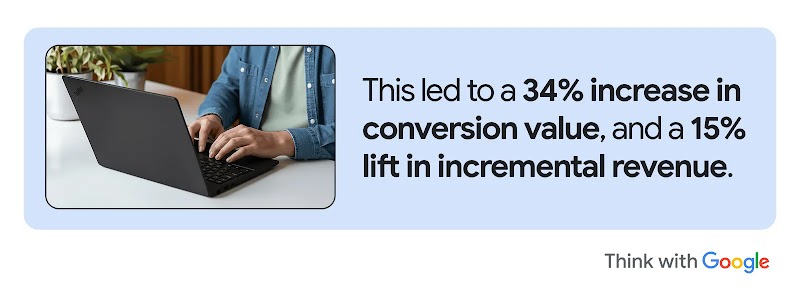
Here’s how embracing change helped us achieve one of our strongest growth margins in years.
Jumping off the plateau
Historically, Lenovo has been very strong on “brand” search, i.e. capturing people who already had us in mind. But that pool is no longer growing fast enough. Increasingly, people are starting with needs, not names. They search for outcomes, comparisons, and use-cases long before choosing a brand, by asking questions like “best laptop for video editing” or “2-in-1 PC for office work”.
That shift matters because it signals demand much earlier in the decision process. This meant if we wanted to achieve incremental growth, we couldn’t stay brand-heavy — we needed to rebalance our investment, with a significant shift towards non-brand search.
To do that at scale, we needed more than insight. To unlock high-value non-brand demand, we had to pair our deep strategic understanding of our customers with the speed and reach of AI, so we could show up in the moments when intent was forming — not after it had already solidified.
The AI confidence litmus test
For any established brand, introducing more automation raises a natural question: ‘how do you scale with AI without compromising control?’
For us, the answer was clarity and guardrails.
We focused on two non-negotiables from day one: a seamless customer journey and strict tone-of-voice consistency. In close collaboration with Google and our global agency partner, Assembly, we put clear frameworks in place to guide how AI could operate, from routing users to the right pages to making sure every message stayed true to our brand standards.
With those foundations set, AI Max for Search was able to operate at speed and scale whilst staying firmly within our parameters. It met our compliance and quality expectations, and also uncovered richer audience signals and intent patterns that would have been difficult to identify manually.
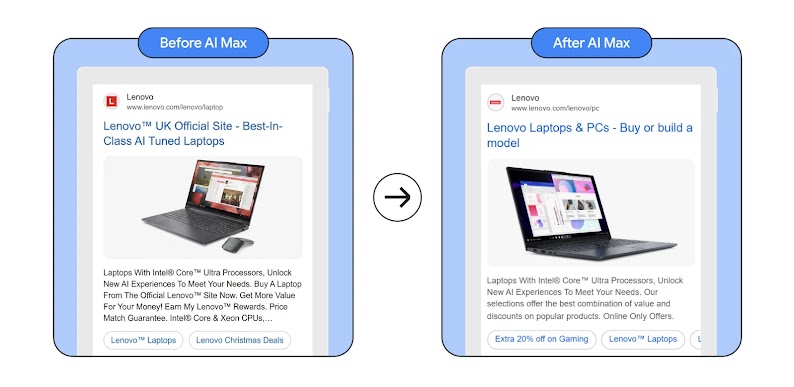
Examples of this included specific brand model names, and products with specific computer spec characteristics — such as ‘Lenovo SoDIMM RAM’, ‘Lenovo Rapid Charge’ and ‘Lenovo 1 TB laptop’.
The AI also helped us uncover a sizable boost in search terms including brand-related questions, such as ‘best deals on Lenovo laptops’, ‘what’s the best Lenovo laptop?’, ‘where to buy genuine Lenovo batteries’.
Rather than losing control, we gained confidence and a deeper understanding of how customers were discovering and choosing Lenovo.
The soft(ware) launch
Assembly rolled out AI Max for Search on our Broad Match campaigns, and powered it with Smart Bidding, text customisation and final URL expansion to create highly relevant ads with customised headlines for better performance. This meant the system could dynamically match users to the most relevant landing page, based on intent.
Previously, our ads were pretty static, tending towards generic queries that often led to generic landing page destinations. With the new setup, Search behaviour directly shaped the experience. Product-specific queries led to product pages, and deal-led searches triggered value-focused messaging and relevant promotional pages.
The rollout was deliberately phased to prove performance. When the U.K. trial proved successful, we kept it live and started to replicate it in key markets such as Germany, Italy, Ireland and the Netherlands.
The computing behind the approach
We validated the approach through a strict A/B test for the UK market. “State A” was our traditional, highly controlled setup, “State B” was driven by AI.
Just 14 days into the test, we knew we were on to something. Alongside improved ROAS (return on ad spend) — even while competing in more expensive, non-brand auctions — the performance gap was clear.
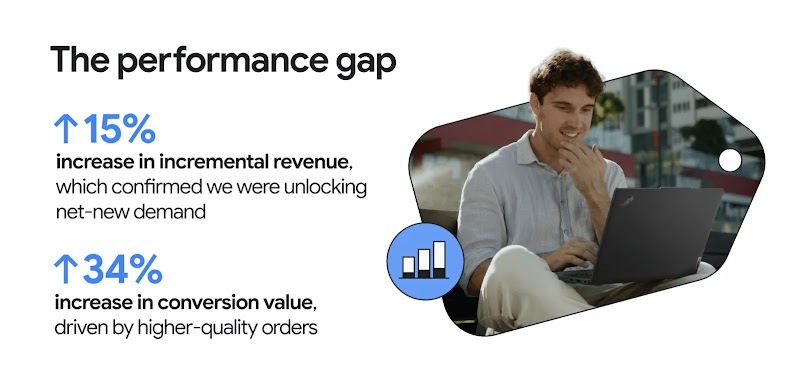
Lenovo EMEA became the in-house champion for AI-led Search transformation globally. What began as a regional test is now informing global adoption, with teams in North America and APAC preparing to scale the approach.
Adding a layer of success
As an established leader in the Search AI optimisation space, Assembly already had successful Performance Max and Demand Gen campaigns running for Lenovo. By adding AI Max for Search to our Google ‘power pack’, they unlocked huge new growth opportunities.
“Our test of Google’s new AI Max for Search product has delivered outstanding results, driven measurable performance improvements and unlocked new growth opportunities. To build on this success, we’ve now scaled the rollout so these benefits can be realised across our accounts and markets,” said Erdem Kosukoglu, search business director for Assembly Europe.
The operational shift
Collaboratively, we established the AI Max for Search test setup, to make sure we could leverage Assembly’s expertise and learn fast. Here’s how it went:
Automation: AI Max streamlined and perfected existing manual processes like Search Query Report (SQR) mining, bulk copy updates, and bid adjustments.
Efficiency: Real-time AI matching freed up 10–40% of operational time.
Reinvestment: Saved capacity was shifted to higher-value work: strategic planning, journey design, and market opportunity analysis.
The outcome: Higher revenue, operational efficiency, and a partnership laser-focused on commercial outcomes.
Ctrl, no Alt + Delete
If you’re hesitant about giving up manual oversight, my advice is to reframe the question. This isn’t about losing something. It’s about deciding where your human expertise adds the most value.
The future of Search marketing is defined by how well you translate business goals, data, and creative intent into signals that AI can act on — not just how well you can manually tweak a keyword list.
We’re now investing more confidently in upper-funnel activity, knowing our Search operation can recognise and capture demand the moment it emerges.
If you’re sitting on the fence about giving up manual control, set clear guardrails, trust your partners, and let AI handle the complexity at scale. As we learnt here, control doesn’t disappear, it moves. Human judgement shifts from execution to direction, and from optimisation to intent-setting.
That’s where the real opportunity lies.
Growth doesn’t come from holding tighter control, it comes from knowing when to let go.
Social Module
Share