



 Sign in with Google
 Kamilė Račiūtė and Lukas Padriezas expand the global footprint of cybersecurity provider Surfshark across more than 100 markets. Račiūtė leads the app marketing and PPC teams, managing high-budget international campaigns. Padriezas is a digital marketing architect with 10 years of experience and specialises in scaling operations across diverse markets.

One common myth in digital privacy is that all users searching for solutions like a VPN share the same intent. As a global cybersecurity brand, we know that the reality is far more nuanced. Someone might need online privacy, another wants to secure their data on public Wi-Fi, and a third is trying to access home services while travelling.
At the same time, market competition has tightened as security companies move from standalone tools to comprehensive suites. As a result, more providers are competing for the same core user needs, whether that’s a safe network, scam protection, or digital anonymity.
To capture this broad range of user demands in a crowded landscape, our legacy strategy at Surfshark, a Lithuanian cybersecurity provider, attempted to control search queries and costs at a granular level. We relied on a hyper-segmented structure split by device, location, language, and match type. This resulted in over 5,000 manual campaigns that overwhelmed both our systems and our team. It was clear we had to make a change.
Consolidating 5,000 campaigns into fewer than 50
To break through our performance plateau, we had to modernise our approach.
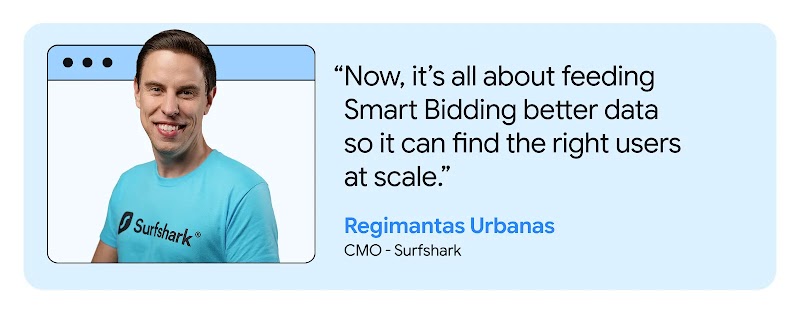
“In the past, we could compete on who was better at building complex campaign structures,” Surfshark CMO Regimantas Urbanas explains. “Now, it’s all about feeding Smart Bidding better data so it can find the right users at scale.”
We embarked on a 6-month transition to consolidate our 5,000 campaigns down to fewer than 50. To prevent performance volatility and cost spikes, we tested four account structures across both high- and low-volume markets:
- Granular reduction: A 150-campaign setup split by country, match type, and device.
- Pure broad match: A fully automated approach built on broad match keywords.
- Match-type segmentation: Dividing campaigns so each country had two or three dedicated setups based on match type.
- A hybrid model: A consolidated structure combining broad match and exact match keywords.
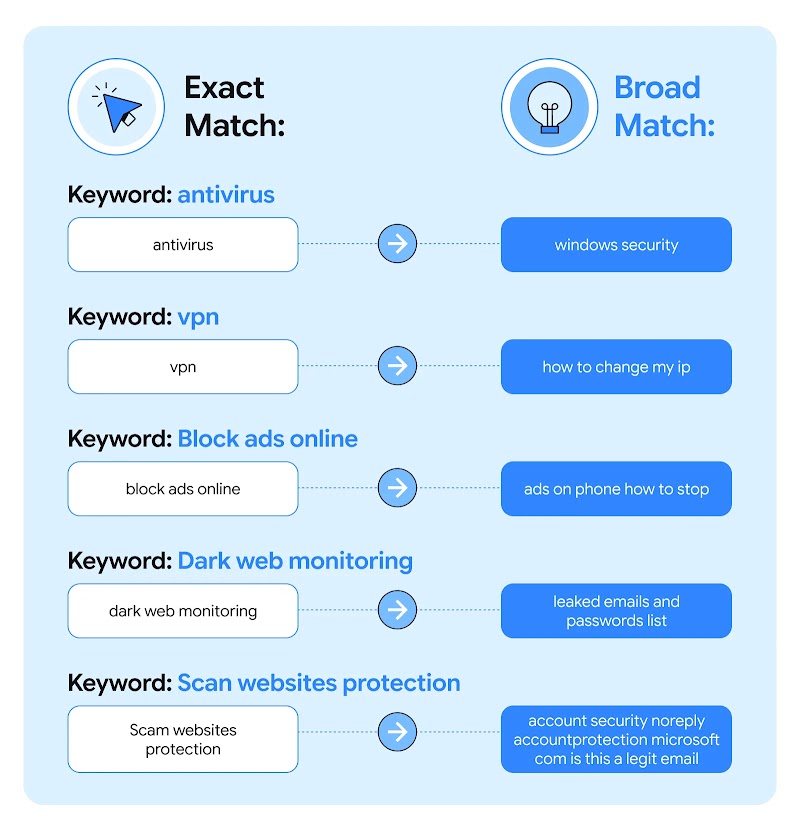
We discovered that broad match is the ultimate growth engine. It captures high conversion volumes by understanding complex, diverse user intent that we couldn’t predict manually. Meanwhile, anchoring our structure with exact match provided immediate efficiency.
Doubling search revenue through a hybrid strategy
The hybrid setup gives us the best of both worlds: automation when we need scale, and hands-on control when speed matters. In an industry where a sudden government decision or major sports event can spark massive search surges within hours, our hybrid setup gives us the flexibility to manually push campaigns when we need to react instantly.
This balance of human control and AI efficiency reflects a broader industry shift.
“With the emergence of AI, competitors are moving toward Smart Bidding and broad match as opposed to doing complex account structuring,” Urbanas says. “Nowadays, it’s all about giving the cleanest, easiest-to-understand data to Google AI so it can make sense of how to reach potential users best.”
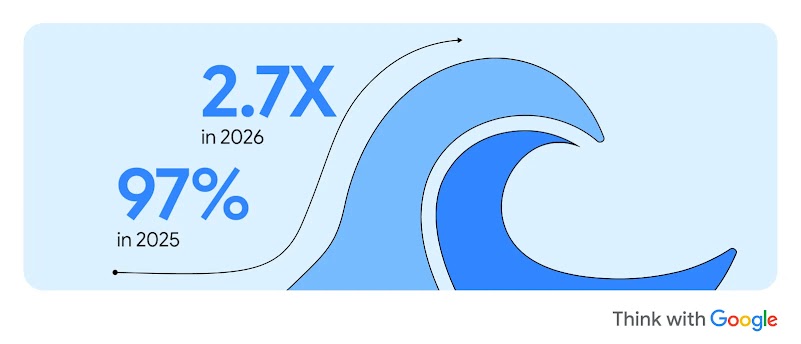
By balancing exact match and broad match within a simplified setup, our team nearly doubled our Google Search Ads revenue in 2025 and further accelerated growth by 2.7X in 2026.
Consolidating our campaigns empowered markets outside of our core audience in the U.S, like Germany, the Netherlands, and Spain to perform better because we finally had enough data to provide for Smart Bidding to optimise effectively.
But the most surprising outcome was what we call the “halo effect”. After migrating to this modern broad match approach, we saw a 15% boost in sales completed through our other digital channels too. The new structure drove growth beyond direct clicks, proving that letting go of excessive control points — in favour of a few exact, high-impact control points — lifts our entire marketing performance.
Moving from constant control to need-based intervention
It’s common for PPC specialists to want to control every single variable, but we learned that having control doesn’t necessarily translate into growth. In fact, it is often the very bottleneck holding your brand back and consuming critical resources.
To maintain our old structure today, we would need a 20-person team. This is why today, whenever our team asks, “What if we need to control X or Y?” our answer is simple: “When that need actually arises, we’ll figure out how to address it.”
Having control doesn’t necessarily translate into growth. It is often the very bottleneck holding your brand back and consuming critical resources.
Campaign consolidation didn’t just save our team time — it finally gave us enough data to run meaningful tests. Back when we managed 5,000 separate campaigns, testing anything was impossible because the data was too scattered to give clear answers. Today, our team focuses on big-picture strategy rather than daily account maintenance. Instead of spending hours manually tweaking bids, our job is to feed Smart Bidding the right data to attract users.
This shift proved critical as we expanded beyond traditional VPNs into newer areas, like scam protection. Unlike VPNs, where people actively search for a specific product, most users facing scams assume they can spot digital threats on their own. Because they aren’t searching for software solutions, we can’t just wait for them to type in a search query.
Instead of spending hours manually tweaking bids, our job is to feed Smart Bidding the right data to attract users.
Automating our campaign management frees up our team to focus on reaching users early. We can show them why common sense isn’t enough and pro-actively guide them towards relevant solutions.