





 Sign in with Google
 Evaldas Balčius leads the digital performance and growth strategies at Lithuanian digital media house Mediatech, where he specialises in transforming complex data into actionable business solutions. Kamilė Šniukštaitė oversees PPC campaigns development and execution.

When your product is innovative, the growth ceiling doesn’t come from reaching all potential customers, it comes from continuously messaging the same audience that already knows your product.
In our wellness division at Mediatech, we realised our primary challenge wasn’t a lack of interest, but a lack of awareness.
It was clear that we hadn’t yet exhausted the potential customer base in our core markets: the U.S., U.K., Canada, and Australia. We were struggling to reach those who were either unaware our solutions existed, or didn’t understand how they could help improve their wellbeing.
The initial test: Diversifying creative messaging angles
Our first instinct was to leverage our campaigns within Performance Max (PMax) as a testing ground for messaging. We relied on PMax’s AI-driven capability to serve ads across all Google channels, hoping to identify which creative angle would break our growth ceiling. To do this, we built multiple asset groups in Google Ads anchored to our proven, high-intent audience signals.
We tested three distinct messaging hooks:
- The first focused on how our products outperform competitors with headlines, like “Compare Top Health Trackers” or “Why Our Smart Scale is More Accurate”.
- The second highlighted technical specifications, such as “Track 15+ Body Metrics”.
- The final hook focused on long-term benefits, like “Achieve Your Wellness Goals”.
However, we soon realised that creative-led testing alone wasn’t enough to move the needle. We were still speaking to the same narrow pool of high-intent users, leaving a massive segment of potential customers untapped.
To scale, we had to stop changing the “what” and start expanding the “who”.
The next phase: Empowering AI to navigate the full customer journey
The insight was clear: to scale, we had to stop changing the “what” and start expanding the “who”. We rebranded our approach as the “Search-intent segmentation” framework.
We moved from organising our PMax assets by creative angles to structuring them by user motivation and intent. This shift allowed us to leverage AI to expand our reach, capturing both high-intent buyers and those in the discovery phase through two distinct categories:
- High-intent product themes: These closely matched the keywords already driving conversions in our established Search campaigns. By using clusters like “best laser hair cap” or “red light for hair”, we ensured we captured existing, bottom-of-the-funnel demand.
- Discovery and incremental layer themes: This category served as our growth catalyst. We introduced broader themes designed to capture demand before a user actively searches for a specific product.
“For example, while we offer red light therapy, many potential customers don’t know it can help with hair loss,” Kamilė Šniukštaitė, PPC Manager at Mediatech, explains.
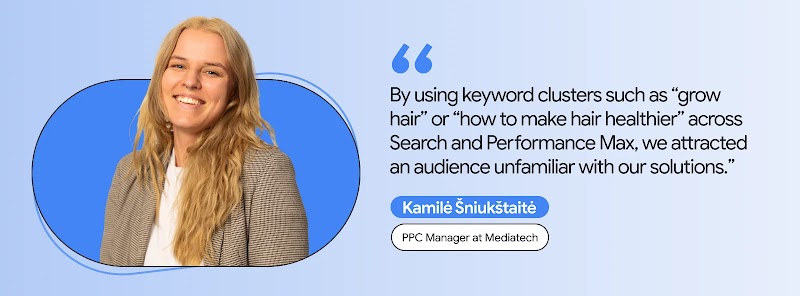
”In other words: by clustering assets around Search Themes, we unlocked neighbouring audiences — users searching for solutions we offer, but who don’t yet know us by name.
By establishing these thematic boundaries, we empowered the AI to navigate the full customer journey. For example, if the algorithm detected a surge in informational searches like “how to fix thinning hair”, it automatically prioritised our lifestyle video assets on YouTube to capture that discovery intent. Conversely, when it identified high-intent signals from users deep in the comparison phase, the AI shifted the bid strategy toward Search and Shopping. This approach ensured that our push for scale did not dilute the efficiency of our core performance.
Creative execution: Aligning assets with intent
To ensure the new structure succeeded, we adhered to Google’s creative best practices, emphasising asset quality, diversity, and a focus on people. We built every asset group in our Google Ads account to achieve an “Excellent” Ad Strength rating by using all 20 available image slots within PMax and incorporating all relevant supporting assets — additional pieces of information that expand the ad — such as sitelinks and price extensions.
We also tailored the creative execution to match the intent of each audience segment:
- High-intent assets: For these ad groups, we used direct, action-oriented descriptions and clear product shots showcasing specific device features to drive immediate conversion.
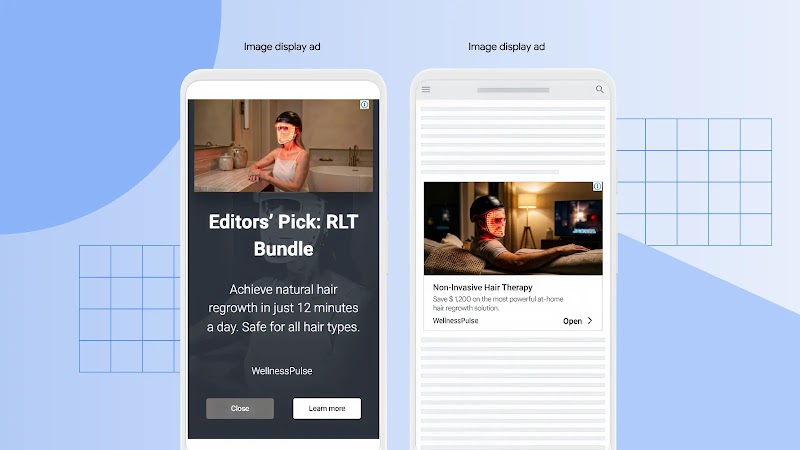
- Broader intent assets: For the discovery layer, we pivoted to educational and solution-oriented descriptions. The imagery shifted to lifestyle content — featuring people engaging with health apps, exercising, or checking their progress.
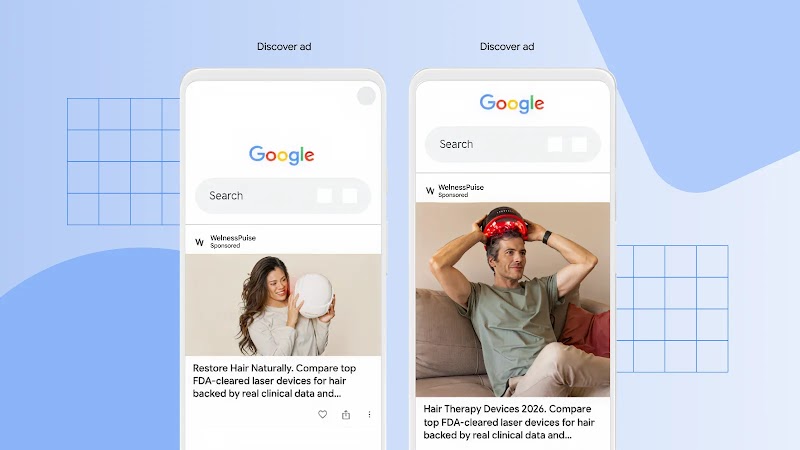
The results validated our strategy, delivering a 2.2X increase in total sales revenue. Within PMax alone, conversion value — representing actual purchases — increased 4.2X, while ROAS efficiency grew by 23%.
This proved that an AI-driven environment, intent-based structure must precede creative execution to unlock true incrementality.
We are now looking to apply this framework to other categories where the product requires education prior to purchase, such as our solutions for reducing anxiety and improving sleep. For these types of products, there is a clear distinction between “I want it” queries and “I am looking for a solution” queries. Our approach ensures we capture both, meeting the user exactly where they are in their journey.


Social Module
Share