





 Sign in with Google

It is both the best and worst of times to be a brand builder.
It’s never been faster or more affordable to create content: GenAI has triggered a 20-50% decrease in production and third party costs. Yet as a result, there’s been a massive influx of creative output and competition. Brands that previously counted themselves out of the online video race are now in a position to actively challenge established industry leaders.
Which is compounded by the fact that the sector has never had so much access to the theory of marketing — the likes of Mark Ritson and Les Binet have driven a veritable renaissance in rigour. This has elevated the standard across the board, but also made outthinking the competition an even greater challenge.
To rise to the occasion — and indeed the top — creative quality remains your biggest lever. 60%1 of overall YouTube sales contribution is down to creative, and if you optimise for the platform, you can double your ROI.
Levelling up from meh to masterpiece
Despite YouTube’s reach, 85%2 of advertising across Europe, the Middle East, and Africa doesn’t meet ABCD creative best practice guidelines. Which means that by taking steps to rectify this, and introducing more creative variety, you’ll immediately gain an advantage.
Fortuitously, the latter — i.e. improving creative variety — is simpler than you might think. The advent of YouTube’s AI-powered Video Reach (VRC) and Video View Campaigns (VVC), mean you can now upload a mix of aspect ratios and time lengths to show up as powerfully as possible across every YouTube-compatible surface and device.
Which matters because VRC campaigns that include at least three vertical videos are proven to be more effective at lifting brand awareness.3 You wouldn’t run a landscape out-of-home poster in a vertical bus stop placement. The same logic applies here.
Creative brilliance on YouTube comes from platform fluency — i.e. making creative that feels native to the environment. Here’s how:
- Humour can improve your creative performance by 6.94 percentage points. This is especially true in the U.K. (no surprises there).
- Casual language outperforms formal and over-scripted, which makes sense when you think about the nature of most YouTube content.
- Shoot creator-style, using camera techniques such as extreme close-ups and quick cuts, to hold attention longer and drive an ROI uplift.
To further establish platform fluency, here are two easily deployable advertising tactics:
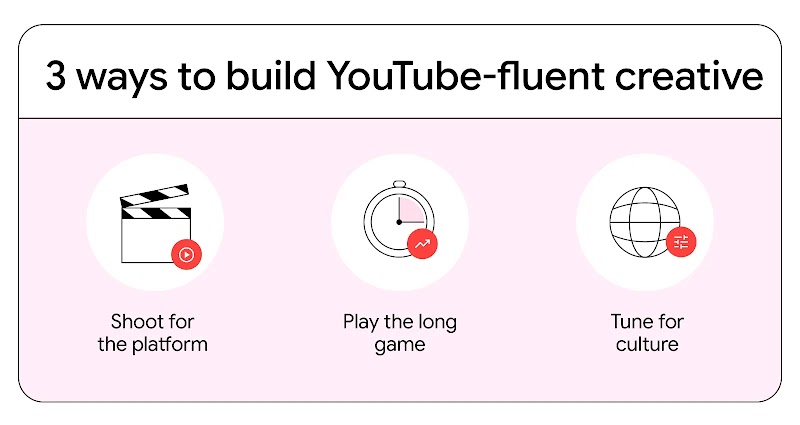
1. Play the long game
Unlike more traditional media, YouTube doesn’t restrict you to 30 or 60-second spot lengths. This means people move fluidly between short- and long-form content, and the most successful brands build campaigns to match that behaviour.
For long-form, our studies show that a 2 to 3 minute video duration delivers the highest consideration lift and cost efficiency.5
2. Tune for culture
The real magic happens when creative and media work together. Tools like Insights Finder allow brands to understand the audience’s specific interests, habits, and need states, which can then be built into creative variations.
Factors you can tailor include:
- Mood and affinity: Build variants to reflect specific audience mindsets — gaming-inspired creative for gaming-interested audiences, for example.
- Time of day and need state: A Friday night soundtrack and visual style is very different to what would work for a Wednesday mid-morning vibe.
- Age and location: The creative possibilities here are vast. Auto brands have connected with students via lo-fi music for study periods, and furniture brands have tailored their outputs to night-owl sports fans watching highlights at 2 AM.
The proof is in the pudding
To make sure creative gets the credit it deserves, there’s a suite of advanced effectiveness tools brand builders can use to measure impact:
- Brand lift studies: To measure the direct impact on top-and-middle-funnel metrics.
- Video experiments tool: To run live, controlled creative testing in real market conditions.
- Marketing Mix Modelling (MMM): To accurately evaluate long-term financial returns.
Make it happen
To develop true platform fluency and outperform competitors, advertisers should focus on three key areas:
Quality: Use YouTube’s ABCD principles to get ahead of 85% of the advertisers and cut-through on the channel.
Variety: Show up across the YouTube canvas by supplying both 16:9 landscape and 9:16 vertical assets, as a minimum.
YouTube brilliance: Build a truly platform-fluent campaign using techniques like shooting for the platform, playing the long game with extended durations, and tuning creative variants directly to audience culture.
By embracing these principles, you’ll be in a much stronger position to get ahead of the massive influx of content from your competitors, and use the unique, lean-in power of YouTube to turn attention into brand fame and fortune.
This article first appeared as part of YouTube Creative University. Watch all presentations here.
Social Module
Share