


 Sign in with Google
e-Conomy SEA 2026: The AI-powered growth trajectory to $1 trillion
Southeast Asia’s digital economy is speeding towards the $1 trillion gross merchandise value (GMV) milestone by 2035.1
The region’s growth dynamics are being transformed by the unprecedented value AI brings to consumers and businesses. This is set to sustain double-digit growth in GMV over the next decade, according to the latest e-Conomy SEA report by Google, Temasek, and Bain & Company.

The report estimates that GMV will grow 17% to reach $368 billion in 2026, proving the digital economy’s resilience amid macroeconomic and geopolitical headwinds.
That impressive GMV growth rate, which is nearly on par with last year’s, also reflects AI’s rise as a strong growth accelerator for the SEA digital economy, where early AI monetisation, infrastructure expansion, and user growth are all gaining momentum.
Generative AI usage, in particular, has become mainstream. Used by 58% of the working population across SEA’s six major markets (SEA-6),2 the technology is deeply permeating every sector. Across e-commerce, online media, financial, travel, food and mobility services, consumers are using AI for discovery and evaluation.
And increasingly, consumers are embracing AI-powered shopper journeys, deepening their trust in AI use for high-stakes decisions, and becoming more open to agentic commerce. These three AI user behaviours will reshape how brands compete and win in the intelligent economy. Here, we share new insights and strategies to help your business get ahead.
AI is the new front door of commerce: Be where discovery starts
Within just three years, generative AI users across SEA-6 have soared to 243 million.3
Many of them are frequent users, with 51% engaging with generative AI weekly.4 That trend is set to accelerate: by 2030, people could be using AI up to 60X more than today, our report finds.5
For these people, AI opens the door to a new world of more customised, immersive, and in-depth shopping experiences. That, in turn, is shaping new shopping behaviours:
- Start with AI: 50% of consumers use AI for initial product discovery6; 19% of consumers begin their shopping journeys directly within standalone AI apps.7
- Shop with multimodal means: 31% of consumers search for products with images, video, or voice.8
- Evaluate options using AI: 69% of consumers use AI to compare products.9 That makes comparisons the top AI use case for shoppers overwhelmed by choice.
Shoppers use AI to cut through the noise and land faster on products that suit their unique needs. Their conversations with AI also catalyse deeper research that helps them feel fully confident about their decisions.
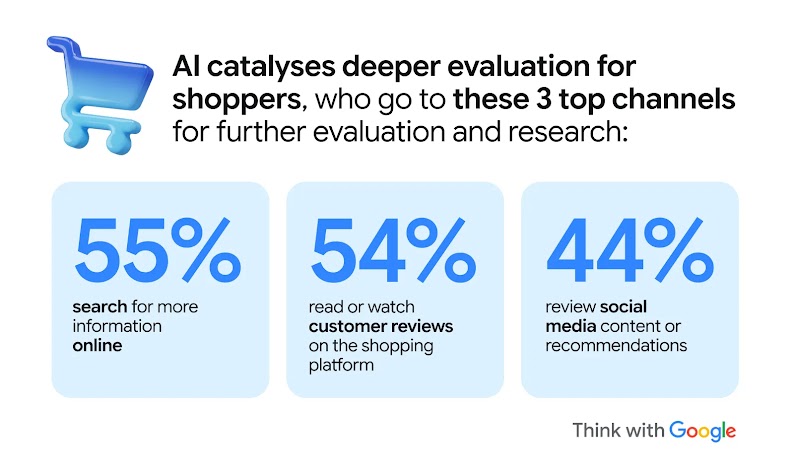
More than 90% of users conduct further research or consult reviews following an AI recommendation.10 Of these shoppers, 55% use online search platforms like Google, making it their top channel. Another 54% use online customer reviews, and 44% use social media content.11
Your move: Create compelling, unique brand content that people will find useful, and that generative AI models can easily crawl and cite when providing relevant answers. By following Google’s best practices for search and generative engine optimisation, you can make your brand and product information highly visible in Search results, including AI responses.
It’s also critical to have a consistent brand presence across the top channels that SEA’s shoppers use to validate decisions. In particular, integrate your ads into authentic, trustworthy content made by YouTube creators who significantly influence SEA shoppers’ purchase journeys.
That’s what McDonald’s Philippines did to scale discovery and consideration of its newly launched McCafe beverage flavours among intended audiences. Using Gemini, McDonald’s analysed over 200 YouTube creators’ content, and collaborated with the ones that aligned best with its brand and resonated most deeply with its customers. It then amplified the high-impact content using Video reach and Video view campaigns.
That AI-powered strategy brewed outstanding results: units sold surged by over 20% and average daily sales revenue jumped more than 30%.
AI is gaining user trust: Make your ads the best answer
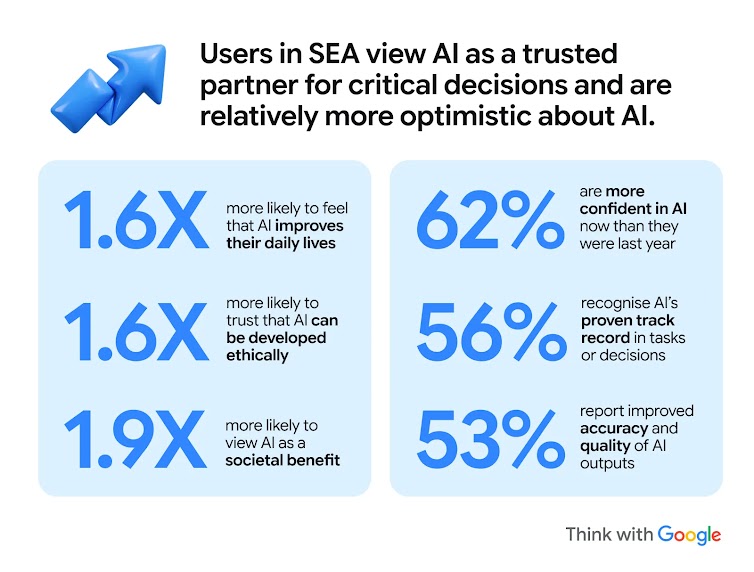
Our report finds that people’s trust in AI is rising, with 62% of SEA consumers saying they are more confident in AI than they were a year ago.12
Their increased positivity stems not just from greater AI usage and familiarity, but their recognition that AI is demonstrating stronger track records in tasks and delivering better quality outputs.
Users in SEA are also more optimistic about AI’s impact compared to other regions like the U.S. and Europe. They’re 1.6X more likely to feel that AI improves their daily lives and trust that AI can be developed ethically.13
Stronger trust in AI is prompting SEA’s users to use AI for high-stakes purchase decisions. In particular, users rely on AI to navigate categories with technical specifications — say, infant care and electronics — and trend-led, big-ticket items like jewellery and furniture.
Your move: To win customers’ consideration and trust during this critical stage of deliberation, meet their nuanced search queries with ads that provide the most relevant answers. For that, you’ll need to apply the power of AI to your business, because manual optimisation simply cannot keep pace with the scale and speed of real-time conversational queries.
Moving beyond traditional keyword-based campaigns to AI-powered Search campaigns like AI Max for Search and Performance Max has become an imperative for marketers today, not just a preferred strategy.
Through features like AI Brief, you can customise how your brand shows up in Search, by setting clear guidelines that steer AI towards your unique business goals. The AI-powered campaigns then handle the heavy lifting of understanding real-time user intent. That ensures your ads are delivered with customised ad messages and creatives at the exact moment when a consumer is seeking answers.
Indonesian online travel agency tiket.com faced a growth bottleneck in its hotel vertical due to a manual keyword strategy that missed high-intent, long-tail search queries. To scale accommodation bookings efficiently, it piloted Google’s AI Max for Search in an A/B test against manual campaigns.
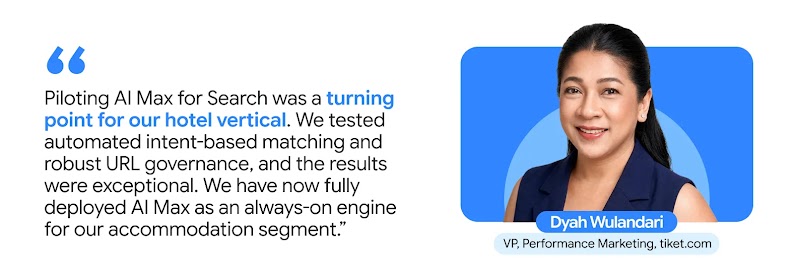
By automating intent-based matching and utilising robust URL governance, the AI-driven approach unlocked massive scale: paid hotel orders spiked 141%, gross booked value soared 94%, and cost per paid order dropped 47%.
Agentic commerce is coming: Adopt the right standards and tools
Our research shows that 75% of AI users are comfortable with allowing AI agents to find the best price and buy the product for them.14
Another 45% of users are willing to delegate purchase decisions to AI agents, within specifications and guardrails. About 50% of these users would authorise AI to make transactions exceeding $10.15 That reflects users’ increased comfort levels with AI agents handling meaningful purchases for them, compared to just one year ago.
Consumers’ openness to delegating the entire process, from research to checkout, to AI agents marks the onset of a major shift in e-commerce. But before agentic commerce can become mainstream, strong guardrails and privacy protections will need to be established.
Your move: To prepare for the agentic commerce era, marketers in e-commerce, retail, and consumer packaged goods sectors can adopt the Universal Commerce Protocol (UCP), an open standard that allows AI agents to seamlessly interact with your products and services.
By integrating with UCP, your business can implement a checkout button on eligible product listings in AI Mode or on Gemini. That makes your products more easily discovered and shortlisted by AI agents. Additionally, provide agents with robust, structured data, such as price, availability, shipping, and granular specifications, via your product feeds on Merchant Center.
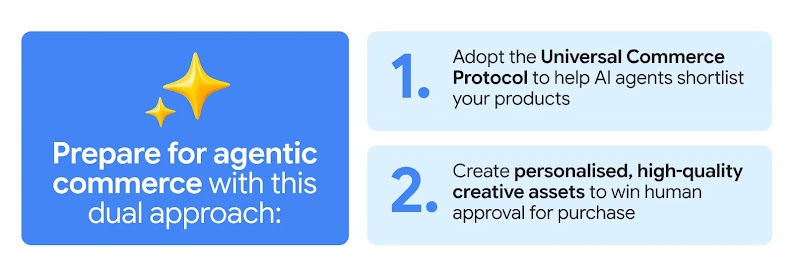
For transactions where the consumer makes the final decision based on AI agents’ curated options, provide compelling, contextually relevant visual assets that capture maximum attention. AI-powered tools like Product Studio for Merchant Center allow you to generate and personalise high-quality creative assets at scale, ensuring your product stands out when it is ultimately presented to the human buyer.
By continuously testing and iterating these assets through AI-powered campaigns like Performance Max, brands can discover which combinations drive the highest conversions in the new agentic commerce landscape.
The rise of SEA’s AI economy is reshaping purchase journeys and digital marketing playbooks. By winning your customers’ trust through relevant, personalised shopping experiences powered by AI, your business can secure a clear competitive edge in the intelligent economy.
Contributors: Samantha Cheok, Strategy & Insights Manager; Muriel Makarim, Country Marketing Manager, Indonesia & Head of Brand and Reputation, Southeast Asia and South Asia Frontier; Judy Wong, Product Marketing Manager; Cheyenne Lee, Digital Marketing Trainee


Social Module
Share