


 Sign in with Google
India’s omnichannel retail landscape is undergoing a structural transformation. As legacy brands’ distinctiveness sharply declines, challenger brands are on the rise.
The share of top Indian brands perceived as truly unique by consumers has dropped from nearly 12% in 2014 to just 4.3% in 2025. Taking the place of legacy stalwarts are Direct-to-Consumer (D2C) challenger brands, whose rapid growth is being propelled by a new generation of “experimental shoppers” in India.
These consumers thrive on spontaneity, novelty, and calculated risk. And they’re fundamentally resetting the purchase journey, according to new research commissioned by Google and conducted in collaboration with WPP Media and Elevation Capital.
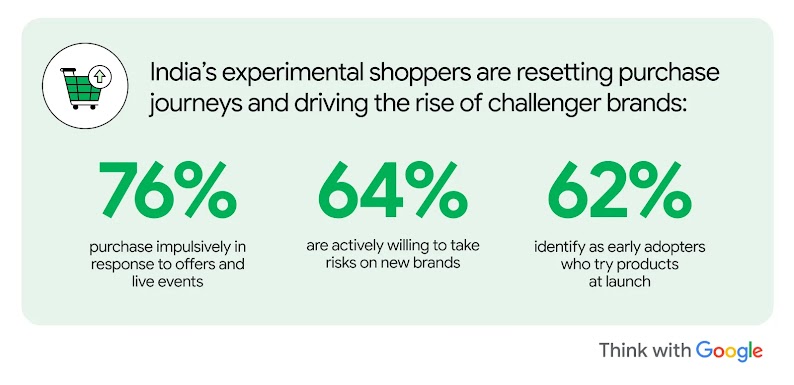
Rather than following predictable shopping journeys, experimental shoppers discover brands organically through online video and social feeds, marketplaces, and creator-led cultural moments. Those moments of spontaneous discovery are opening new opportunities for challenger brands to win customer trust and leapfrog legacy players.
Supported by India’s robust digital backbone and rapid channel innovation, challenger consumer brands have outgrown their FMCG categories by 2X to 3X over the past five years. Looking ahead, these businesses are set to scale India’s online D2C sector 4.5X to $72 billion by 2030.
Our report helps challenger brands position their full funnel marketing strategies to capture this next-level growth. From our deep insights into India’s experimental shoppers, we’ve distilled five codes of success, which can be adapted to your brand’s current revenue stage to help you reach the ₹500 crore (roughly $50 million) milestone — and beyond.
Brand positioning: Build a foundation on differentiation
In a retail market defined by infinite choice, Indian challenger brands win by sharply defining their positioning across four pillars of differentiation:
1. Uniqueness: Instead of competing on generic claims, breakout brands solve one contextual problem exceptionally well, and own one hero product before expanding to others.
That’s a savvy strategy for increasing revenues, since strongly-differentiated brands are about 2X as likely to grow as weakly differentiated ones, according to Kantar. Comet is a prime example. The footwear disruptor, which carved out a unique niche by optimising for aesthetic design and cultural relevance, scored four-digit growth percentages.
2. Aspirational value: Disruptors know that premium perception is structurally cheaper to establish early, rather than to rebuild later. So from day one, they protect their price architecture instead of offering discounts to chase volume. That means structuring prices, product packaging, and formats to maximise aspirational value for shoppers.
Our research finds that customers of breakout brands buy into the stories of verified superior ingredients and exclusivity behind the products. For example, 50% of challenger brand buyers associate premium materials directly with higher product quality.1
3. Superior customer experience: Disruptors reinforce this value by offering tangible product attributes like unique unboxing experiences, specialised formulations, or proprietary technology, which buyers of challenger brands view as decisive quality signals.
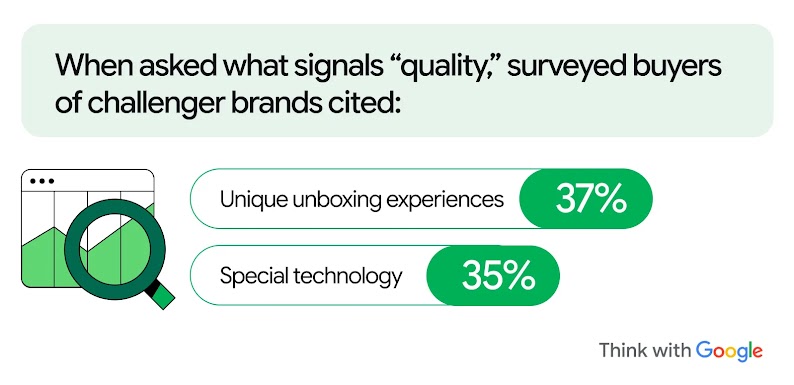
D2C brands that provide such assurances of product excellence via an omnichannel retail marketing strategy can build enduring pricing power. The Sleep Company, for example, offered tactile proof of its patented SmartGRID technology through physical experience centres, where shoppers can test out its mattresses.
4. Community belonging: Successful disruptors nurture strong participation among their customer communities by leveraging high-trust ecosystems like YouTube. Their customers’ deep sense of belonging is reflected in the data: 91% of challenger brand buyers follow the brand online post-purchase to stay connected,2 and 86% download the brand’s app to deepen their daily engagement.3
Credibility: Win trust swiftly through customer validation
Unlike incumbents that rely on brand familiarity cultivated across multiple generations, challenger brands compress discovery-to-decision journeys from years into mere days. In fact, 55% of challenger brand buyers purchase within “a couple of days” of first discovering the brand.4
To win customers’ trust at such unprecedented speeds, D2C brands can build a multi-layered strategy to systematically clear three layers of consumer validation:
1. The digital legitimacy check: Shoppers start their journeys by exploring brands that are visible on platforms they trust highly. Those platforms serve as a “legitimacy filter”: The majority of surveyed buyers of challenger brands question a brand’s authenticity if it doesn’t appear on Google Search or YouTube.

2. Rational justification: Once shoppers discover a brand, they look for objective evidence to rationally justify the purchase, with 42% actively checking brand credentials and 37% verifying product claims.5
3. Authentic social proof: Before checking out, 53% of experimental buyers seek peer validation.6 Wakefit understood this consumer need, so it created a reality-style documentary where “sleep interns” tested its mattresses for 100 nights and gave their approval. Now into its fifth season, the viral series on Wakefit’s YouTube channel has lifted direct-to-site conversion rates by 25%, proving that peer endorsement seals the conversion.
Creative strategy: Communicate a distinct point of view
Today’s winning creatives lead with a sharp point of view rather than a generic product claim, because consumers buy into what a brand believes before what it sells.
For example, The Whole Truth Foods makes radical ingredient transparency its core brand identity. Bypassing conventional taste claims entirely, it focused its creative strategy on its “clean-label” nutrition bars and authentic ingredients.
To scale their brand narratives, marketers of disruptor brands turn to creators to help them bridge audiences’ discovery and validation. That’s because 4 in 5 consumers leverage creators to discover new brands,7 and 1 in 3 consumers rely on creators to make a final purchase decision.8

Notably, many founders themselves are becoming creators. Building authentic connections with audiences in this way can accelerate brand adoption, because 74% of consumers like knowing the entrepreneur or founder behind the brand.
Channel Mix: Driving scale with sequential discipline
Disruptor retail brands scale successfully by climbing a “channel ladder,” rather than prematurely attempting an omnichannel sprawl. Each of the following channels offers distinct advantages for specific industries:
1. Direct-to-Consumer (D2C) websites and apps: Setting up a home base here allows a brand to better control margins, own customer data, and rapidly iterate on product feedback. D2C sites also allow brands to build direct customer relationships that foster deep brand affinity and trust. In fact, 92% of buyers who research on a D2C site express intent to buy again.9
Those advantages are particularly vital for fashion and apparel brands, where 34% of purchases occur directly on branded sites.10
2. Marketplaces: These platforms deliver massive reach, ease of use, and credibility. They serve as the dominant engine for beauty and personal care brands, with e-commerce accounting for 27% of those brands’ sales.11
3. Quick commerce: This channel capitalises on the demand for immediate convenience and serves as a critical growth layer for food and beverage brands, driving 16% of purchases and 10% of brand discovery.
4. Physical retail and in-store channels: Indispensable for tactile evaluation and building brand equity, these touchpoints are the most beneficial for the home and living sector, where 33% of purchases still happen in-store.
Media Activation: Compounding growth
Enduring D2C brands understand that performance marketing alone only captures visible, in-market intent. That’s why they replace linear full funnels with an AI-driven, compounding media flywheel strategically structured around four growth levers:
-
Create demand before the search begins. Challenger brands reach high-intent, attentive audiences on expansive surfaces like Connected TV and YouTube Shorts.
The Sleep Company used engaging, educational storytelling via Shorts to make its brand highly memorable for audiences even before purchase intent formed. The strategy paid off: Its Video reach campaigns drove 75% in-market audience reach and a 54% increase in store visits.
-
Convince by turning proof into preference. Provide verifiable proof, such as expert reviews, whitelisting through a Creator partnership boost, and customer testimonials. That’s far more effective than passive claims in capturing shopper preference when they’re evaluating products.
Skincare brand Deconstruct partnered with YouTube creators to simplify ingredient science and showcase its products’ efficacy. By using audience signals for precise targeting along with Brand Lift and Search Lift studies, Deconstruct’s YouTube campaign strengthened customer trust and scored a best-in-class 9.6% view rate, 17% increase in platform sales, and 400% improvement in video ROAS.
- Convert intent frictionlessly wherever it appears. Capture active demand by optimising commerce touchpoints, product feeds, and AI-powered bidding via Search and Performance Max. Slurrp Farm automated high-intent capture using Google’s Commerce Media Network solutions to achieve a 6.6X ROAS and a 95% higher conversion rate.
- Compound long-term growth by growing customer loyalty. Growth accelerates when first-party customer intelligence is fed back into the media engine. That’s why brands like digital health platform Clinikally are leveraging customer lifetime signals with Customer Match in Google Analytics and Smart Bidding strategies to drive repeat purchases and grow customer lifetime value (LTV). Clinikally increased revenue contribution from new customers by 71%, boosted ROAS on retention campaigns by 2.5X, and reduced cost per acquisition by 62%.
Underpinning this flywheel is an integrated core of data infrastructure, AI solutions, and incrementality measurement. It enables every campaign cycle to make the next one even faster, sharper, and more cost-efficient.
The ‘Zero to ₹500 crore’ playbook for challenger brands
Scaling from an agile startup to an enduring market leader is an exercise in structural maturity. In their journeys towards the ₹500 crore revenue milestone, brands often find that what builds early momentum is rarely what sustains institutional scale. Here’s how your brand can adapt the five codes of success to each successive stage of revenue increase.
Early anchoring (0–₹150 Cr): Win through fierce discipline. Owning a single hero product and establishing deep niche relevance have helped challenger brands reach ₹100 crore in just two to four years, compared to the two decades required by legacy predecessors.
Acceleration (₹150 Cr–₹300 Cr): Shift from finding product-market fit to defending margins and positioning against premature expansion. Successful brands scale by building increasingly premium sub-brands, while ensuring that offline retail expansion is backed by healthy unit economics and rapid capital expenditure payback.
Institutionalisation (₹300 Cr–₹500 Cr): Convert founder-led momentum into a durable, multi-brand ecosystem. Through customer intelligence, consistent omnichannel pricing, and an AI-powered media flywheel, your brand can turn earned trust into an institutional asset.
For brands rewriting the rules of India’s commerce, the path to future market leadership is clear: build compounding growth systems and creator marketing strategies. The next era of omnichannel retail will be won by challenger brands that learn, adapt, and scale the fastest.

Contributors: Pushkar Gupte, Head of Industry, CPG; Debraj Gupta, Agency Relationship Manager


Social Module
Share