





 Sign in with Google
 Matt DelRe leads the AI-driven evolution of Search ads and organic, global product solutions. Throughout his 19-year history with Google, he has been central to major shifts into video, mobile, and automated solutions. Google’s Pavel Jašek brings over a decade of expertise to the online marketing and e-commerce space. He is driven by a passion for web analytics and the nuances of customer intelligence.
How do you drive rapid growth in your home market while simultaneously laying the groundwork to expand across Europe? For many marketers in Central and Eastern Europe (CEE), this isn’t a theoretical question — it’s the daily challenge.
The CEE region is full of opportunities for ambitious brands to scale quickly. But this dynamism creates a paradox. Many feel they have to choose between two worlds: maximising short-term profits today or preparing for an AI-driven future tomorrow.
During the Think Consumer event in Warsaw our teams at Google introduced a framework designed to bridge this gap. It’s a way to do both at once.
A new growth formula to win at home and overseas
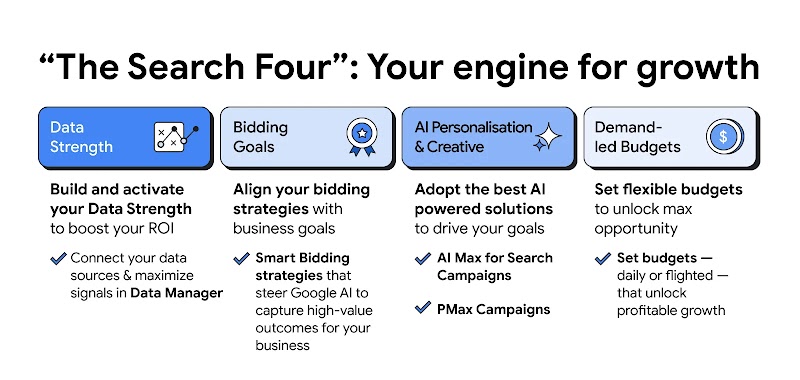
We call this framework the ‘Search Four,’ and it’s built on four foundational pillars: data, goals, AI, and budgets. It’s a playbook that not only helps you master the complexities of your domestic market but also prepares you for international expansion. It’s about building a marketing engine that is both powerful today and ready for tomorrow.
1. Getting your data right for the AI era
To win twice, both at home and internationally, CEE brands must treat their first-party data as their most valuable asset. In the era of AI, data is the bridge between local success and continental scale.
Building a comprehensive data strength setup involves optimising for high-quality signals that balance business value with speed. It requires moving beyond simple conversion tracking toward value-based bidding. This is achieved by:
- Mapping the conversion path: Identifying actions close to the final sale, such as finishing an insurance quote, to reduce the data feedback loop.
- Predictive scoring: Using internal signals like customer demographics to assign a Predictive Lifetime Value (pLTV) to each lead.
- Bidder Integration: Feeding these values directly into AI-powered bidding algorithms to ensure the system prioritises high-value users over high-volume, low-quality clicks.
Think of a Polish auto insurance company that has mastered its data at home, measuring key website actions and capturing first-party data. By identifying broader audience trends at the point of entry, they’ve determined which customer profiles are most likely to remain loyal and drive long-term profitability.
When they decide to expand into Germany, Romania or Czechia, they don’t start from zero. They feed their established home-grown knowledge into automated bidding systems. The AI uses these historical patterns as a blueprint to automatically prioritise bidding on signals that align with the most profitable customer segments in any new market.
When you feed clear, value-based goals into AI-powered bidding tools, you empower the system to identify the most valuable shoppers for your business.
2. Setting goals that drive real business value
The next step is to translate data into powerful, profit-driven objectives. To navigate the paradox of current yield versus future scale, marketers must move beyond surface-level metrics and set goals tied directly to bottom-line profitability using metrics like Profit on Ad Spend (POAS).
When you feed clear, value-based goals into AI-powered bidding tools, such as Smart Bidding, you empower the system to identify the most valuable shoppers for your business — not just the highest volume of clicks. This precision ensures that your local CEE operations provide the maximum financial runway for your broader European journey.
3. Deploying AI to uncover hidden opportunities
This is where the framework truly comes to life, especially for international expansion. Marketers often have preconceived notions about their home market. But when entering a new country, you may not know how people search, think, or buy. Additionally, marketers in CEE often pay a fragmentation tax — the heavy cost of manually localising campaigns, managing multiple currencies, and navigating varying consumer behaviours across borders.
This is where AI becomes a strategic multiplier. By deploying solutions like AI Max for Search or Performance Max, you give the AI the freedom to discover what shoppers in that new market are searching for and how to optimise for visibility across search queries.
Additionally, advertisers are increasingly leaning on AI-powered solutions to reduce the manual effort and costs associated with tailoring campaigns for multiple languages. Tools like Campaign Translator are becoming essential for Search, App, and Performance Max ads. By supporting over 200 language pairings, these technologies allow brands to reduce the manual effort required to localise international campaigns.
Building on this localised foundation, AI Max for Search campaigns is now a key growth engine in the region. This is fueled by the scaling of search term matching, automated text customization for ad creatives, and final URL expansion that improves relevancy for users.
A prime example of AI Max’s adoption is Rohlik Group. This Czech grocery technology delivery company, operating in five European countries achieved a nearly 3X increase in conversions, and a 7.5X increase in return-on-ad-spend.
4. Funding growth with unconstrained budgets
Finally, to truly capture the opportunity AI uncovers, your budget must be as agile as your strategy. Rigid, pre-allocated budgets are often the greatest barrier to “winning twice"; they force a choice between defending the home front and exploring new territories. By removing these constraints and focusing on return-on-ad-spend or profit-based bidding, you allow the AI to pursue every profitable conversion available in real-time.
In the CEE context, this agility is your competitive edge. It ensures you are not leaving growth on the table at home while simultaneously providing the scalability needed to enter a new European market. When the system identifies a high-value customer, whether they are in Warsaw, Berlin, or Paris, an agile budget ensures you have the liquidity to capture them.
From reactive tactics to proactive growth strategy
In a volatile economic climate, the ‘Search Four’ provides a reliable, adaptive foundation that helps marketers respond to shifting consumer behaviour in real-time. By moving from rigid budgets to an agile, profit-centric model, marketers can capture high-value customers across borders without the friction of manual scaling.
The most successful CEE brands will be those that embrace this dual mindset: winning today through automation while building a proactive engine for tomorrow.


Social Module
Share