


 Sign in with Google

Akash Saxena leads high-ROI strategies across user acquisition, engagement, and CRM programmes for MENA omnichannel retailer Home Centre. He has over 12 years of end-to-end digital marketing experience under his belt, and his current role spans mobile apps, paid media, cross-channel campaigns, and analytics.
Let’s be real. In retail today, the demand for fresh content never really stops. Between product drops, seasonal shifts, and flash sales, there’s always something new to talk about.
In the homeware space, a real driver behind all that content comes down to how differently people shop for their living spaces. Someone actively searching for furniture reviews on YouTube is in a totally different mindset than someone just scrolling for fresh seasonal decor ideas on social media.
Anyone who has ever run a marketing team knows the tightrope we walk: how do you create great, tailored visuals for all different categories, audiences, and formats without blowing through your budget or burning out your team?
The truth is, marketers have been hitting that exact wall for years. But, at Home Centre, we decided we were done dealing with that same-old bottleneck. With generative AI progressing by leaps and bounds, we’ve shifted gears to bring the technology straight into our creative process.
Room for innovation (within strict brand guidelines)
We know the old, linear marketing funnel has officially left the building. Today’s shoppers find inspiration everywhere, on every screen, meaning we have to deliver the right message at the exact right moment.
With that in mind, heading into White Friday, the region’s culturally adapted take on Black Friday, we wanted to completely refresh our advertising in Saudi Arabia to boost engagement and reach shoppers who had never bought from us before.
We fine-tuned the outputs until lighting, depth, and colours were completely photorealistic, and brought a distinct local lens to the visual space, creating environments that felt genuinely Saudi.
Our biggest obstacle? Fuelling a true “always-on” strategy meant we needed fresh assets fast, especially during a peak retail moment, when high ad frequency means shoppers can get hit with creative fatigue, leading to steep drops in engagement and higher ad costs. Generative AI offered the ideal solution to scale quickly without sacrificing quality.
To make this AI collaboration a success, we first established clear guardrails to uphold our brand’s identity, visual quality, and cultural resonance. We wanted to ensure product authenticity shone through, so a linen sectional, for example, kept its exact texture and proportions as in our stores. We fine-tuned the outputs until lighting, depth, and colours were completely photorealistic, and brought a distinct local lens to the visual space, creating environments that felt genuinely Saudi. Ultimately, we believed that these high standards wouldn’t limit AI, but elevate it.
Designing a smarter workflow with AI
To bring this vision to life at scale, we teamed up with digital marketing agency, Jellyfish, to build an AI-driven production pipeline that could scale our brand-authentic creative.
The engine powering this shift was Pencil Pro, the AI orchestration platform created by Jellyfish’s parent company, The Brandtech Group. By using it as a central control layer, Jellyfish unified Google’s AI models inside a single, brand-governed environment that carried our campaign from brief to ideation and from production to measurement.
This setup gave us direct, structured access to Google’s suite of tools. We deployed Nano Banana for crisp image generation and product manipulation, Veo for dynamic video creation, and Gemini to transcreate and localise our campaign copy into Arabic. This video, for example, encourages viewers to create their ideal home oasis and “elevate any room into a warm and sophisticated sanctuary”, with a “Shop now” call to action.
Executing this at scale required a close, hands-on partnership to ensure speed never compromised our brand standards.
“By embedding Pencil Pro as an AI orchestration layer, with brand and localisation guardrails built into the platform itself, we enabled Home Centre to scale creative while maintaining control and consistency,” explains Saumil Mehta, Account Director at Jellyfish. “Every model in the pipeline adhered strictly to Home Centre’s core brand guidelines while respecting key localisation rules for the Saudi audience, from visual tone to nuanced Arabic copy.”
With this governance in place, our core creative concept came to life: “sketch to reality”. The idea was simple yet visually striking. We began with raw, hand-drawn sketches of a living room, and used Google’s AI models to seamlessly transition those outlines into a fully styled, photorealistic living space featuring Home Centre furniture. By visually bridging the gap between an initial idea and a finished interior, we showed Saudi shoppers just how effortlessly their dream spaces could be transformed.
Driven by this automated creative assembly, the workflow completely overhauled our output. Almost overnight, we generated 15 brand-new static assets, three distinct videos, and tested 15 localised headline variations at scale.
The impact went far beyond asset creation. Pushing new creative directly into Google Ads established a real-time feedback loop to score quality and run live A/B tests on the fly. Instead of spending weeks on a single hero asset, we deployed dozens of variations instantaneously, testing opening hooks, messaging, and calls to action.
This continuous optimisation automatically funnelled spend into winning ads, maximising return on ad spend (ROAS), cutting turnaround times, and eliminating ad fatigue. Crucially, this agile approach quickly revealed unexpected high-performers. For example, beyond core categories like sofas, lamps, lighting, and mirrors emerged as key drivers of new customer growth.
Room for imagination and real business growth
Aside from saving time, generative AI acted as an intelligent co-pilot, giving our team the freedom to realise ambitious ideas without traditional budget constraints.
Instead of navigating complex permits and multi-location shoots for a single seasonal look, we could instantly place products in a fully customised, Saudi-inspired environment. This kept our high-touch production focused on core hero storytelling, using AI for the heavy visual lifting to expand that foundation into bespoke spaces.
Far from replacing human insight, the technology brought our “sketch to reality” concept to market in record time, with our designers maintaining full artistic control over every detail.
But clearing our creative bottleneck was just half the battle. High-quality visuals only drive value if they reach the right audience. This is why we fed our fresh content directly into Performance Max campaigns, specifically leveraging the New Customer Acquisition (NCA) goal. This feature optimised our spend to scout out high-value Saudi shoppers who had never bought from Home Centre before. Feeding Google’s algorithm a rich, diverse mix of localised copy and AI-generated visuals gave it the exact engine needed to identify and convert brand-new shoppers at scale.
Pairing AI-generated creative with AI-powered targeting proved to be the winning formula, and the performance gains were immediate:
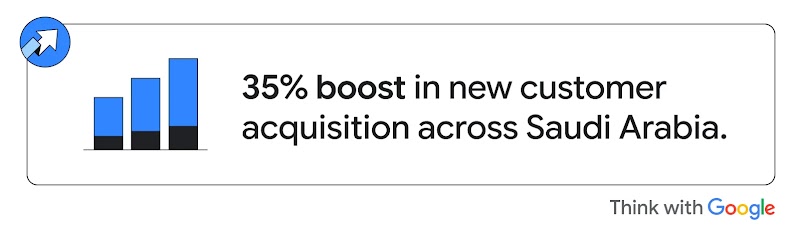
- +35% increase in new customer acquisitions in Saudi Arabia compared to our previous 30-day baseline.
- 1% lift in click-through rates over our average, a margin of gain notoriously difficult to achieve in modern retail media buying. Proof that the localised visuals genuinely resonated with our target audience.
Building a future with agentic AI
Using generative AI to craft creatives and pairing them with Performance Max proved beyond a doubt that AI-driven workflows are a core driver of retail growth.
But as game-changing as this campaign was, it’s really just step one of our collaboration with AI.
Looking ahead, we’re really excited about the rise of agentic AI and moving from assisted creative generation to autonomous agents. These systems can independently analyse real-time performance, predict emerging creative fatigue before it happens, and self-optimise asset variations on the fly. They sound incredibly promising for the future of marketing.
For an always-on brand like Home Centre, playing with Agentic AI is the next frontier. It means our team can spend less time managing production cycles and more time steering overarching creative vision and strategy, building an ecosystem where speed, quality, and scale truly run on autopilot.