




 Sign in with Google
In her third annual letter, Vidhya Srinivasan, VP and GM of Ads and Commerce at Google, shares how her teams are reimagining commercial experiences to be fluid, assistive, and personal in this new expansionary moment for the industry.
A version of this article was originally published on The Keyword Ads and Commerce blog.
Historically, consumers have faced a necessary trade-off: buy quickly and risk getting it wrong, or spend hours researching to get it right.
We’re seeing that trade-off disappear.
Consumers are continuing to search, scroll, stream, and shop, and now, AI is proving that speed and certainty can go hand in hand. It’s an expansionary moment for businesses and consumers alike that requires a new playbook.
In 2026, we’re reimagining commercial experiences to be fluid, assistive, and personal, so businesses can build confidence from the start.
Turning influence into impact on YouTube
As the No. 1 most-watched streaming platform in the U.S. for nearly three years,1 YouTube is fueling discovery, whether people are watching #GRWM Shorts, their favorite podcasts, or big moments like the Olympics. Creators on YouTube are today’s most trusted2 tastemakers, and these relationships can help consumers move from “just looking” to “just got it” faster.
In 2026, we’re building stronger connections between brands and creators. We’ve started down this path with open call, exploring new ways for advertisers to source creator partnerships. This year, we’re taking it even further: using AI to deeply understand content and audiences, and instantly matching brands with the creator communities that will love their products. This turns creators’ organic influence into real business impact.
Reinventing ads for the new era of Search
Search is no longer limited to keywords. More and more, people are brainstorming, snapping photos, and asking questions conversationally. In 2026, this shift is turning Search into a more powerful tool for discovery, where ads can inspire and answer all at once. We aren’t just bringing ads to AI experiences in Search. We are reinventing what an ad is.
Research shows that AI Mode provides a more helpful shopping experience when users can compare brands and stores.
Take AI Mode, for example: It offers new opportunities for businesses to fit naturally into the conversation. That’s why we’ve spent the past year testing new ad formats that bridge inspiration and action. Our research has shown that AI Mode provides a more helpful shopping experience when users can easily compare a variety of brands and stores.3
AI Mode already surfaces organic shopping recommendations based on what’s most relevant to a query. Now, we’re testing a new ad format to showcase retailers that offer those products, clearly marked as sponsored. This new format helps shoppers easily find convenient buying options, and offers retailers the opportunity to show up in these key moments of consideration. We are testing similar formats in categories beyond retail, like travel, to help people find relevant products and services.
User flow of the new shopping format in AI Mode is featured below organic results with a “Sponsored” label.
We also recently introduced a new monetization experience in AI Mode, Direct Offers, to help brands stand out in the moment that matters. Direct Offers allow businesses to share a tailored offer with a shopper who is ready to buy, to help close the sale, without changing what they offer everyone else. We will expand these to include special offers that go beyond price to value, like loyalty benefits and product bundles.
Unlocking the future of agentic commerce
In 2026, agentic commerce is no longer just a concept; it’s reality. It will transform how we shop, from discovery to decision, while helping brands differentiate themselves.
Our goal is twofold: One, remove the gruntwork of shopping so consumers can focus on the fun parts. Two, work hand-in-hand with the industry on the building blocks needed to make agentic commerce seamless and secure.
This is why we launched the Agent Payments Protocol (AP2) in 2025, and built on it with the introduction of the Universal Commerce Protocol (UCP) last month. UCP standardizes how businesses connect with AI agents across the entire shopping journey, including the critical step of enabling secure digital identity and payments. In the weeks following the launch, we’ve received tremendous interest from hundreds of top tech companies, payments partners, and retailers interested in integrating it. It’s already improving shopping experiences on Google. In fact, UCP-powered checkout is rolling out now, letting U.S. shoppers buy items from Etsy and Wayfair, right in AI Mode in Search and the Gemini app (with Shopify, Target, and Walmart coming soon).
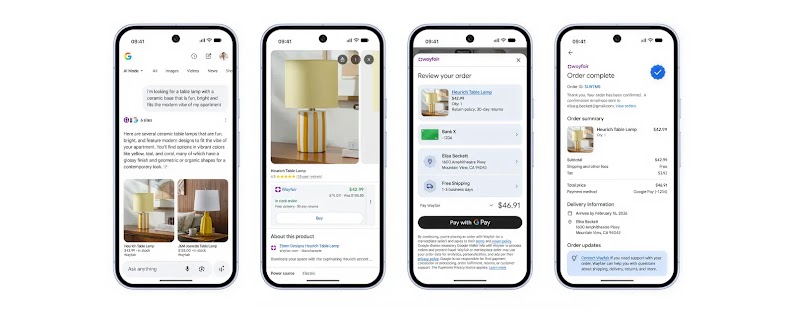
UCP’s potential extends far beyond retail. It’s helping to lay the foundation for a future where all commercial experiences can be seamless and agentic.
Accelerating growth with Gemini 3
During this time of transformation, businesses need tools that can keep up. Last year, we delivered a decade’s worth of innovation in 12 months, culminating in the arrival of our most intelligent model to date, Gemini 3. Gemini underpins our ads tools. And, as the models improve, our products improve, without customers needing to change anything.
In 2025, we saw a 3X increase in Gemini-generated assets created by advertisers.
In 2026, our Gemini-powered ad tools will drive even more growth through creativity, performance, and, ultimately, real business impact.
It starts with creativity: taking imagination and turning it into action with tools like Nano Banana, and now Veo 3, in Google Ads Asset Studio. This is helping advertisers produce studio-quality work in minutes, effectively making AI a real-time creative partner for businesses. Adoption is accelerating, proving that generative media is now a scalable reality. In 2025, we saw a 3X increase in Gemini-generated assets created by advertisers, and, in Q4 alone, Gemini was used to generate nearly 70 million creative assets in AI Max and Performance Max.4
Performance apparel brand Rhone maximizes existing assets by using Nano Banana and Veo for powerful image-to-video generation in Google Ads.
But great creative is meaningless if it doesn’t show up at the right moment. AI-powered campaigns help advertisers adapt as experiences evolve. Building on our campaigns, last year, we introduced AI Max to power performance and expand the reach of advertisers’ Search campaigns. It is already unlocking billions of net-new searches that these advertisers weren’t reaching before.5
Campaign tooling is only as powerful as the data and measurement fueling it. But with disjointed data and conflicting industry solutions, it’s hard for businesses to know which data they’re missing and where to invest. So, we’re reengineering the measurement stack to serve as a one-stop shop for advertisers, ensuring every decision is driving real, measurable growth.
Building on a foundation of trust
None of this works without trust. As the world around us changes, our commitment to bold and responsible innovation remains constant.
That’s why we are grounding this agentic, AI-first era in the same principles that have defined us for 25 years. As we empower agents to act on behalf of consumers and businesses, our rigorous standards for data privacy and security ensure that the fast lane remains the safe lane.
With this foundation in place, and this expansionary moment ahead of us, we can reimagine what’s possible. Together, we can shape a new era where it’s easier to buy, but it’s also delightful to discover and decide.
Interested in learning more? Here’s a preview from my recent conversation with Google’s Joshua Spanier for the Frontier CMO podcast.
In this conversation with Joshua Spanier, Google’s VP of AI and marketing strategy, Vidhya discusses the next era of commercial experiences. They explore what businesses can expect in digital advertising and commerce in 2026, including agentic commerce, reinvented Search ads, Gemini-powered ad tools, and more.
Social Module
Share