





 Sign in with Google
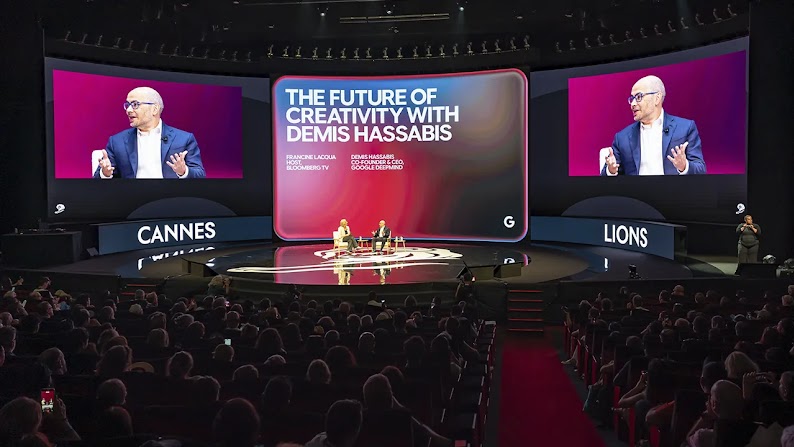
If you walked down the Croisette in Cannes this week, you would have noticed a subtle but profound shift in the air. The most-attended, standing-room-only sessions at the Cannes Lions International Festival of Creativity weren’t about traditional advertising formats or standard networking plays. They were about the future of AI and its intersection with human expression.
Among those leading the conversation was Google DeepMind Co-Founder and CEO Demis Hassabis. Google DeepMind was recognized with the Cannes Lions Grand Prix in Digital Craft for Project Genie, a research prototype that allows users to generate interactive, playable 2D worlds from a single text prompt or image. By championing a collaborative, responsible path for generative AI, Hassabis shared how technology can empower and extend human creativity. For marketing leaders looking past the near-term noise, these insights offer a clear road map for how AI can enhance, rather than replace, the creative process.
Co-designing the future of creativity
High-end production used to require massive budgets and giant teams. Today, AI tools like Veo, Nano Banana, and Flow are leveling the playing field. By working directly with artists, professionals, and industry leaders — including a new research partnership with A24 — Google DeepMind is ensuring these tools supercharge the creative workflow with input from the artists using them.
Creatives can do 10X more than they used to be able to do, try out more extreme ideas, and iterate faster.
“We work with many professional directors and amazing collaborators. We talk to them to design our tools to help enhance and empower their creative process,” Hassabis said. “I think it’s going to be incredible. They can do 10X more things than they used to be able to do, try out more extreme ideas, [and] iterate faster. These [AI] tools allow them to try out things in relatively inexpensive and quicker ways. If you use it in an innovative way, it should add to the creative process.”
Helping more artists tell their stories
AI is also erasing old friction points and fundamentally changing who gets to create. By knocking down financial walls and geographic barriers, it allows fresh, diverse talent to break into the industry. “AI will democratize creative tools, so more people try out their ideas, relatively quickly and easily,” said Hassabis. “A lot more people can break into those industries. There’s a lower bar to entry, less gatekeeping. That will probably mean that more new, professional creators will find a path, wherever they are in the world, through using these tools.”
Moving at the speed of imagination
As the tools become more accessible, AI continues to shrink the gap between what we can imagine and what we can build. Things that once felt too complex or expensive — impossible shots, lost eras, new worlds — can now be tested in minutes. Crucially, the breakthroughs happen when creators use AI to overcome creative impossibilities, not just production inconveniences.
The real breakthrough in AI tools is the ability to iterate, pivot, and hone the work.
But creativity isn’t a straight line. It’s a messy, iterative process. The real breakthrough in AI tools isn’t generating a pretty asset from a single prompt; it’s the ability to iterate, pivot, and hone the work.
Hassabis highlighted this shift using a recent viral success. “One reason Nano Banana became so popular was because it produced great images. But then if you had some other iterative idea you wanted to pursue, which always happens with the creative flow, then you could just describe in natural language what bit you wanted changed, without it regenerating the whole image. That’s really important for the creative process so that you can just tweak things, so you can have the kind of polish and finish that you want.”
This capability is expanding beyond images. Hassabis pointed to the development of Omni, a model designed to bring this same level of conversational, fine-grained control to any medium. “Our more recent Omni model ... is called Omni, because it can take basically any type of modality input, whether it’s sound or video or text, and then it will eventually be able to output any sort of modality as well,” he said. “And the key thing is not only the quality of the outputs — you know, video outputs or image outputs — but also the fact that you can fine-grain edit those outputs.”
Underlying these conversational editing tools is visual and spatial intelligence. Rather than simply memorizing patterns, they understand physical environments. “The reason things like Nano Banana and Omni are good at doing that is because underlying them, they also have an understanding of language and ... they’re kind of like world models, where they have a bit of world understanding,” Hassabis explained. This allows creators to direct edits using natural, spatial commands, such as asking the tool to “move this object over here” or “behind this thing.” Because the model understands the composition of the entire scene, it can execute the change seamlessly without disrupting the rest of the canvas.
Keeping the craft human
Ultimately, AI is meant to serve the creator, not the other way around. “I’m a huge believer in human ingenuity and human creativity,” Hassabis concluded on stage. “We’re an unbelievably adaptive species ... and the next generation will work out how to best use these technologies to express even more humanity.”
For marketing leaders, the goal should not be to use AI to generate average content faster. The goal must be to use these tools to pursue artistic curiosity, embrace bold risk-taking, and ensure that the craft and the soul of the work remain uniquely human.
Social Module
Share