





 Sign in with Google
Graeme Adams is a senior marketing and media executive with a track record of delivering strategic growth, award-winning campaigns, and transformational leadership across BT, EE, and Plusnet.
At BT, we realised we were paying more for fewer eyeballs, mostly from older demographics. It’s a mathematical reality that would keep any marketer up at night. Our three brands – BT, EE and Plusnet – were built on a solid foundation of TV advertising, but it was becoming increasingly apparent that the times, and indeed viewing habits, were changing. The performance of our TV advertising remained strong, and we could see that YouTube could offer significant additional audience levels, but we remained unsure as to whether its skippable nature would – or could – replicate the performance of linear TV.
So I knew we had to make a definitive choice: stay as we were and enjoy dependable results, or force a step change that could add to or – if anything were to change with those results – safeguard our performance. We chose the latter.
Tuning out the static on flat budgets
Marketers today are operating under severe profit and loss (P&L) pressures. Our team was handed a massive challenge heading into Q4: flat marketing budgets. In an inflationary market this essentially equates to a significant cut.
Concurrently, we were tasked with maintaining overall consumer awareness, consideration, and market share across our three distinct portfolio brands.
Our internal analysis revealed a glaring challenge to achieving these goals. We were under-indexing on younger demographics and oversaturating other audiences with excessive frequency.
Changing channels to make a £6M call
To survive and thrive in today’s landscape, we had to stop treating video advertising as a sunk traditional media cost and start treating it as a profit engine. We decided to execute the largest channel shift on our annual plan, and shifting over £6M into YouTube Connected TV (CTV).
So, we transitioned to a comprehensive AV strategy. This holistic approach to video planning integrates digital platforms like YouTube to address changing consumer behaviours and active viewing habits.
Our approach balances cross-channel OneAV planning at the top of the funnel with in-platform, full-funnel activation on YouTube. This framework recognises that lower-funnel performance drivers on YouTube – such as Demand Gen and Performance Max – do not generate demand in a vacuum.
Instead, demand, preference, and active consideration are primed across the upper-funnel mix, including Linear TV, Cinema, BVOD (Broadcaster Video on Demand) and SVOD (Subscription Video on Demand). By getting the top-of-funnel AV balance right through OneAV, we’re able to make sure YouTube’s action-oriented formats perform more effectively than they would within an isolated, siloed ecosystem.
Our communications framework is also central to this YouTube strategy: it’s aligned to the customer journey, from initial priming and active consideration right through to purchase and post-purchase engagement. This framework defines distinct communication tasks – driving consideration, building preference, driving sales, and ultimately winning customers.
Essentially, this approach is designed to maximise impact within a fragmented media landscape, by creating and converting demand through diverse brand assets, closing the measurement loop through comprehensive reporting, and using YouTube’s AI-driven solutions to improve return on investment.
Hard data that rings true in the boardroom
A radical shift requires rigorous, unassailable proof. We couldn’t just rely on platform metrics like clicks and views; we had to speak the language of the CFO, i.e talk in monetary figures and, more specifically, ROI. We worked with our agency, WPP, and Google to validate the approach, co-funding a third-party deep dive with our data verification agency, Ebiquity.
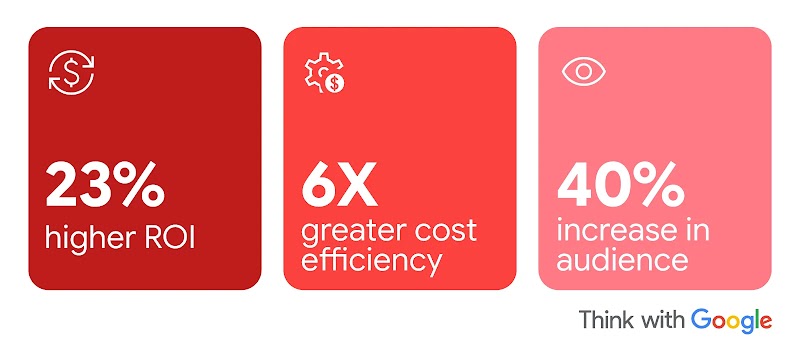
Using marketing mix modelling (MMM), we bridged the gap between media metrics and precise financial diagnostics. The results fundamentally reset our benchmark for full-funnel video marketing:
Dialling into the next generation of screentime
We have now made an ongoing commitment to increase our year-on year YouTube CTV investment by 30%, using the upcoming year as a testbed to continuously validate results via MMM models.
I believe the era of passive media planning is over. True marketing transformation requires moving past legacy assumptions, leaning heavily into robust third-party measurement, and knowing how and where to follow the audience. Here, we proved that smart automation and data-backed measurement can confidently win boardroom budget battles.
Social Module
Share