





 Sign in with Google
David C. Edelman is a digital transformation pioneer, executive advisor, and Harvard Business School professor with over 30 years of experience driving growth at the intersection of technology and consumer experience.
The opinions here are his own and may not reflect those of Google.

David Ogilvy defined a brand as “the intangible sum of a product’s attributes: its name, packaging, and price, its history, its reputation, and the way it’s advertised.”1 That served well for an era of packaged goods and controlled channels. Jeff Bezos brought the definition into the networked age: “Your brand is what people say about you when you’re not in the room.”2 Now even that needs updating. Today, your brand is increasingly what AI systems say about you when you are not in any room; what AI agents do on your behalf across thousands of daily customer interactions; and what any AI-enabled experiences you deliver reveal about how seriously you take a customer’s priorities. That shift makes brand strategy not a marketing nicety but the most consequential problem any CMO faces right now, and it demands a radically different scope of leadership.
Four forces are making this urgent simultaneously. AI has changed how brands are discovered. Culture now moves at a speed and volume that can overwhelm any brand without a clear filter. AI has changed what governs content creation and service delivery. And AI is changing what a brand can fundamentally offer its customers. Each force rewards brands that have clarity, specificity, and depth of purpose, and punishes those without it.
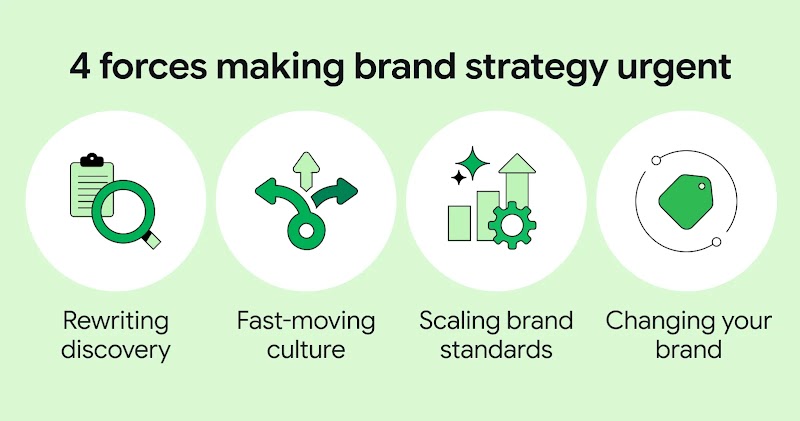
Force 1: AI has rewritten discovery
When customers turn to AI-powered search tools to evaluate their options, they receive a synthesized narrative that AI has assembled from everything it can find about a company, drawing on third-party reviews; editorial commentary; community forums; and whatever content, ads, and structured data the brand itself has provided. The implications are more disruptive than most CMOs have yet internalized. As Britney Muller, a leading researcher in AI search dynamics, has put it: “Brand mentions are the new backlinks in the age of AI search. While Google counts links, AI counts conversations. The game has shifted from link-building to voice-building.”3
The operational consequence is that AI search engines function as active curators, presenting only the brands they deem worthy to be included in their synthesized responses to users’ personal queries. Those brands are the most relevant ones, and they can be new brands that users did not know before. Recent research by Google found that users are then using Search to explore the brands they are learning about, which is often leading to more total search activity than before.4 But now it is guided by that powerful, originating AI curation.
A company in the Fortune 20 can lose out to a midmarket firm, because they’re not tuned into how AI engines work.
Brandlight, an AI visibility platform that works with enterprise brands to track and govern how they appear across AI engines, has found that within financial services alone, AI-driven traffic has climbed more than 1,000 percent across more than 20,000 prompts so far in 2026.5 Its CEO Imri Marcus has identified precisely what is at stake for brands that are not paying attention. “You’ll see cases where a much larger brand gets outranked by a smaller competitor, probably without even knowing what they did right. AI acts differently than traditional search. A company in the Fortune 20 can lose out to a midmarket firm in certain verticals, because they’re not tuned into how the engines work.”6
What the engines reward is not media spend or domain authority alone. It is coherence, depth, and a consistent identity across every public-facing source. Brands that have invested in building a clear, substantive, and authoritative point of view across their own content, earned media, product content, and customer community are the ones that AI systems cite confidently. Those that have let brand strategy drift find themselves either misrepresented or absent from the conversation entirely.
In AI search, your brand is what the model has learned it to be, from everything that has ever been said about you.
Kimberly-Clark has been among the first major consumer goods companies to treat AI search visibility as strategic infrastructure rather than a tactical experiment, investing in governing how its portfolio of brands, from Huggies to Kleenex to Scott, appears across ChatGPT, Gemini, Perplexity, and Google AI Mode.7 The underlying insight driving that investment is one that every CMO should be sitting with. Your brand is no longer what you say it is. It is what the model has learned it to be, from everything that has ever been said about you.
Force 2: Culture moves faster than any brand without a filter
AI has not just changed how brands are found. It has dramatically accelerated the pace at which cultural trends, social movements, political currents, and viral moments arrive, demanding a response. The combination of creators, algorithmically amplified content, and the sheer volume of public discourse means that brands are now confronted daily with questions that used to arise maybe once a quarter: Which of these trends is relevant to us? What is our position? Do we lean in or step back? Is there an opportunity here or a trap?
Without a clear brand strategy to serve as a filter, these decisions get made reactively, inconsistently, or not at all, and AI makes the problem worse before it makes it better. AI-powered social listening tools can now scan thousands of signals across social platforms, news feeds, and community forums in real time, surfacing trends and triggering campaign briefs faster than any human team could.
The brands that will win stay anchored in long-term goals and know when to enter the conversation with intention.
Chipotle Chief Brand Officer Chris Brandt has observed the challenge directly. “With the rise of bots campaigning against brands and individuals by amplifying negative conversations, it’s now difficult to take social listening at face value and have it paint the full picture of how your brand is being perceived online.”8
Andrew Rebhun, former CMO and chief experience officer at Cava and current CMO of Panera Bread, has named the underlying discipline that separates brands that navigate this environment from those that flail in it. “Virality alone doesn’t build brand equity. The brands that will win are the ones that stay anchored in long-term goals and know when to enter the conversation with intention, not impulse. You have to balance cultural participation with strategic discipline. Otherwise, you end up chasing moments instead of building a movement.”9
The best brands have made this into a genuine capability. Duolingo has built what amounts to a cultural radar system, using deep audience insight to determine which moments authentically fit the brand’s irreverent, chaotic identity and which do not. When it dispatched employees in Duo costumes to Charli XCX concerts in 2024 with no official sponsorship, the stunt generated millions of organic impressions, because it felt entirely consistent with who the brand is. As the team has described the philosophy, the goal is not to “follow the trends, but try to invent your own trend, and trust the talent in your team.”10 In 2025, Duolingo’s campaign in which the mascot appeared to die and users were challenged to collectively earn points to revive him generated 1.7 billion impressions and twice the social conversation of the year’s top Super Bowl ads.11 The campaign worked because it was completely consistent with a brand identity precise enough to govern bold choices.
Cultural decisions require the same governing brand filter as any other decision, and it must catch mistakes before they go to print.
The cost of that precision being absent is equally clear. In 2024, Bumble launched a rebrand campaign that attempted to engage a cultural trend around dating frustration with billboards reading, “You know full well a vow of celibacy is not the answer.” The campaign misjudged how its core audience, women who had built real loyalty to Bumble’s founding identity around female empowerment, would experience that message.
The backlash was immediate. Bumble’s own statement captured the failure: “We made a mistake. Our ads referencing celibacy were an attempt to lean into a community frustrated by modern dating, and instead of bringing joy and humor, we unintentionally did the opposite.”12 The lesson is not that brands should avoid cultural risk. It is that cultural decisions require the same governing brand filter as any other decision, and that filter has to be explicit enough to catch mistakes before they go to print.
Force 3: Brand standards now govern machines, not just campaigns
Generative AI has given marketing teams the capacity to produce content and deliver service at a scale that was unimaginable five years ago. But that scale multiplies whatever the underlying brand strategy contains.
Sephora’s CMO Zena Arnold has faced this challenge directly. Her brand’s identity rests on a distinctive and specific challenge to prevailing beauty norms. As Arnold has said, “Sephora is one of the first brands that really challenged the assumption that beauty is all about unattainable ideals and brought it more into being about self-expression and community and fun.”13 That precision of purpose is what must travel through every AI-driven content decision, personalization model, and customer interaction across 40 million loyalty members. When asked to define what differentiates Sephora in an increasingly crowded marketplace, Arnold’s answer points directly to the lived brand: “Our differentiator is really encompassed in the experience: You can play with things; you can get expert advice from beauty advisors; there is a community we’ve built.”14
Brand strategy is becoming software specification, and it has to be precise enough to run on a machine.
But brand standards now govern more than content. They govern how AI agents speak and behave in real time. Salesforce has documented what happens when this governance fails. A luxury financial services firm whose AI agent responded to wealthy clients with “No problem!” and “Sure thing!” deployed language that “completely undermined their brand experience as sophisticated wealth advisors.”15 A healthcare company whose AI buried simple answers in clinical jargon contradicted a brand that promised accessible care. These are not technology failures. They are failures of brand specification.
Adobe recognized this imperative and built its Brand Intelligence platform to address it directly, designing a system that learns how a brand behaves not just from written guidelines but from what Adobe calls “decision traces.” According to its 2026 Digital Trend Report, “The signals left behind as content are reviewed and refined — comments, edits, rejected versions, and final approvals. They reflect how teams interpret the brand in practice, not just what the rules say but how they’re actually applied.”16 Brand strategy is becoming software specification, and it has to be precise enough to run on a machine.
Force 4: AI is changing what your brand can actually be
The fourth force is the most consequential. AI is not just changing how brands communicate. It is changing what brands can offer, and companies across sectors are discovering that their brand positioning must evolve with their ambitions or it will undercut them.
Delta Air Lines has been repositioning itself not just as an airline but as a total travel companion. At CES 2025, CEO Ed Bastian announced Delta Concierge, an AI-powered tool designed to coordinate an entire journey and framed the philosophy: “New marvels like AI, the digital revolution, and sustainable technology are giving us incredible tools to transform the travel experience. But amid the wonder of new technology, we’ve always understood that the entire point of innovation is to lift people up.”17
Marriott is pursuing a parallel ambition. On its Q4 2025 earnings call, CEO Anthony Capuano said, “We see AI as an opportunity to potentially redefine the customer acquisition paradigm that has governed our industry for the past several decades.”18 Marriott Bonvoy, with 271 million members, is described by the company as a “life partner” beyond accommodation, and making that work requires the brand to earn trust in categories far removed from hotel rooms.
Consumer engagement in their own health and care is the holy grail that will drive trust and much better outcomes.
CVS Health is pursuing perhaps the boldest brand evolution of all. At its 2025 Investor Day, CEO David Joyner declared, “CVS Health is committed to being the most trusted healthcare company in America,”19 and launched Health100, an open AI-native platform that integrates data across insurers, providers, pharmacies, labs, and connected devices, inviting third-party health innovators to build applications on top of it. Tilak Mandadi, CVS’s chief experience and technology officer, articulated the ambition plainly: “Consumer engagement in their own health and care is the holy grail that will drive trust and much better health outcomes.”20 That is a staggeringly different promise from “pharmacy and convenience store,” and whether customers come to trust CVS in that role depends entirely on whether the brand makes good on it across every AI-mediated interaction, including those on a platform CVS does not fully control.
The CMO’s new role: Chief experience architect
What these examples demonstrate is that brand is no longer a marketing asset. It is an operating system, and it now runs across decisions made by the chief technology officer, the chief customer officer, the head of product, and the head of HR. The CMO who wants that system to actually function has to be a genuine crossfunctional architect, convening the C-suite around a shared set of customer promises specific enough to generate real decisions about technology, training, service design, and operations.
When I was CMO at Aetna, I extended my responsibilities to building the company’s customer experience capabilities and organized that work around explicit customer promises, one of which was, “We will always understand your personal context.” That statement lived far beyond the marketing function. It shaped how the CTO’s team designed data systems, changed how customer service representatives were trained to open a conversation, and forced difficult policy decisions about whether standardized underwriting rules could bend enough to acknowledge individual circumstances. The brand promise was the organizing principle for decisions that never appeared in a marketing brief.
A major industrial goods distributor I work with is navigating the same challenge now. The head of marketing is leading a repositioning from capable online catalog to genuine partner in inventory management and supply chain optimization, enabled by proprietary data and AI capabilities. That shift demands reprioritized IT investment, a reskilling of the sales organization from product-selling to advisory partnership, new service design, and marketing that credibly expresses what the company is becoming. The brand is leading the transformation but only because marketing is operating at C-suite scope, aligning functions that never before had to coordinate around a shared brand promise.
Is your brand strategy ambitious enough to describe what your company does today and what AI makes it possible to become?
This is exactly where the CMO role becomes most powerful. When brand strategy is precise enough to govern AI agents, filter cultural decisions in real time, guide content at scale, and define what the company is becoming, it stops being a marketing function and starts being an enterprise strategy. The CMOs who seize that opportunity, not just articulating a richer brand but using it to organize technology investment, service design, and organizational capability around a shared vision of the customer experience, are positioning themselves as indispensable architects of growth.
The question is whether your brand strategy is up to that task. Is it specific enough that an AI agent could draw on it to decide not just what to say, but how to say it, and what it would never say? Is it clear enough to tell your team which cultural moments are genuinely yours to own and which ones would ring hollow? And is it ambitious enough to describe not just what your company does today, but what AI now makes it possible to become for your customers?
Those are the questions worth sitting with. The CMOs who answer them well will find that the AI era, for all its disruption, has handed marketing the most consequential seat at the table it has ever had.

Social Module
Share