





 Sign in with Google
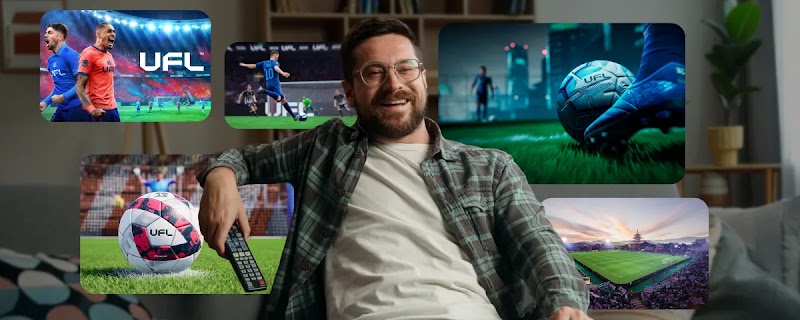
Eugene Nashilov is the CEO and co-founder of international gaming company Strikerz Inc., the latest game production and development venture of his 18-year career. Last year, the company launched UFL in the U.K., a next gen multi-platform football simulation game for Playstation, Xbox, and mobile.
How do you successfully launch a challenger brand into a market that’s been firmly locked down by established leaders for over a decade?
When our team set out to launch UFL, a new free-to-play football simulation game, we knew that going toe-to-toe in the U.K. — the undisputed home of football and one of the most mature, saturated gaming markets on earth — would be the ultimate David vs. Goliath battle. Or, in football terms, Crystal Palace vs. Manchester City in the 2025 FA Cup Final: what a moment.
So, to provide a point of difference, we introduced a new “fair to play” alternative, as we believe football gaming should be competitive and rewarding based on the player’s skill, not spending power. But having a different model isn’t enough if nobody knows you exist. To carve out our niche, we had to reach the right people, with the right message.
Scouting the opposition: Finding true fans
If we’d followed the traditional marketing playbook, we would have been fighting in the most expensive and crowded space possible: buying standard gamer audiences. So we needed a smarter approach. We had to move beyond gamers to find a much broader audience of football fans; people with a deep passion for the sport, a competitive streak, and an openness to a new proposition.
Armed with our brief, our media partner Allformance helped us navigate the entirety of this complex campaign. They came up with a strategic, global DV360-based and AI-centred campaign framework across our target markets; designed a comprehensive audience strategy to provide precision targeting and maximise brand impact; and then supported us tactically during the launch.
We used YouTube Masthead placements on the platform’s homepage, to help us achieve widespread brand recognition and ensure maximum exposure. The strategic booking of these placements in advance helped us achieve cost-efficiency here, as the campaign benefited from low CPM rates.
We then turned to Display & Video 360 (DV360)’s AI capabilities to hyper-segment our audience. More specifically, we used it to identify complex patterns that would be impossible to manage manually. AI then also helped us combine signals across viewing behaviour, device usage, and audience overlaps to pinpoint “football sim enthusiasts” and “console owners”, specifically in the U.K. We looked beyond the obvious, and instead targeted people who consumed football content on YouTube, watched match analyses, or followed popular creators on their Connected TVs (CTV). This meant we could divide our audience into extremely granular groups, and zero in specifically on sports game enthusiasts and console owners aged 18–55. These were our players, they just didn’t know it yet.
And we got their attention with some undisputed big hitters. We used global football icon Cristiano Ronaldo and ex-Manchester City legend Kevin De Bruyne in our ads, to establish instant Premier League credibility, and make people sit up and pay attention.
Connecting the midfield: Bridging the measurement gap
But reaching this new audience on the biggest screen in the house through CTV was only half the battle. The other 50% was cracking the attribution code. Our specific measurement challenge here was: how do we connect a YouTube ad viewed on a Smart TV to a game downloaded later on an Xbox or PlayStation?
After all, people don’t typically click on a TV ad. They watch it, and later, they pick up a controller, search the console store, and hit download. To bridge this fragmented journey, our team integrated a third-party Mobile Measurement Partner (MMP).
This world-first CTV-to-console tracking solution gave us the validation we needed. It allowed us to connect media exposure directly to acquisition events and post-install activity. This wasn’t us looking at impressions and hoping for the best; we were now tracking how specific YouTube campaigns translated into actual player base growth, engagement, and retention.
A clinical finish: Winning the away game
The results shattered our expectations. By booking guaranteed placements, like YouTube Mastheads on CTV, the U.K. campaign reached an impressive 3.5X more users than planned (16.9 million in total), and we successfully translated this mass awareness into 600,000 new monthly active users.
But the impact went far deeper than immediate downloads; it completely shifted brand resonance across generations. UFL secured a 23.6% lift in ad recall across the U.K. This skyrocketed to a massive 36% increase among younger audiences (18–24) — a powerful testament to the creative execution.
At the same time, we observed a sizeable surge in search intent. Search queries for UFL keywords spiked during the campaign flight, with “UFL Football” jumping 108% and “UFL Game” rising 100%. Interestingly, we also captured growing anticipation for the upcoming PC version, particularly among the 25–44 age bracket.
The key lesson here is that efficiency is the ultimate equaliser. You don’t need the biggest budget in the room if you have the smartest placement and a specialist media partner like Allformance. For challenger brands like ours, every pound invested has to work harder. If you can’t track the final action (in our case, the console install) you can’t optimise the campaign.
By marrying AI-driven audience segmentation with rigorous, cross-device attribution, we proved that a data-backed upstart with jumpers for goalposts can indeed win the away game on an incumbent’s home turf.
Social Module
Share