





 Sign in with Google
 The transformation of Search is fundamentally reshaping the dynamics of customer connection across every industry.
With advancements in Google AI, Search has evolved from a directory of links into a sophisticated, multi-turn dialogue. Today, conversational Search experiences like AI Mode and AI Overviews are redefining the ease, speed, and confidence with which customers find relevant information for high-stakes decisions.
Those experiences are increasingly impactful for India’s banking, financial services and insurance (BFSI) industry. It’s where customers spend significant time and effort on researching financial data before making multi-year commitments.
We decode how AI-powered Search is influencing customer journeys, and generating quality leads and conversions for BFSI marketers.
How AI-powered Search shapes user intent and customer journeys
For over 90% of customers in India, the path to purchasing financial products starts online and spans multiple touchpoints.
In fact, potential finance customers typically do deeper research than those in other categories. On average, they use five or more touchpoints, compared to categories outside of finance, like electronics and auto, or beauty and retail, where five or less touchpoints are used.1
To help them navigate complex terminology and move faster from intent to purchase, finance customers increasingly turn to Google AI-powered Search. It’s designed to support easier, deeper, and quicker financial research in three ways:
1. Decoding financial terminology
AI Overviews provide users with easy-to-understand snapshots of relevant or valuable information. And to further demystify financial topics, AI Mode uses interactive responses and advanced reasoning to surface content that best meets users’ shifting needs.
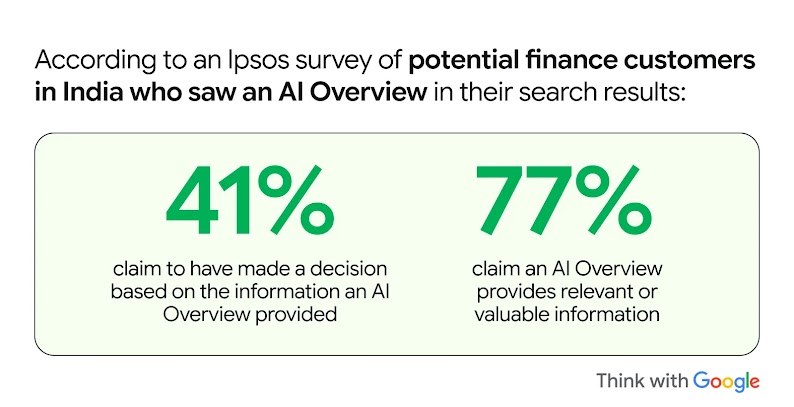
We’re also observing that Indian users are moving away from generic search terms like “credit cards.” Instead, they ask nuanced conversational queries like “zero annual fee credit card with international lounge access” in local languages.
And AI Mode, which is available in multiple vernacular languages from Hindi to Tamil and Malayalam, intelligently adapts to their shifting search behaviours.
2. Support deeper research
To make better-informed financial plans and decisions, Search users are asking multi-layered questions such as: “Which pension fund manager is best for National Pension System retirement accounts?”
AI Mode supports users’ deep dives by dividing such questions into subtopics and searching high-quality web content for each one simultaneously. That improves the factuality of its responses, and helps to build user trust.
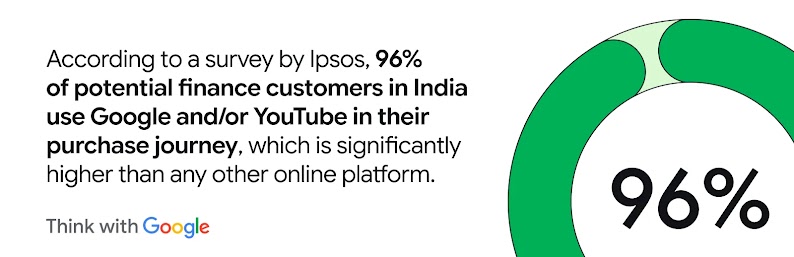
In fact, more potential finance customers in India trust the content and information they find on their journey on Google and/or YouTube than other leading search, social, streaming, or AI platforms, according to a survey by Ipsos.2 That’s why most potential finance customers prefer using the two platforms.
3. Provide time-saving market research
To help users move faster from research to decision, AI-powered Search can swiftly generate detailed analyses and comparisons of BFSI products. No wonder, then, that AI Overviews and/or AI Mode users in India feel they make decisions faster (84%) and more confidently (87%).3
When marketers move beyond generic keywords to embrace customers’ multi-layered Search journeys, they reap significant efficiency gains.
A prime example is PolicyBazaar. To efficiently capture untapped demand among high-intent users searching in their vernacular languages, the insurance platform leveraged AI Max for Search campaigns.
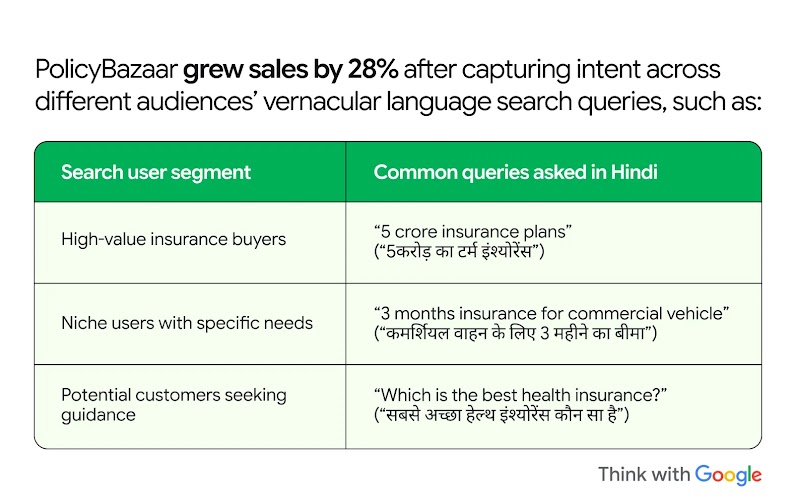
The Google AI-powered campaign expanded PolicyBazaar’s reach into new queries that it wasn’t accessing before, and delivered optimised ad content that meets customers’ life needs. The results glowed: Health insurance sales surged 28% while cost-per-sale fell 23%.
Why AI Search drives early awareness and quality leads
As AI-powered Search meets people’s financial fluency needs, it’s also simplifying their brand discovery. That makes it a powerful “lead qualification engine” in two ways:
1. Grow zero-cost awareness for brands. By helping users learn about finance offerings, it lets marketers influence customer journeys earlier without additional media spend.
2. Divert unqualified leads and drive quality ones. Contrary to the myth that AI-powered Search prevents users from visiting brands’ websites, it actually deflects unqualified leads — say, those that bounce away after clicking through for a basic definition — by answering those low-intent queries directly.
That helps to convert passive browsing into highly qualified “confident clicks,” with customers better informed and prepared to transact once they land on a website.
To influence modern conversion paths spanning a vast spectrum of queries, HDFC Ergo paired a full-funnel AI Max strategy with demand-led budget pacing. By transitioning to a keywordless, asset-based framework powered by automation and real-time data, it captured the long-tail queries and “new-to-market” audiences that traditional keyword strategies often overlook.
Advertisers that adopt AI Max for Search campaigns are seeing 27% more conversions at a similar CPA or ROAS compared with campaigns that mostly use exact and phrase-match keywords.
Source: Google Internal Data, based on campaigns with more than 70% of conversions or conversion value from exact or phrase-match keywords for non-Retail advertisers, 2025.
Brands like Acko General Insurance are already scaling impact using the lead qualification engine. It spotted the opportunity to win early awareness and conversions with Search users during the research phase, when they’re forming intent but traditional ads rarely appear.
So Acko used AI Max for Search campaigns to capture high-quality traffic for specific queries like “best insurance for bike” or “compare two-wheeler insurance.” That enabled it to efficiently lift bike insurance leads and car insurance leads by 21% and 8% respectively.
What fuels your AI-powered Search marketing: Data strength
In addition to using Search to generate quality leads, savvy finance marketers also harness the full power of Google AI to turn conversions into profitable sales.
They’re building their data strength to fuel Search campaigns’ performance and optimise for valuable leads, rather than lead volume, using these steps:
- Centralise audience signals: Integrate your website, app, CRM and Google Analytics tools to fuel AI with unified data sources.
- Implement server-side tagging: Improve data quality by serving a Google tag from your own servers. Advertisers who adopted Google Tag Gateway on average observed a 14% conversion uplift.4
- Activate your data with value-based bidding: Optimise AI-powered bidding strategies toward ROI and customer lifetime value, not just cost-per-lead.
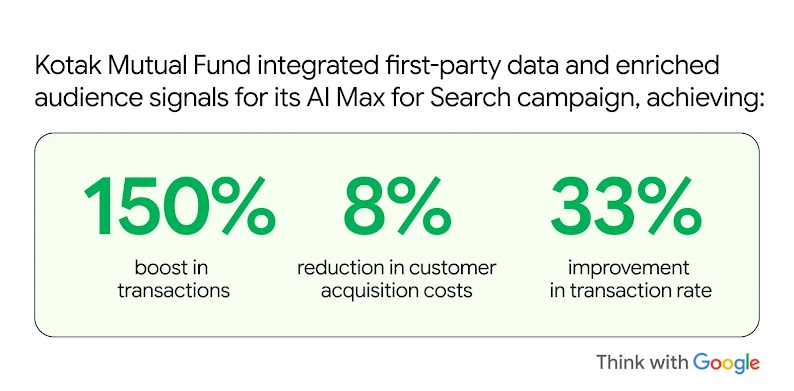
Asset manager Kotak Mutual Fund understood that rich audience signals can fuel Search ads’ performance. So it integrated first-party data into its AI Max for Search campaign and captured broader market intent. That helped it convert untapped generic search interest into higher sales.
In the age of AI, the playbook for BFSI brands has dramatically shifted. The winners won’t be those with the highest keyword volume, but the ones using data-driven, AI-powered Search as a trust accelerator to help customers confidently choose them. That presents a clear imperative for modern CMOs: Bridge the gap between curiosity and confidence, by making your brand an integral part of conversational Search journeys.
Contributors: Prashant Gutch, Senior Marketing Manager, Shopping and Scaled, Ads Marketing; Randeep Kaur, Product Marketing Manager, Ads Marketing; Deepansha Trivedi, Account Executive, Fintech; Archit Sureka, Account Executive, Media & Telecom, Large Customer Sales


Social Module
Share