





 Sign in with Google
 Across APAC, businesses are deep into strategic planning for 2027 and beyond.
For every marketing team, growth indisputably tops the agenda. But how to drive growth effectively and efficiently is stoking debate: should we bet on performance marketing, or brand-building, or both?
Currently, 55% of agencies in APAC say their clients prioritise short-term performance marketing activations over long-term brand-building, according to WARC’s 2026 Asian Effectiveness Report.
But as the latest research shows, a disproportionate focus — skewed either towards performance marketing or brand-building — is clearly not the best approach.
“Brandformance” integrates brand-building and performance marketing to simultaneously create new demand and capture existing intent.
Multiple studies, including WARC’s report and Analytic Edge’s new meta-analysis of several hundred APAC advertisers, point to the solid case for “brandformance.” This integrated approach balances branding and performance spend. And it’s been proven to drive better marketing outcomes, such as 1.6X higher ROI for Indian advertisers’ brandformance campaigns, compared to paid social media.
Brandformance: Why choose when you can have both?
Marketers have long grappled with how to capture maximum consumer demand.
As research by Professor John Dawes of Ehrenberg-Bass Institute shows, demand is unevenly distributed over time. A small minority of consumers — say 5% to 20%, depending on the product or service category — are “in-market” and ready to purchase immediately. The majority are “out-of-market” buyers who will purchase in the future. James Hurman calls this Current Demand and Future Demand.
This naturally gives rise to the need for two distinct approaches:
- Performance marketing: Captures existing demand from in-market buyers.
- Brand marketing: Creates desire and conviction among out-of-market buyers.
For modern marketers, the challenge of capturing this unevenly distributed demand is further complicated by AI-empowered shoppers’ unpredictable behaviours.
Shoppers are using AI tools to explore brands and finalise decisions more swiftly across open-ended cycles of discovery. They can flip from being “out-of-market” to “in-market” buyers at any point along their journeys, since inspiration, intent and conversions happen at any moment — and sometimes all at once.
A balanced investment approach is key to concurrently cultivate and capture demand across AI-powered shopper journeys.
Shoppers’ non-linear paths are blurring the timelines for capturing immediate sales via performance marketing, and driving long-term growth via brand-building.
Today, if your business doesn’t take a balanced investment approach to simultaneously capture and cultivate demand within every shopper journey, you risk falling into the “Customer Acquisition Cost (CAC) Valley of Death.”
Harvesting in-market demand may be relatively cheap and easy, but without simultaneously creating new demand, CAC will eventually become unsustainable. The maths simply does not support a performance-only strategy.
What does support performance is brand-building: it actually helps performance marketing better achieve short-term goals, according to advertising experts Les Binet and Peter Field. Their research, which firmly debunks the myth that branding campaigns only drive long-term impact, found that the “long” sets up the “short,” and the “short” drives revenues.
That concept applies fully to APAC advertisers. According to WARC’s Pace Principle, APAC campaigns that balance branding and performance investment equally deliver the strongest effects on both short-term and long-term business metrics.
The Pace Principle also aligns with research by Google and WARC that a roughly 50:50 split between brand-building and performance marketing is the sweet spot for maximising ROI.
Better together: Boost brandformance on Google and YouTube
Branding and performance marketing clearly work better together. And they work even better on Google and YouTube, as advertisers’ success stories show.
Leading players like Lenovo India, Ajio, and Zepto are using AI-powered campaigns like Performance Max and AI Max for Search to turbocharge their performance marketing by efficiently capturing demand.
And on YouTube, brands like Dutchie and Vaseline are using Demand Gen and other brandformance campaigns to drive everything from awareness to engagement and conversions.
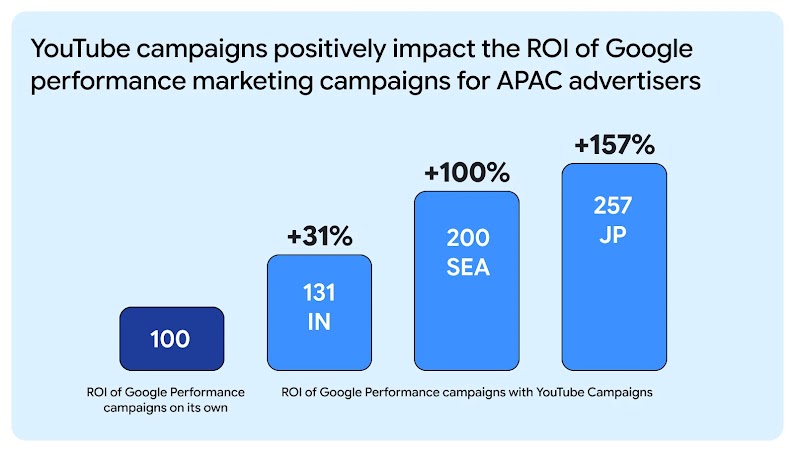
The anecdotal evidence cited by advertisers is supported by new data from Analytic Edge’s Debiased Machine Learning (DML) MMM meta analysis studies. According to those studies in APAC markets, YouTube brand-building campaigns can significantly boost the ROI of Google performance campaigns, with an uplift as high as 157% for advertisers in Japan.
Better yet, running both YouTube and Google performance ads together delivers a combined average ROI that is 2.4X of paid social ROI for advertisers in Australia;1 1.3X for advertisers in Japan,2 1.6X for advertisers in India, and 1.2X for advertisers in SEA.3
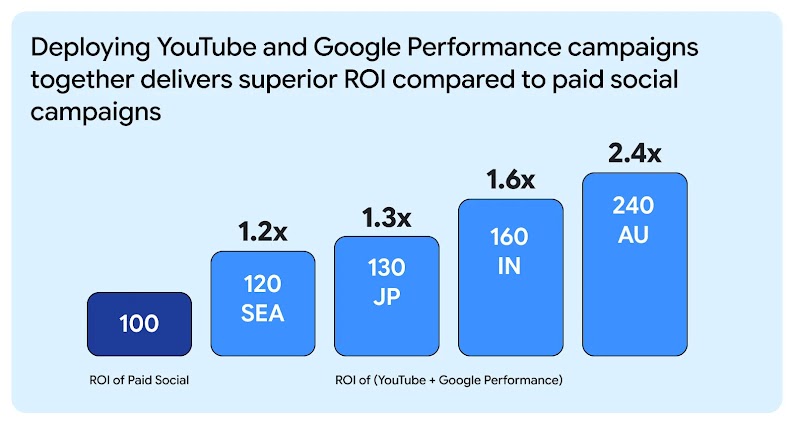
Notably, these combined average ROI values are based on short-term campaigns. The data suggests that even running brandformance campaigns for a relatively brief time can deliver better ROI outcomes, compared to running social media performance ads alone.
How to have it all: Optimise brandformance using the full stack
Savvy brands like GCash understand they no longer need to choose between branding and performance to maximise ROI.
The Philippines-based finance app recognised that profitable growth comes from concurrently creating and capturing demand for its features like GLoan, which offers cash loans with free health insurance.
So it ran video view, video reach and Performance Max campaigns that maximised both brand awareness and conversions among qualified users. GCash’s storytelling ads, featuring a catchy “Loan Song Syndrome” jingle, were a hit: User perception of GCash as a “brand I can depend on for emergency or additional funds” jumped seven points, and search interest in “free health insurance” soared almost 6X. Better yet, daily users rose 14.5%, while CAC dropped 95% compared to standard search baselines, improving profitability.
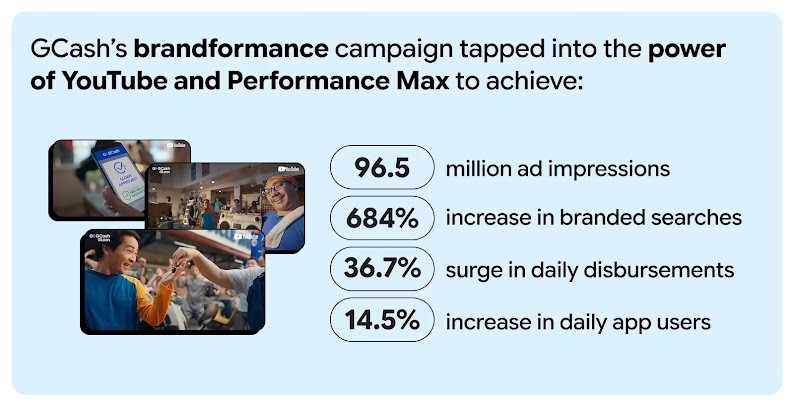
Like GCash’s campaign, which won the Best of Philippines honours at the YouTube Works Awards 2026, your business can use the full suite of Google solutions to score sparkling brandformance results. Here are some ways to embrace an integrated approach:
If you over-indexed on performance marketing: Invest in YouTube campaigns to enhance brandformance ROI. A key opportunity to do that is coming up: during the year-end and new year mega-sales moments.
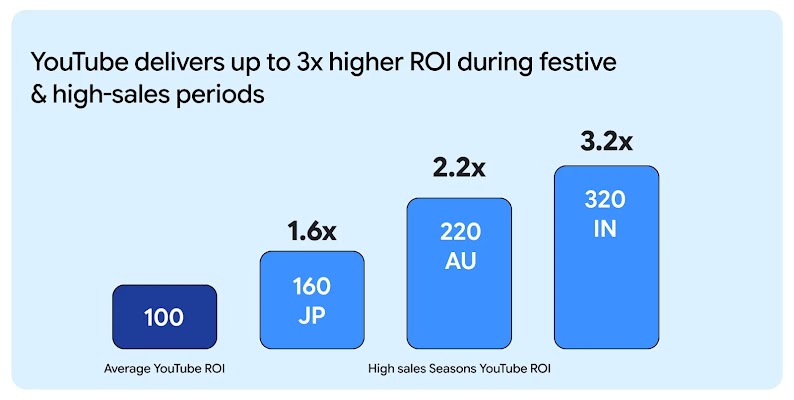
According to Analytic Edge’s meta-analysis in India, during high sales periods, YouTube delivers up to 3.2X higher ROI for advertisers compared to its average performance.4 Similarly, advertisers in Australia, Japan and SEA see higher YouTube ROI during peak sales.
If you over-indexed on brand-building: Improve performance with solutions like Creator Partnership Boost. It lets you use YouTube creator videos in your ad campaigns to convert new audiences.
Additionally, use Commerce media through Google Ads to accelerate high-intent shoppers’ journeys from discovery to check-out for your products on marketplaces like Blinkit, Flipkart, Myntra, Swiggy and Zepto in India, and Shopee and Lazada in SEA.
You can also use BrandStack, which just launched in India. The all-in-one planning and buying engine combines high-frequency branding with performance strategies to drive bottom-line growth.
To optimise your brandformance: It’s critical to accurately understand the ROI contribution of your branding and performance campaigns. For that, you’ll need to extract granular insights using DML. The causal inference method, which can be applied using Google’s open-source DML, removes the bias of external factors, or “confounders,” such as seasonality. By teasing out the true incremental impact of brandformance, you can make better budget decisions.
As AI-powered shopper journeys compress the timelines between attention and action, brandformance becomes critical for helping your brand simultaneously convert in-market and out-of-market buyers. By using the full stack of Google ads and measurement solutions, you can effectively capture maximum demand and ROI growth.


Social Module
Share