





 Sign in with Google
The ‘DICA customer’ journey: How Indian insurers can capture digital intent
In India, one customer archetype stands out for its enigmatic behaviours.
This group of high-value buyers embraces digital-first customer journeys, but mostly abandons digital carts near the last stage. And they spend 80% of their research time roaming multiple online channels, but stick to human-centric offline channels when they finally buy.
Meet the modern insurance customer, whose “digitally influenced, closed-with-assistance” (DICA) purchase journeys may look puzzling to marketers at first glance. But for insurers with the right strategies for engaging the DICA customer, a massive sales opportunity is ripe for the picking.
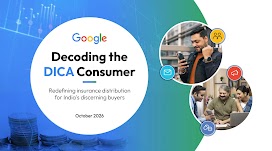
In India, sales of over 40% of all annual life and health policies are digitally influenced before being closed offline. In other words, DICA customers buy over 20 million policies annually. That’s 4X the policies bought via direct online channels, suggesting a massive upside for digital insurers who shift to omnichannel strategies.
These findings are part of in-depth research on DICA customers conducted by Google with knowledge partner McKinsey & Company. Our report about this cohort’s distinct behaviours and omnichannel journeys can help insurers rewire their cross-channel attribution, marketing, and distribution strategies to drive next-level growth.
Why customers opt for digitally influenced, human-assisted journeys
For India’s digitally fluent customers, buying insurance is a deeply personal journey that draws on the best of both worlds: personalised research via online channels, and human assurance to finalise the purchase offline.
That’s giving rise to distinct DICA customer journeys, which are significantly influenced by online channels like the following:
1. AI-powered search: It’s where people go to satisfy their lengthy, complex queries with relevant answers that match their intent and needs. Our survey of over 1,000 insurance customers in India found they’re conducting longer queries, which make up 18% of their insurance-related searches.1 And 41% of surveyed customers made a financial product purchase decision based on information gleaned from AI Overviews.2
2. Mobile apps: Active monthly users of insurance mobile apps grew almost 6X over four years from 2022 to 2026, according to Sensor Tower’s data.
3. Online videos: On YouTube, for example, views for insurance content have surged to over 2.5 billion annually, growing 80% year over year in Q1 2026.3 More than 15% of these views occur on CTV.4
Digital channels drive much of insurance customers’ financial education, discovery and engagement. Yet paradoxically, direct e-commerce accounts for few of the final conversions — just 5% of new business premiums for individual life insurance, and 14% of gross written premiums for health insurance, the Insurance Regulatory and Development Authority’s 2024-2025 statistics show.
The reason for this “conversion gap” lies in the high-stakes, high-trust nature of insurance purchases: Indians choose a human-led final transaction to help them feel fully confident about making a financial commitment of 10 to 30 years.
Notably, 78% of people have already narrowed their evaluation to just two or three brands online — out of over 60 insurers in the market — before consulting with advisors.5 And after they speak to an advisor, over 50% of customers stand by their original online insurer shortlist.
These findings reflect the shifting dynamics of insurance sales: People conduct extensive online research to help them shortlist brands and build conviction. They then turn to human advisors for the final steps, such as validating capital safety (44%) and navigating fine print (28%).
Leading insurers are paying close attention to customers’ surging digital research, which helps them confidently close purchases with agents. As Parthanil Ghosh, managing director and CEO of HDFC Ergo General Insurance, points out, “the emergence of the DICA customer is good news for both awareness and accessibility of insurance.”
How to engage DICA customers: Know their key traits
To effectively drive omnichannel engagement with DICA customers, insurers first need to understand this archetype’s distinctive traits.
Our research found that DICA customers have a relatively higher “digital nurture rate (DNR),” a metric showing the extent of digital influence on purchase journeys. DNR calculates the proportion of total conversions (across all channels) that involve a customer researching and leaving a lead on an insurer’s app or website.
DICA customers typically are:
- Prime-earners: Among all demographic segments, the 25-35 age group and 35-45 age group show 1.5X and 1.3X higher DNR, respectively, compared to the baseline. Additionally, salaried professionals’ DNR is 2X higher than self-employed individuals and 10X higher rate compared to other groups like retirees or students.
- Located in top non-metro cities: These cities’ DNR was roughly 2X higher than the national average of roughly 11%. Regional hotspots include the South (DNR of 36%) and Southeast (26%).
- High-value buyers: DICA customers exhibit a roughly 40% average ticket size uplift compared to the overall customer portfolio, and a 19% to 20% higher likelihood of attaching riders to their policies.6
Insurers’ 3 digital strategic imperatives
Given the high-earning, high-margin profile of DICA customers, it’s no wonder that insurers are investing in Direct-to-Consumer (D2C) distribution strategies to capture digitally influenced intent. In turn, growth in premiums from D2C channels are far outpacing that of insurers’ overall portfolio — at CAGR multiples of 3.5X for Axis Max Life and 3X for HDFC Ergo, for example.7
But to truly capture outsized growth, insurers need to stay seamlessly engaged with DICA customers during the “handoff” stage when they transition from online to offline channels, and a human advisor helps them complete purchase.
That means avoiding common handoff pitfalls, like the lack of customer conversation context and personalised recommendations, that cause insurers to lose high-intent customers.
Leading insurers like Axis Max Life Insurance understand the importance of being present across DICA customer journeys. As its MD and CEO Sumit Madan observed, “When more than 40% of policies are already digitally influenced, the industry’s next growth opportunity lies in converting informed intent into meaningful protection.”
To master the handoff and win the sale, insurers must undertake three strategic imperatives:
1. Rewire the organisation for cross-channel execution. Align channel objectives for agents, agency leaders, and digital marketing teams. Create shared ownership among them to drive insurance distribution by seamlessly connecting digital customer engagement to offline assisted closure.
2. Implement multi-channel attribution. To accurately measure and capture the value created by digital marketing, shift from single-channel attribution where 100% of policy sales are credited to one channel, to estimating every touchpoint’s contribution to overall conversions.
3. Build a capability stack. Adopt these three layers: a foundation of consumer and lead data; an AI-powered decision-making engine that orchestrates handovers through lead scoring, and thirdly, an engagement loop that builds context, drives faster decisions, and captures personalised recommendations across all channels.
As India’s digitalisation accelerates, DICA customers are set to become mainstream. To win over these high-value customers, shift from siloed, single-channel execution to cross-channel strategies that capture every intent and conversion down to the final purchase. For insurers who offer customers the best of digital and human engagement, the growth opportunities are boundless.


Social Module
Share