





 Sign in with Google
The best way for a brand to sell is to actually stop selling and start entertaining. That is the ethos that powers popular YouTube channels Korean Englishman (6.2M subscribers) and Jolly (5.2M subscribers).
What started as a university friendship for creators Josh Carrott and Ollie Kendal has evolved into a global media brand. While Korean Englishman remains a gold standard for niche cultural content, Jolly was launched to be more personality-driven — a formula that has attracted A-list guests from Arnold Schwarzenegger to the cast of “Stranger Things”.
With over 2.6 billion views on that channel to date, the duo has mastered a high-energy, long-form format that turns their content into a winning formula for audience retention and living room viewing.
We sat down with Josh and Ollie to explore their strategy for growth and why the most effective brand partnerships feel indistinguishable from their regular content.
Why did you set up the Korean Englishman channel back in 2013, and what made you do it all over again with your second channel, Jolly?
Josh Carrott: We started on YouTube because we loved making videos together. We used what was most readily available: my ability to speak Korean and passion to share that culture, and Ollie’s talent for filming and editing.
Korean Englishman picked up an audience quickly, but after six years, we realised we wanted a playground for our friendship. Jolly allowed us to experiment.
YouTube is unique because of its authenticity in a world where you don’t often see authenticity.
Ollie Kendal: Jolly is friendship-driven. That has given us incredible longevity, both creatively and personally. And from a business perspective, it opened up a much broader horizon for different types of content and partnerships.
You host many guests tied to cultural moments, like the cast of “Stranger Things”. How do you distinguish between a passing viral trend and a true cultural moment?
Josh: A lot of it is intuition, but the first thought is always: “Will our audience enjoy this?” And just as importantly: “Are we having fun?” If we aren’t enjoying the filming, it becomes very obvious to the viewer and it isn’t entertaining.
Ollie: YouTube is unique because of its authenticity in a world where you don’t often see authenticity. We seek out those unscripted moments that would be cut from a traditional TV interview. On YouTube, those moments are the content.
We do a huge amount of research into a guest’s interests because if the person we’re interviewing is surprised and delighted, we know we’ll get the authentic moment that delivers. We try to give every guest the best interview they’ve ever had.
What are the ‘Dos and Don’ts’ of these content collaborations? How do you ensure an integration adds value?
Josh: The golden rule is to use as much creativity on partnerships and adverts as you do on the content itself. If we bring our audience something unique that they care about and are entertained by, that brings value.
Ollie: That’s only possible when we can have fun with it. Some brands give you limited bandwidth to move, but the ones that trust our knowledge of our audience get the best results.
Our partnership with NordVPN is a great example. Now in its fifth year, we started making original songs and music videos for them — we’ve done over 20 now in various genres. Last year, we did a tribute to Pavarotti with “Nessun Norda”. Because they trust us as entertainers, the integration becomes a highlight of the video rather than a segment people want to skip.
Josh: Our celebrity work actually started through advertisers wanting to promote movies. We would pitch taking actors out for an authentic Korean meal. We gave them a genuine experience and a break from their repetitive junket day. At the end, we talked about the movie.
Our video with the “Avengers” cast in Korea, for example, got about 30 million views. It was easily the biggest press they did in that country, and it was a brand integration.
Ollie: Counter-intuitively, the best way to sell a product or a movie is not to “sell” first. If something makes us laugh, it’s usually a good signpost. We’re looking to bring humour, joy, and longevity to our content, and that extends to brand partnerships as well. About 50% of our viewers are now watching on TV, so our approach is: how can we make something genuinely surprising, delightful, and funny?
If half of your audience watches your videos on TV, does that change your creative process?
Ollie: It changes everything, from the boring technical things to the core strategy. We now grade our visuals for TV rather than mobile, and our sound guy rents proper mixing studios to ensure the audio is TV-standard. We even do team “watch-throughs” on a big office TV to check how the graphics look.
Josh: We’ve found a direct correlation between video length and the device used. If a video is under 14 minutes, the percentage of people watching on TV drops. So, we now specifically pre-produce and edit for longer formats to capture those living room views.
The “maximum virality” style of editing — short and punchy — has mostly moved over to YouTube Shorts. We now use Shorts as a promotional tool to drive people toward the high-production, long-form content on the main channel. TV viewers have higher watch time and retention, which is exactly what brands and creators want.
Because the brand gave us that freedom, the video didn’t feel like an ad […] It racked up over 150 million views across all platforms
What is the key to moving an audience from passively watching to actively buying a product?
Josh: You have to approach every brand uniquely. How is our specific audience going to perceive this brand? Promoting a movie is completely different from persuading someone to download an app. We have to have the flexibility to change our production style to fit the goal.
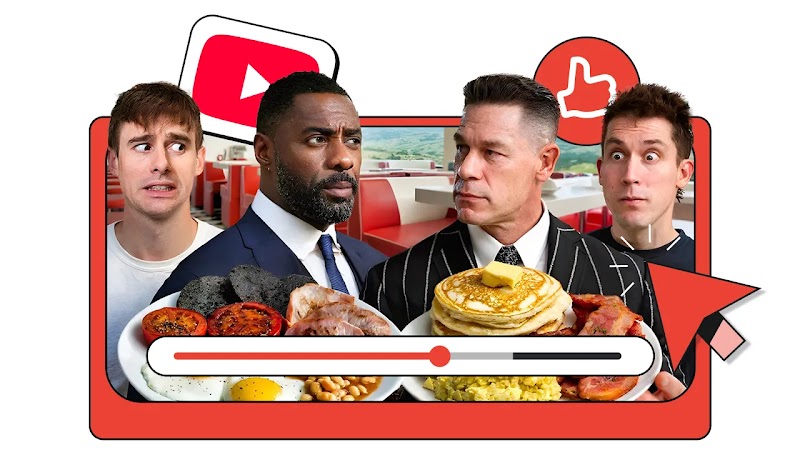
Ollie: A perfect example was our video with John Cena and Sir Idris Elba for their movie “Heads of State”. The studio originally wanted us to film at a promotional pop-up event. We suggested a “British vs. American Breakfast” battle instead. Since the movie involved a U.K. Prime Minister and a U.S. President, it was a perfect thematic fit.
We filmed the American side in New York and the British side in London. Because the brand gave us that freedom, the video didn’t feel like an ad — it felt like an ordinary Jolly video that happened to feature two of the biggest stars in the world. It racked up over 150 million views across all platforms. That’s the power of trusting the creator’s voice.
How do you go about securing your A-list guests, like David Beckham and Ryan Reynolds?
Ollie: We’ve been doing this for 13 years, and celebrity interviews for 10. That level of experience is quite unusual on the platform. We have booking agents in LA, New York, and London, and long-standing relationships with various studios. But some of our best content comes from making our own luck.
We were lucky enough to be invited to a state banquet at Buckingham Palace for the King. While dignitaries like the Prime Minister and Prince William were milling around, I spotted F1 driver Alex Albon. I just introduced myself, and it turned out he’d seen our content. Before you knew it, we were sitting down for a meal on camera. You have to be competitive and constantly look for opportunities, then make sure you make the most of them when they appear.
What’s next for Jolly and Korean Englishman?
Ollie: The grind never stops. We’re heading to the States soon to follow a NASCAR driver for a weekend and we’re planning a large-scale series in East Asia.
Josh: We’re also experimenting with new formats all the time. On Jolly, the horizon is incredibly broad; we can take the channel in almost any direction as long as we stay true to our friendship.
On Korean Englishman, the challenge is different — it’s about how to innovate and keep things fresh within a very specific niche. But after 13 years, I still find it just as stimulating as day one.
Social Module
Share