





 Sign in with Google
Octavia Benham and Nick Dover lead digital growth at Dreams. By linking commercial strategy with real-time data and agile media buying, they make sure marketing spend is always optimised. Their demand-led approach scales what works to drive maximum conversion and incremental revenue.
How do you make sure your marketing spend is always exactly where it needs to be? Traditionally, many brands have relied on rigid, pre-planned budgets — a “set it and forget it” approach. But in a volatile market, a fixed ceiling can give a double-edged problem. Namely, missing out on high-intent customers when demand surges, or overspending when the market goes quiet.
This was the exact challenge we were facing at U.K. bed retailer Dreams. Our team’s traditional, budget-first approach meant constantly adjusting campaign targets to either pull back spend or try to stimulate demand that wasn’t there.
The result was a loss of market share to more agile competitors during critical trading periods. This led to the realisation that, to truly capture growth, we needed a new operational model. We decided to shift from a budget-led approach to demand-led growth, and the first step to achieving that was building a new kind of relationship with our finance department.
The ‘uncapped’ budget myth, and why finance fears marketing flexibility
The core of the myth surrounding demand-led growth is often a simple misunderstanding of control. For finance teams, control has traditionally meant a fixed budget cap. Marketing’s goal, however, is to generate the highest possible return. The way we handled our demand-led growth gave us a solution that meant everyone could sleep at night.
A demand-led model argues that the real control mechanism shouldn’t be a rigid spending limit, so much as a consistent, agreed-upon ROAS.
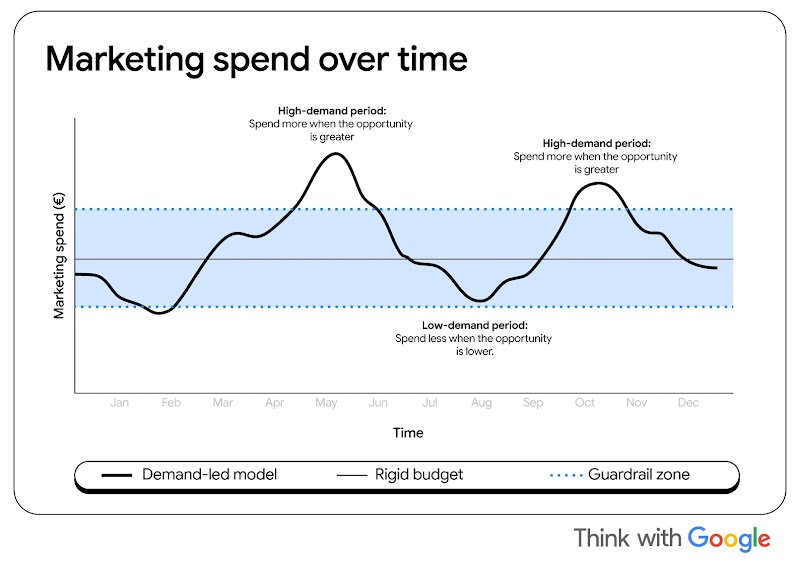
By holding that return steady, your spend can flex naturally to meet market demand. It wakes up and rises to capture opportunities when they’re hot, then hits the hay to conserve resources during the quiet periods. This transforms budgeting from a fixed cost that stays stationary to a variable one that moves in step with the business.
But fair warning: you can’t just sleepwalk into this. Getting there requires a deliberate strategy built on a foundation of trust and shared language.
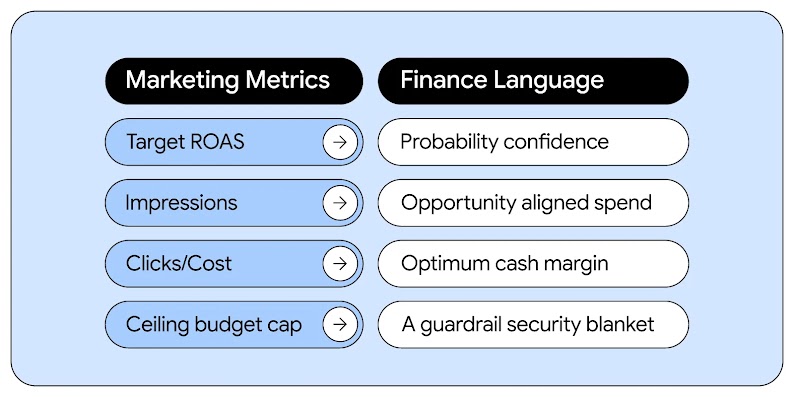
Step 1: Translate marketing goals into the language of cash flow and margin
The first step in building a bridge to our finance team was to start speaking their language. While marketers are fluent in KPIs like conversion rates and click-throughs, these metrics can feel abstract to a finance team focused on the bottom line. Success requires translating marketing objectives into financial terms, so the board doesn’t lose sleep over what it could perceive to be abstract numbers.
We initiated this shift by moving away from softer marketing KPIs like impressions, click through rate, and reach in our conversations with finance. Instead, we leaned into terms that resonated directly with financial stakeholders and thought about our plans in their terms: cash margin, reliability, risk, and forecasted spend.
We then — and this was crucial — established regular “touchpoint” sessions to discuss forecasts and track progress. This created consistent communications that fostered transparency, built confidence, and ultimately meant they were always in the loop and able to ask questions at any stage.
This wasn’t about changing our marketing goals. Instead, it was about reframing them in the language of business impact, to create a shared understanding of what success looked like.
Step 2: Use forecasting to create predictable guardrails for spending
The fear of an “uncapped” budget is a fear of the unknown, but we were careful not to get caught napping here, and we certainly weren’t going to let our grip on the finances drift off. We found the solution isn’t to remove all limits, but instead replace a rigid ceiling with a predictable, forecasted range. Which is where practical guardrails come into play.
To overcome our finance team’s reservations about unpredictability, we provided robust forecast work that narrowed the perceived range of possible spending outcomes. So the practical guardrail came in the form of spend caps which, while never reached, gave the team assurance that our spend wouldn’t scale wildly beyond expectations.
So, instead of a single, immovable cap, we established wide guardrails. This gave our campaigns the flexibility to respond to market dynamics, while providing the finance team with the peace of mind that comes from knowing the outer limits of potential spend.
The conversation was then able to shift from the term “uncapped” (which may make your finance team shudder) to a more controlled reality of operating within defined, predictable parameters. It may sound like a small change in language, but it represented a fundamental shift in mindset, and really helped us move forward cohesively.
Step 3: Prove the model with data that shows outsized gains in peak moments
Don’t sleep on the evidence that actually moves the needle. With a shared language and a predictable framework in place, the final step is to prove the model’s value with hard data. For us at Dreams, this involved conducting a causal impact analysis and then two rounds of incrementality testing in the second half of last year.
The tests were designed to validate our target ROAS and give both our marketing and finance teams greater confidence in the demand-led approach.
AI is the engine that drives our demand-led strategy, and is now the foundational enabler for our strategic budget decisions. A combination of tools help fuel our demand-led budget:
- Performance Max to find converting customers across Google channels at the right time; and
- AI Max for Search to optimise ads in real time.
The outcome of Dreams
The results demonstrated a powerful double win. During unexpected high-demand moments, our campaigns remained unconstrained, while many competitors who were not demand-led hit their budget ceilings.
This created a less crowded bidding auction that allowed us to capture an outsized share of the market. This uplift was quantified by completing causal effect analysis, which demonstrated the incremental revenue and orders we had driven by following demand led budgeting practices. The tangible impact was clear: over a three month period, the new strategy delivered an 18% increase in incremental revenue and a 21% jump in incremental orders.
And there was another significant benefit: stability. By sticking to a consistent ROAS target instead of constantly making manual adjustments, we allowed our Google AI-powered bidding to operate as the best version of itself. The algorithm learnt to be less tentative after every (frequent) change, which meant it could perform more effectively and efficiently. This proved that a hands-off approach, guided by a consistent strategy, could deliver better results.
For marketing leaders, the path to greater agility runs directly through the finance department. By translating our goals, providing predictable forecasts, and proving the value with data, we can reframe flexible spending not as a risk, but as a predictable, data-backed engine for growth.
We believe the future of marketing depends on this collaboration. It’s not about bigger budgets, it’s about building the trust that unlocks smarter, more responsive ways of working, and a sustainable partnership that doesn’t hit the snooze button on innovation.


Social Module
Share