





 Sign in with Google
Harikesh Nair, senior director of data science and engineering at Google, explains how marketers can bridge the “actionability gap,” the disconnect between having data-driven insights and the ability to act on them in real time. In this article, he shares how brands can transform marketing mix modeling from a retrospective report card into a forward-looking strategic asset.
For decades, brands have used marketing mix modeling (MMM) as a compass to navigate the media landscape. But with today’s explosion of digital channels and intense pressure for efficiency, these models too often act as a rearview mirror rather than a guide. To explore modernizing this approach, Google sponsored research by Harvard Business Review Analytic Services.
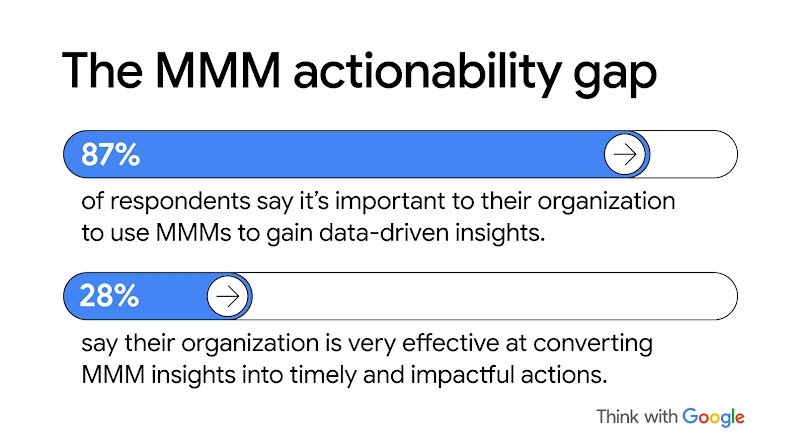
The results are stark. While 87% of respondents say it is important to their organization to use MMM, only 28% say their organization is very effective at converting MMM insights into timely action.1 To bridge this actionability gap, marketers must transform MMM from a static report card into a dynamic tool that guides future decisions through real-world simulations. This modernized approach allows leaders to directly connect every marketing investment to overarching business outcomes, ensuring that media spend is never viewed in isolation from the company’s bottom line.
This transition requires more than just new tools. It demands a new partnership between data and strategy built on three core principles:
- Democratizing the science. Building universal trust through transparent methods.
- Automating complexity. Freeing marketers to focus on strategy rather than data prep.
-
Unifying the view. The next era of marketing measurement centers on a truly unified perspective. We’re focused on bridging the gap between fragmented data and a single, authoritative view.
The research reveals a clear divide between how leaders and laggards bridge this gap. The report defines leaders (22%) as those organizations who are very effective at both gaining data-driven insights from MMM and converting them into timely, impactful actions. Conversely, followers (36%) are only somewhat effective in these areas, while laggards (42%) are not very effective at turning their modeling into meaningful results. By adopting the following four strategic shifts, these top-performing leaders are moving beyond historical audits and toward predictive foresight.
Proving marketing ROI across a fragmented landscape
Two factors are driving the return of MMM: 68% say their organization is using MMM for a greater focus on ROI marketing efforts, while 54% are doing so due to increasing marketing channel complexity. With customers fluidly moving across search, social, and streaming platforms, traditional tracking is failing, making MMM an essential tool for the modern landscape.
MMM has evolved from a nice-to-have report into an essential survival tool for measuring success in a crowded digital world.
For DoorDash, this fragmentation was compounded by the loss of traditional tracking signals. To solve this, the company leaned into MMM as a privacy-safe way to capture the big-picture impact of its spend. By analyzing aggregated, channel-level data, from TV to search, DoorDash can measure the impact of its spend without tracking individual journeys. Moshe Katzwer, senior manager of data science and analytics at DoorDash, sees this shift as a strategic necessity to maintain a reliable view of performance: “Marketers are being pushed into a world where we have to use MMM.”
Ultimately, as traditional marketing measurement methods disappear, MMM has evolved from a nice-to-have report into an essential survival tool for measuring success in a crowded digital world.
Modernizing the tech stack through data strength and integration
The biggest obstacle to moving faster isn’t just a lack of tools, it’s the state of the data itself. According to the report, data quality in MMM insights (47%) and integrating siloed data from multiple sources (46%) are the top challenges companies experience when converting MMM insights into meaningful action. Leading brands are overcoming these hurdles by focusing on two foundational changes:
- Automating the busy work. To eliminate manual bottlenecks and fragmented data, specifically for complex sources like earned media and influencer activity, jewelry brand Pandora used AI to automate its historical data categorization. Doing so improved its overall data hygiene and significantly reduced human error, which Jeppe Borch, Pandora’s director of digital media, notes has directly improved the accuracy of its MMM output and strategic insights.
- Finding one version of the truth. Agency Hearts & Science focused on triangulating different data signals rather than relying on a single, potentially flawed perspective. Shamsa Jafri, head of analytics at Hearts & Science, believes in a measurement approach where incrementality tests calibrate MMM results: “If results don’t agree, we don’t debate opinions. We run the next-best test and let causality decide. This takes pressure off the models to be perfect and puts the focus on continuous learning.”
Moving at the speed of the customer
Though 46% of respondents say their organization faces slow internal processes when converting MMM insights into meaningful action, the most successful organizations are finding ways to accelerate their response times.
The research shows that leaders stand out by:
- Connecting data to decisions. Leaders are far more likely than laggards (55% versus 20%) to connect their MMM outputs to real-world marketing decisions.
- Increasing the pulse of marketing measurement. To keep up with the market, 65% of organizations that effectively use actionable MMM will update or refine their MMM design at least quarterly.
By shortening the cycle from seeing the data to experimenting and adjusting the plan, companies can optimize their campaigns in real-time to capture new opportunities.
Building a collaborative insights culture
Modern measurement works best when it is a shared effort. While 41% say their organization struggles with siloed teams that prevent the sharing of MMM insights across departments, today’s leaders are breaking down those walls to create a more unified and collaborative environment.
Bridging the actionability gap is less about finding better math and more about an organizational commitment to agility.
Lisa Giacosa, chief transformation officer at Spark Foundry, noted that, while finding talent with the right mix of expertise is critical, the real unlock is simplifying the work itself. Successful organizations focus on establishing a common language. Half of the top-performing companies ensure that analytics and execution teams use the exact same metrics. By providing clear and intuitive dashboards, companies allow business teams to, as Giacosa puts it, “connect the dots and see patterns” across the organization. This ensures data becomes a collaborative tool that empowers the entire business to grow together, rather than a black box reserved for specialists.
A new engine for growth
This evolution pulls marketing out of its silo and establishes it as a primary driver of enterprise-wide success. By reframing marketing as a capital investment in a brand’s portfolio, MMM insights allow the CMO and CFO to move in tandem, shifting the conversation from defending a budget to co-authoring growth plans that allocate capital based on risk-adjusted returns.
Through these shifts, organizations transform their measurement ecosystem from a reflection of the past into a high-speed engine for future growth. It moves beyond simply tracking where the money went to showing exactly where the next dollar should be invested to drive the greatest impact.
To learn more about how your organization can bridge the actionability gap, find the full Harvard Business Review Analytic Services report here.
Social Module
Share