





 Sign in with Google

Harikesh Nair is a senior director of data science and engineering at Google, where he leads the Media Effectiveness Measurement Engineering team and the Analytics, Insights, and Measurement data science group. A former professor at Stanford University, Nair now focuses on developing products and strategies to help marketers understand and improve the effectiveness of their media investments, by driving innovation in the field of ads measurement.
As the saying goes, if you want to know the future, look at the past. It stands to reason then, if you want to look far into the future, you need the ability to look even farther into the past. This simple concept represents one of the biggest bets in media measurement today, and Gemini has unlocked our ability to win it.
Using models trained with historical data, marketers should soon be able to understand the impact of demand-creation campaigns in generating conversions over the long term. More impressively, they should also be able to use those signals to predict demand, conversions, and returns in the future.
These capabilities will help marketers pace and plan their businesses more strategically than ever before, differentiating them from their competitors and, ultimately, driving higher revenue by making smart optimizations early and often. Here’s how my team is exploring and testing new approaches to accurately measure and predict the long-term value of advertising.
Playing the long game in demand creation
For years, a silent tension has existed between the marketing department’s mandate for growth and the finance department’s demand for immediate proof. Unfortunately, this has led to systemic “short-termism” in ad attribution, by restricting focus and credit to what happened right before the conversion. This practice has produced a system that is clean for accounting but catastrophic for growth marketing and demand creation.
When you evaluate demand-generating campaigns using short-term metrics, more than half the value being created is uncounted. It’s invisible.
A typical attribution strategy (such as providing conversion credit to last-touched ads over a standard 30-day look-back window) continues to work well if you are attempting to convert existing demand. Our new research shows that 70% of conversions for a standard Google Ads campaign are captured within the 30-day click and 3-day engaged-view conversion look-back window.1 Great. Perfectly reasonable results.
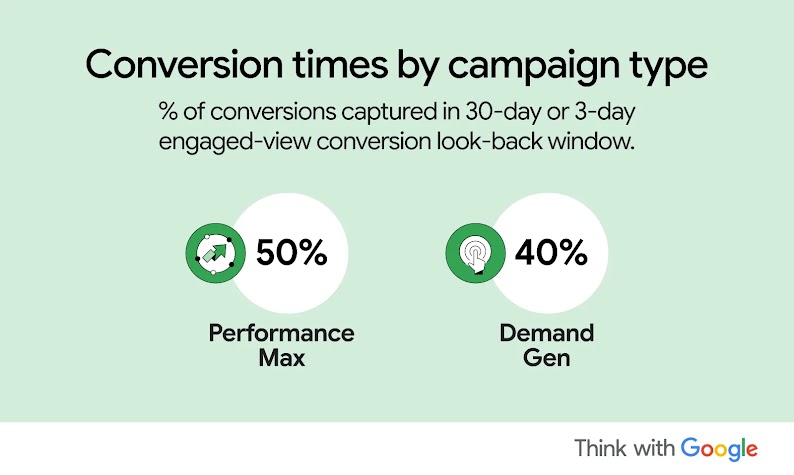
But what if you are trying to create and convert new demand? Sales cycles for many products are considerably longer (for example, expensive and high-involvement products often involve consumer research and consideration time prior to purchase); and newly engaged consumers take time to engage with the brand, research the product, and eventually purchase. That’s why when we evaluated campaign types oriented toward demand creation, we saw a reduction in conversions occurring within the standard windows. We found that only 50% of conversions from Performance Max campaigns are captured within the 30-day click and 3-day engaged-view conversion look-back window.2 And just 40% of conversions for the Demand Gen campaigns are captured within the same time frames.3
This means that when you evaluate demand-generating campaigns using short-term metrics, more than half the value being created is uncounted. It’s invisible. This is a problem my team of data scientists is working to solve.
The science of breadcrumbs
To better measure the long-term impact of Google Ads campaigns and improve overall advertising effectiveness, my team has focused on methodologies that emphasize transparency, auditability, and explainability. The long-term impact of such campaigns involves attributing conversions to ad interactions that happened over many previous months. To be credible, we need a clear trail of breadcrumbs that show the user has demonstrably engaged with the advertised brand and moved further along the path to conversion after being exposed to the ads.
To do this, we use what we call leading user actions (LUA) as mile markers. LUAs are qualified, intermediate steps that occur between an initial ad engagement and a conversion. LUAs are observable and verifiable, forming a consistent and repeatable way of knowing the advertising induced movement along the purchase journey prior to the conversion.
We need a clear trail of breadcrumbs that show the user has demonstrably engaged with the advertised brand and moved further along the path.
Examples of these LUAs include:
- Branded searches, moving from searching for “best suvs” to searching for a specific brand or model.
- Deep engagement, interactions with advertiser-linked YouTube channels, such as “like,” “subscribe,” or “share.”
- Micro-conversions, shallow actions like adding a product to a cart or signing up for a trial.
To use the attribution for optimization, we leverage sophisticated AI algorithms to predict future long-term conversions, leveraging observed LUAs and other signals. Using these AI predictions allows bidding algorithms to accurately value users on their likelihood to purchase, optimizing for long-term growth without waiting months for the conversion to hit the books.
A tested and proven approach
While Google is still in the testing stages of developing new products oriented around this thinking, our measurement partners have already begun publishing findings from similar experiments.
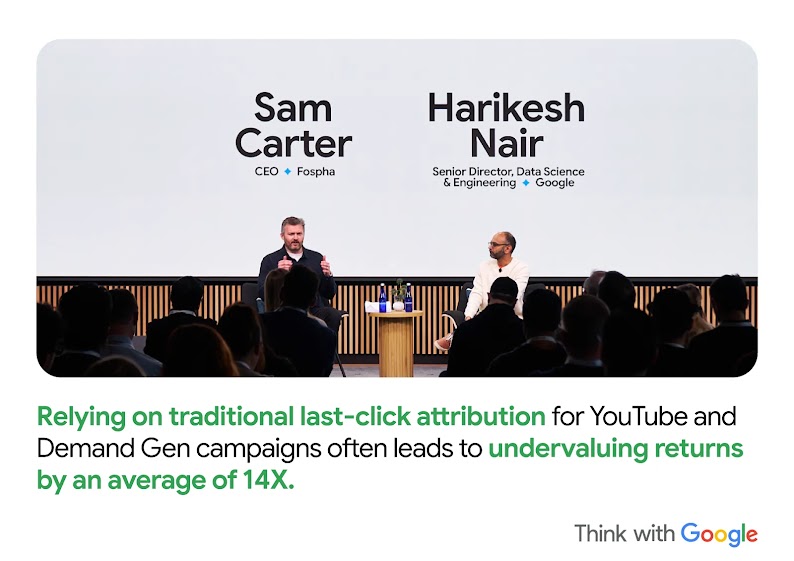
As an example, a 2025 Fospha report notes that relying on traditional last-click attribution for YouTube and Demand Gen campaigns often leads to undervaluing returns by an average of 14X. This highlights an industrywide shift as advertisers move beyond last-observable touchpoints to better account for the impact of awareness and consideration focused ads.
When you look at the gains from long-term signals, it’s clear that advertisers are leaving money on the table — or at least not reporting it accurately to their financial stakeholders. The performance of the ads hasn’t changed. It’s just been hidden by a systemic bias toward short-term wins. It’s time to shift the focus to the full picture.
Start preparing now
We are entering a new era of digital marketing where the linear funnel is a relic and the ability to measure demand creation is going to be the new mandate. Take action today to stay ahead of the curve. To ensure success with long-term marketing ROI metrics in the near future, we recommend advertisers start by taking the following three steps:
- Renegotiate short-termism: Start conversations with your finance counterparts to align on the critical role of demand creation. Educate your CFO on how traditional last-click attribution can undervalue YouTube and Demand Gen returns by up to 14X.
- Audit your time-to-conversion windows: Using Google Analytics 4, marketers can analyze the time lag between a user’s first interaction and their final conversion. Key methods include using path exploration to trace user journeys and analyzing path length reports to understand conversion latency.
- Apply for the reporting pilot: In the first half of 2026, we plan to broaden our testing cohort for long-term demand reporting and bidding in Performance Max. Interested Google clients should talk to their account teams about enrolling in the pilot. Seats are limited and participants will be selected on a case-by-case basis.
Social Module
Share