





 Sign in with Google

Orlando Wood is chief innovation officer at global marketing effectiveness platform System1 Group. He is the author of two books on advertising effectiveness: “Lemon” and “Look Out”, and creator of Advertising Principles Explained (a.p.e.).
What’s the last advert you truly remember watching? When you reach for a chocolate bar, what slogan comes to mind? How about a takeaway delivery service or an optician?
Ads can stick with you for decades, and any that do are most likely examples of “showmanship”. These ads use compelling narratives and relatable characters to find the magic in a product. Their starting point is often a fundamental truth. This creative style charms through emotional appeal, builds memory structures, and shapes preference.
Then there is “salesmanship”. These ads nudge the sale and give a reason why you should buy. They target only the small percentage of consumers who are ready to buy right now or have already been warmed up to your brand by your showmanship.
Our research at System1 shows that the advertisers have dramatically prioritised salesmanship over the last two decades, and this is to their detriment:
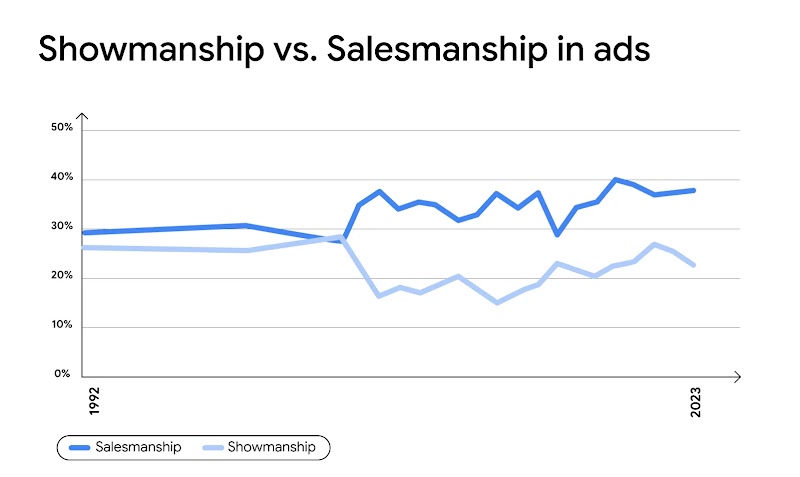
The chart from System1 Group tracks “showmanship” and “salesmanship” over 30 years in U.K. TV advertising.
The cost of the decline in showmanship
The problem with this rise in salesmanship is an associated reduction in effectiveness. It’s estimated that last year, globally, brands and marketers spent over $1trillion on advertising. Yet, going by System1’s research, maybe only 6% of it was truly effective — achieving the kind of emotional response needed for profit and growth.
Showmanship is about strengthening the fundamentals of the business: establishing salience and trust, strengthening pricing power (things that fleeting salesmanship rarely achieves), in addition to creating sales.
And as showmanship features have been sacrificed and efficiency prioritised, advertising’s overall effectiveness has declined. This single-minded focus on short-term results over long-term impact, means brands risk disappearing from the cultural consciousness. And a decline in growth and sales is most likely to be what follows.
The revolution we need isn’t technological; it’s creative. We need to rediscover the lost art of the show.
The attention-backed case for characters and creativity
Showmanship and salesmanship speak to two different modes of receptivity, two different modes of attention.
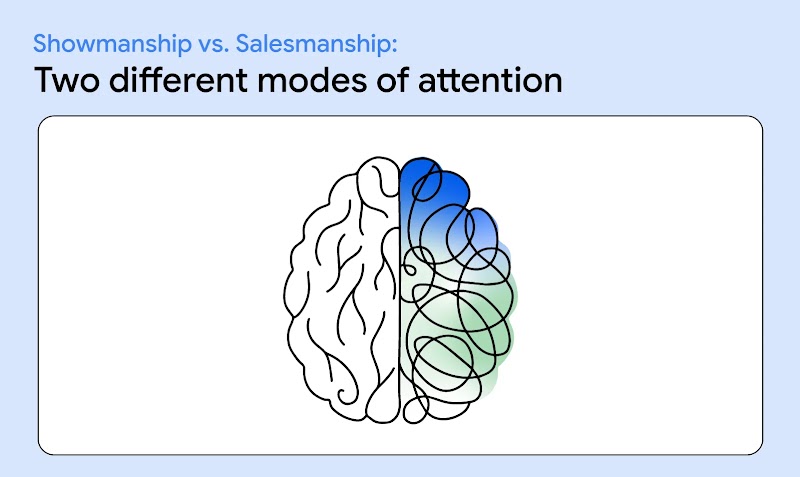
Drawing on the work of neuro-psychologist Dr. Iain McGilchrist, we can see how these two approaches appeal to the two types of attention associated with the different hemispheres of the brain.
The right hemisphere gives a broad, open, and vigilant form of attention to our surroundings. It understands context, metaphor, narrative, music, and humour. It grounds us in the world and understands the living — characters, human interaction, and a sense of place. It’s open to novelty and alert to the unexpected.
Showmanship captures the broad-beam attention of the right hemisphere, creating fame and growth.
This is where “fluent devices” come in. It’s a term I coined to describe recurring characters like the Geico Gecko, or repeatedly used scenarios, like Specsavers’ “Should’ve gone to Specsavers” campaign.
These devices are powerful vehicles for showmanship. They are living manifestations of a brand’s personality, ensuring consistency over time while also allowing for freshness with each new execution.
Data backs this up. In work with Peter Field for the Institute of Practitioners in Advertising, we found that campaigns with fluent devices are significantly more likely to drive profit and market share gain. They also reduce price sensitivity more than campaigns without.
So, where does salesmanship come in? Anything of interest to the right hemisphere is passed to the left hemisphere for it to bring a narrow, focused, and close-up attention to what it sees.
The left-hemisphere is goal-oriented; it’s literal and explicit, and breaks things down into smaller parts. It favours things and tools over people. This is the world of salesmanship: close-ups on products, direct calls to action, words telling you what to do with little sense of narrative, character or place.
Actionable lessons from brands that have mastered showmanship
So, if your ads are more sales than show, where do you begin? By looking for the magic in your product and finding a way to dramatise a fundamental truth. As the legendary David Ogilvy said: “Tell the truth, but make the truth fascinating”.
Your goal is to find a big, encompassing idea, an organising principle that people will grasp easily, and that quickly taps into a fundamental human motivation.
- Specsavers – “Should’ve Gone to Specsavers”: This enduring scenario-based fluent device dramatises the observation that poor eyesight or hearing can lead to easily-avoidable and humorous mistakes. It uses humour to lodge the brand in memory long before a purchasing need arises. Ensuring that when the moment comes, the solution is instinctively known.
- Compare The Market’s Meerkats: This long-running character fluent device uses meerkat characters Aleksandr and Sergei to remind people that if you want cheap car insurance you should go to Comparethemarket.com, not to Comparethemeerkat.com. Simples.
If you don’t embrace showmanship you are running the risk of diminishing returns, of increasing reliance on discounts and price reductions, and it will limit your growth.
If you want to grow, you have to put on a show. And that means creating advertising that is interesting, compelling, and entertaining — advertising that builds an emotional connection.
Combining showmanship and salesmanship for a bigger impact
For the generation of marketers who have “grown up” in this performance salesmanship world, the practical principles of Showmanship can be learned. My course Advertising Principles Explained (a.p.e.) was created precisely to help marketers understand the kind of creative that drives profit and growth, helping you to bridge the knowledge gap.
Both schools of advertising are important, both play a role, but of the two, showmanship is the more important, and it makes your salesmanship work harder. It’s not a case of choosing one approach over the other, but about restoring balance. Effective marketing needs both.
Broad-reach showmanship creates the salience, associations, and trust that make your salesmanship really perform. Showmanship primes the people who aren’t buying from your category today, so that your brand is the one they automatically turn to when the time comes.
As technology and AI make the mechanics of salesmanship ever more efficient, the human touch of showmanship will become our most valuable tool. It’s time for a new creative revolution.
Social Module
Share