





 Sign in with Google
Jon Evans is the host and executive producer of the Uncensored CMO podcast, one of the world’s most popular marketing podcasts, with more than 100,000 monthly listeners.
When I first sat down to record the Uncensored CMO podcast in 2019, I had a confession that would make most audio creators shudder. I had never actually listened to a podcast. I was just curious to see if I could do a better job than the dry, over-produced interviews I’d stumbled across.
Fast-forward to today, and we’ve crossed 250 episodes and 3 million downloads. After 20 years in FMCG leadership — managing brands like Lucozade and Ribena — I’ve essentially spent the last few years getting a “peer-to-peer” PhD from the world’s most iconic marketing minds.
Talking to interviewees from Kory Marchisotto, president of e.l.f. Beauty, to Mike Cessario, the founder of Liquid Death canned water, I’ve noticed a pattern. Success isn’t about being the most technical marketer in the room. As Kory once told me, success is defined by the distance between the C-suite and the customer, and the time from insight to action.
Here are the five universal lessons I’ve gathered from over 250 conversations with the industry’s heavyweights:
1. Maintain a “humble curiosity”
The best CMOs I’ve interviewed don’t act like the finished article. This is a fascinating paradox: they’re considered the industry’s gold standard of how a CMO should think, act, and behave. Yet they remain open to feedback and being challenged.
The top tier of marketing leadership never stops asking ‘Why?’ even when they’re at the top of the mountain.
They are essentially behavioural psychologists. They are obsessed with how the world works and why humans make the decisions they do. Which is why I frequently have experts like Rory Sutherland, Dan Ariely, or Richard Shotton on the show. They give me the “why” behind the “what”. The top tier of marketing leadership never stops asking “Why?” even when they’re at the top of the mountain.
2. What got you here won’t get you there
By the time you become a CMO, you aren’t really ‘doing’ marketing anymore. You’re a leader. I found that out pretty quickly in my first CMO role — I spent less than 10% of my time on actual marketing. The rest was what I call the Four Ps of the CMO:
- Politics: Navigating the organisational hierarchy to understand how decisions are actually made.
- People: Identifying talent and nurturing them. You can’t do the brand manager’s job; if you try, you’ll just burst their bubble and micromanage them into mediocrity.
- Planning: Owning the vision and providing the “air cover” that allows your team to work without interference.
- Persuasion: Constantly framing marketing in business metrics that the CFO and the board can get behind.
3. “Restaurant smart” vs. “corporate smart”
This insight was inspired by Will Guidara, who built New York City’s Eleven Madison Park to become the number-one restaurant in the world. Will differentiates between “corporate smart” (focussing on uniformity, efficiency, and scale) and “restaurant smart” (where the best-paid person in the building is on the floor, obsessed with the customer).
The most successful leaders treat their roles with a founder’s mentality. They act like owners, stay dissatisfied with the status quo, and refuse to let the “head office” mentality distance them from the people buying their products. They maintain a sense of rebellion, and a relentless drive to make things better, regardless of how successful they were yesterday.
4. The power of compounding (and strategic laziness)
My podcast journey taught me a vital lesson: growth is rarely linear. It’s a hockey-stick curve. I’m a slightly better podcaster today than I was in 2019, but I have a thousand times more downloads. That doesn’t mean I’m 1,000x better than I was, it’s just the power of compounding — staying consistent every week for six years.
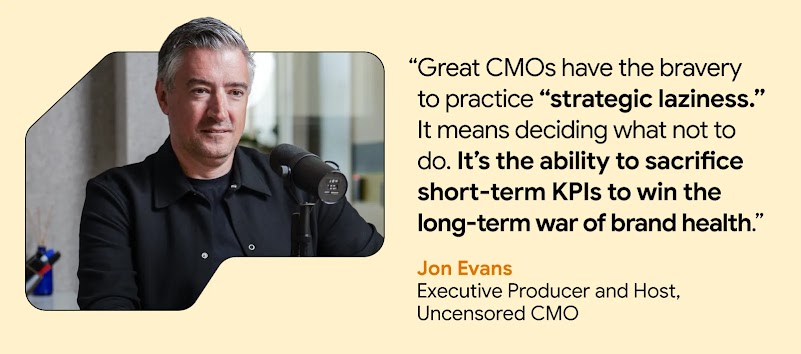
In marketing, the biggest mistake is “new leader syndrome”: changing the agency, the brand platform, or the creative direction just to make a mark. Great CMOs have the bravery to practice “strategic laziness,” a term I stole from author & CEO of the Marketing Society, Sophie Devonshire. It means deciding what not to do. It’s the ability to sacrifice short-term KPIs to win the long-term war of brand health.
5. Greatness is in the agency of others
As New York University business professor Scott Galloway famously said, “Greatness is in the agency of others.” To scale, you must be brutally honest about what you’re rubbish at. I hire people who love the technical tasks I find draining, or just can’t do well.
Your job as a leader is to provide the “air cover”. You take the hits from the sales team or the board so your team has the freedom to create. If your team had a productive week and never knew you spent Tuesday defending their budget in a heated meeting, you’ve succeeded. You take the blame when things fail; you give them the credit when things fly.
To scale, you must be brutally honest about what you’re rubbish at.
The road ahead
As we move through the AI revolution, I’m bullish on the power of creativity. We are currently in an era of massive technological displacement, similar to the industrial or computer revolutions. It’s that momentous.
During any revolution, everyone focuses on the tool. They ask, “Will it save me money?” or “Look what the tool just did!” But after the initial shock, the focus always shifts to how we use the tool.
Right now, we’re stuck in a window of cost-cutting discussions. In the next few years, the CMOs who win will be the ones who move past the tool’s novelty and use it to do something fundamentally magical: combining high-speed execution with deep human insight to solve customer problems in ways we previously thought impossible.
In 2026, the CMOs who win will be the ones who stop obsessing over short-term gains and start using these tools to bridge the gap between human insight and magical execution.
My advice is to own the story, protect your team, and never stop being the most curious person in the room.
Social Module
Share