





 Sign in with Google
Professor Karen Nelson-Field is a globally recognised voice in media science, and the founder of attention agency Amplified. With a PhD in audience measurement, her career has seen her transition from academia to pioneering attention measurement that moves beyond reach to actual human engagement.
My career has been dedicated to the study of human attention. How we earn it, how we measure it, and what the future of it is.
That future isn’t about more dashboards or more complex tracking. It’s about embedding the reality of human behaviour so deeply into our AI systems that the hard work of building for attention is done for us, by default.
This journey started for me over a decade ago. I remember being in Italy when I first developed the concept: “Not all reach is equal.” It was born out of a challenge from a global CPG giant frustrated with viewability metrics — the industry standard of 50% pixels for two seconds.
They knew, as we all do instinctively, that just because an ad is technically on a screen doesn’t mean a human is looking at it.
Through years of research at Amplified, we’ve proved that there is a massive gap between an ad being “served” and an ad being “seen.” I knew we had to stop looking at the ad and start looking at the human.
The physics of the thumb: Respecting the platform
We often hear that attention is a demographic problem — that “Gen Z has a short attention span.” My data says otherwise. Attention is governed by the user experience of the platform.
Whether it’s me or my teenage son scrolling through a feed, our behaviour is remarkably similar. That’s because we are both beholden to the same physics of the thumb. We are trapped by the scroll speed, the skip mechanics, and the glass ceiling of the interface. This creates what I call attention elasticity:
- Inelastic platforms: These have a hard limit. If a platform’s UX is designed for high-speed scrolling, even a Cannes Lion masterpiece won’t get more than a couple of seconds. The stage is simply too small for a long performance.
- Elastic platforms: Platforms like YouTube are more stretchy. While there is still a baseline, high-quality creative has the power to significantly extend the viewing time.
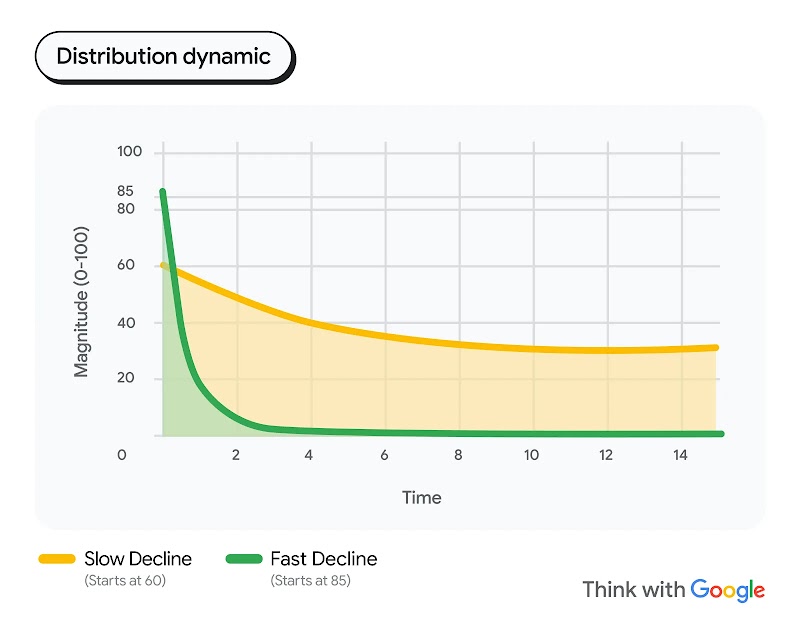
Not all platforms lose an audience — a process I call “attention decay” — at the same rate. On high-speed social feeds, the decay curve is sharp. On platforms like YouTube, the curve is shallower, allowing for the sustained attention necessary for deeper information processing.
The 1.5-second “hack” for brand memory
You cannot out-creative the physics of a fast-scrolling feed. However, you can hack it. While my previous benchmark for memory encoding was 2.5 seconds, our latest research reveals that you can successfully encode a brand memory in just 1.5 seconds — but only if you have asset fluency.
Asset fluency is the speed at which a consumer recognises your brand. It’s the cheat code that allows a brain to identify you instantly through distinctive brand assets (DBAs) — your specific colours, shapes, or sounds — without needing to see a logo or name.
In a world of infinite scrolling, emotion earns the moment, but branding converts it.
Brands without fluent assets pay what I call a self-inflicted tariff. Because their branding isn’t instantly recognisable, they require longer attention times that digital feeds rarely provide. They are effectively paying a tax for being generic.
It is also a mistake to think that creativity alone — specifically emotional storytelling — can bypass these physics. I know how powerful emotion is in building memory structures. Emotion is what earns you those extra moments of attention.
But here is the catch: You can earn ten seconds of attention and still lose the sale if your branding is weak or late.
In a world of infinite scrolling, emotion earns the moment, but branding converts it. Without asset fluency, you are simply entertaining the consumer for a few seconds before they misattribute your hard-earned attention to a better-known competitor.
Garbage in, garbage out: Training your AI on truth
But the great news is, with AI like Google’s Gemini, built into Google’s advertising products, marketers can take the heavy lifting out of building campaigns that earn attention.
Most of us are using AI in our daily workflows. And as we all know, an AI is only as good as the data it’s trained on. If we train machine learning models on proxy metrics like impressions, we’re teaching them a skewed version of reality.
Through our research filming people interacting with content, we’ve learned that attention is highly predictable.
A million impressions on a platform where users scroll rapidly and attention decays in under two seconds is profoundly different from a million impressions on a platform that commands more sustained focus. Yet, to an AI trained on raw impression data, they look identical.
The solution is to give our AI systems a better teacher.
Real human attention, measured through computer vision and biometrics, is the grounding signal needed to connect AI’s processing power to the reality of human behaviour.
Through our research filming people interacting with content, we’ve learned that attention is highly predictable. The way a person watches a video on YouTube is fundamentally different from how they scroll through a social feed, and these patterns are consistent.
The platform’s design — its scroll speed, its skip mechanics, the level of user control — creates the physical constraints within which creative must perform.
These attention physics are a set of predictable rules that can be codified and fed into machine learning models. Attention data becomes the constraint that trains AI on how humans actually view, or ignore, advertising.
The bottom line: Memory starts in the blink of an eye
This future is not a decade away; it’s happening now. The shift to AI-first marketing is accelerating, and the inputs we choose matter more than ever. The first step is to begin the process of valuing human attention over simple exposure.
It requires a mental shift from asking, “How many impressions did our campaign serve?” to “How many seconds of quality attention did we actually earn?” The goal for the modern marketer is no longer just to “serve” ads to a million people. It is to be seen, processed, and remembered.
We are moving toward a world where you won’t have to be an attention expert, because your systems will be.
By training our AI on the truth of human behaviour, we unlock its potential to not just make our ads more efficient, but to make our connection with people more meaningful. Because in the end, memory drives growth — and memory starts in the blink of an eye.
Social Module
Share