





 Sign in with Google
In this series, we challenge brands to create the “impossible ad” using AI-powered tools. Here, we share an exclusive look at how Virgin Voyages used Google AI to achieve one-to-one AI personalization at scale, turning individual traveler signals into cinematic, tailor-made creative ahead of the campaign’s public launch.
In a luxury cruise market defined by visual uniformity, Virgin Voyages used Google’s AI stack to make marketing feel as unique as the trip itself. Its “Postcards from Your Future Self” campaign, set for launch later this year, will capture high-intent signals from a traveler’s browser behavior and convert that session data into unique, AI-generated creative. By using Gemini, Imagen, and Veo to build cinematic postcards tailored to individual interests, Virgin Voyages seeks to prove AI can collapse the distance between creative intent and personalized execution, at a scale previously deemed impossible.
Breaking industry uniformity with AI-driven creative
Visual homogenization makes it difficult for brands to stand out in the cruise industry. To the average consumer, every ship and every itinerary can start to look the same — a phenomenon the brand calls “white ship syndrome.” “In the cruise industry, every cruise ship looks the same, which is exactly why our ships are gray by design,” said Billy Bohan Chinique, VP of global brand marketing and AI transformation at Virgin Voyages.
The technology allowed us to let customers see themselves in our product.
To break through category fatigue, the company’s marketing strategy needed to move beyond generic “brand-as-hero” advertising and shift the narrative to the traveler’s own experience. The goal is to make a future vacation feel tangible through a personalized preview of the future.
“With this campaign, we didn’t try to make the brand the hero. Instead, nostalgia and the feeling of travel were the heroes,” Bohan Chinique said.
Turning real-time intent into personalized assets
The campaign uses advanced generative AI marketing tools to reinvent the oldest form of travel communication: the postcard. By leveraging real-time, on-site signals, Virgin Voyages is creating a digital “wish you were here” moment to make the future trip feel personally tangible. “Nothing is more personal than a postcard, but generating that at a scale can only be done with a tool like this,” said Christian Schrader, creative director at Virgin Voyages. “The technology allows us to let customers see themselves in our product.”
To bring this impossible brief to life, the team has developed an integrated workflow where human intent directs the AI’s production power and operational efficiency, solving the historical trade-off between one-to-one AI personalization and exponential cost.
- Translating intent: Serving as the central intelligence engine, Gemini interpreted session data, such as viewing Mediterranean itineraries or premium cabin features, to generate bespoke creative briefs for Imagen and Veo. This shifts the output from generative art to a precise, data-driven narrative that can show each traveler exactly what awaits them on board.
- Creative orchestration: To shatter traditional production ceilings, the brand utilized Imagen and Veo to pull from a curated brand library and approved stock. These tools help transform that core imagery into hundreds of unique variations, ranging from static postcards to cinematic video assets, essentially sending a “Postcard from Your Future Self.” The output allows travelers to see their future vacation and then book it, making it possible for Virgin Voyages to achieve a level of personalized versioning that was once prohibitively expensive.
- Human-in-the-loop model: The team can enforce strict brand guidelines, such as preserving the ship’s signature gray hull, while maintaining character consistency for featured travelers. This ensures every AI-generated frame feels like a seamless, premium part of the Virgin Voyages universe.
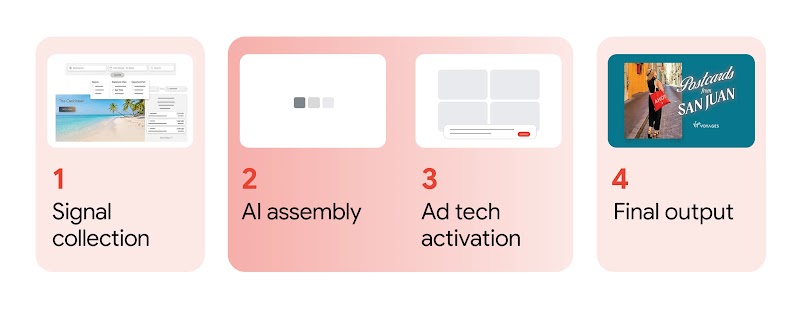
Bohan Chinique said, “AI is incredible at following very specific instructions regarding what to touch and what it has license to manipulate, which infinitely scales what could be an endless versioning of the work.”
From pilot to AI-powered business growth
While Virgin Voyages is currently finalizing the campaign’s technical rollout for a public launch later this year, the initiative is a successful proof of concept that has already changed how the brand operates. By automating the technical side of versioning, the brand has removed the production ceiling that once forced a trade-off between quality and scale.
This [initiative] allowed us to change the chemistry of how we’re thinking about the business … as an accelerant for everything we do next.
As Bohan Chinique explained, this level of real-time creation would be “really undoable” at scale for humans alone. Eliminating this barrier saved 20 to 30 hours of work every week, freeing creative teams to focus on big-picture strategy.
Reflecting on the impact of the initiative, Bohan Chinique said, “This has fundamentally changed the way we think about what AI could do for us. It has allowed us to change the chemistry of how we’re thinking about the business … as an accelerant for everything we do next.”
Social Module
Share